
Imagine Maria hears an old alarm in a new room
Imagine Maria has learned to read silence before anyone else can. In her last relationship, a warm weekend was followed by three days of coldness. Then came an apology, a rush of affection, and another withdrawal. She became an expert at small changes: a shorter text, a late call, a kiss that felt distracted. She promised herself she would never miss the signs again.
Now Daniel is steady but not constantly available. He works long shifts. He tells Maria when he will be free, and most of the time he keeps that promise. One evening, his reply comes late. Her thoughts sprint ahead. He has lost interest. He met someone else. She has been foolish. By midnight, she has built a case against a man who has not actually broken an agreement.
That case deserves kindness, not blind obedience. Fear is information, but it is not always a verdict. Sometimes it reports the room you are in. Sometimes it reports the room you survived before. Your work is to separate the two.
This is where astrology gives the question a deeper shape. The natal chart describes the emotional habits you bring into intimacy. Synastry describes the particular places where another person activates those habits. A Moon-Saturn contact may make closeness feel serious, conditional, or hard to receive. A South Node contact can create immediate familiarity that pulls you toward an old emotional script. Neither contact, by itself, proves that a man is wrong for you.
The decision turns on the meeting between symbolism and conduct. What does the chart awaken? What does he do with what it awakens? Keep those questions together. You need both.
Maria’s first mistake would be to treat her nervous system as a detective with perfect records. It is not. The body remembers through sensation, speed, and association. A harmless pause can resemble the doorway to an old loss. That resemblance matters, but it does not tell her what waits on the other side. She needs another kind of evidence, gathered in the present and gathered more than once.
Her second mistake would be to dismiss the fear as baggage and force herself to be easygoing. Women often get pushed toward one of these extremes: trust every alarm, or silence every alarm. You can do neither. Stay curious. Keep your standards. A fear that softens when a man offers clear care is different from a fear that grows because he keeps giving you reasons to doubt him.
Sources: What’s Your Sign? An Intro to Synastry Charts and Astrological Compatibility; Overview chart types
Name the fear before you name the man
Before you study his chart, write the fear in one clean sentence. Not “Something feels off.” That phrase may be true, but it gives you nowhere to look. Try “I fear he will become distant once I need reassurance,” or “I fear that asking for clarity will make me seem difficult,” or “I fear I will lose myself if I let this become serious.” A precise fear can be tested. A cloud of dread cannot.
Then separate the trigger from the meaning you gave it. The trigger might be a delayed reply, a changed plan, a quiet mood, or his reluctance to define the relationship. The meaning might be “I am being rejected.” Those are not the same fact. You can respect the trigger while questioning the conclusion.
Ask three plain questions. What happened? What did I predict? What did he do next? The third question matters most. A man who takes one evening to reply is not the same as a man who vanishes after intimacy and returns only when he wants comfort. A man who needs a day to think is not the same as a man who uses uncertainty to keep you available without committing.
Your old pattern often speaks in absolutes. Always. Never. This will end badly. It may also push you to act before the present has had time to reveal itself. Give the present a fair hearing. Do not give it unlimited time.
A useful boundary makes the difference. You might say, “When plans change, I need a quick message rather than silence. Can you do that?” His answer is only the beginning. Watch whether his behavior follows it. Fear becomes more trustworthy when it points to a repeated mismatch, not when it merely produces a loud sensation.
You can also ask where the fear lives in your body. Does your chest tighten before you have read his message? Do you feel an urge to send five texts, withdraw completely, or make him prove that he cares? The urge is a clue about your old strategy. It is not an instruction. Put down the phone. Take a walk. Return to the facts when you can see them without adding ten imagined endings.
Try a two-column note. In the first column, record present evidence: he canceled twice, he answered directly, he introduced you to his friend, he refused to discuss exclusivity. In the second, record inherited conclusions: men always leave, my needs drive people away, calm means he does not care. The columns may meet. They may not. Keeping them separate gives you room to find out.
Notice the timing, too. Old fear often spikes at a familiar threshold: after sex, after a warm declaration, after you ask for exclusivity, or after he meets an important person in your life. The threshold may matter more than the event itself. It tells you what kind of closeness your history marks as dangerous. You can honor that threshold by moving with care, not by pretending it is harmless and not by fleeing automatically.
You are allowed to wait before answering the fear. You do not have to confront him at the peak of panic, and you do not have to make a breakup decision in the same hour. Give yourself a small interval, then return to the question with a settled body: what do I know, what do I need, and what would I expect from a man who is able to meet me here?
Imagine Maria has been dating Daniel for six weeks. He answers when he says he will, makes room for her friends, and talks plainly about what he wants. Still, when he takes a few hours to reply, her body prepares for abandonment. She wants to end it before he can hurt her. Is that fear warning her about Daniel, or repeating an older relationship pattern? Start with both possibilities. Astrology can show why a certain kind of closeness wakes up fear in you. It can also show why a man feels uncannily familiar. But the final test is not how powerful the chart feels. It is what happens when you name a need. If he responds with care, adjusts where he can, and keeps showing up, the fear may belong to an old pattern asking for a new experience. If he mocks the need, punishes you for having it, disappears, or keeps you guessing, your fear has current evidence. Slow the pace. Watch the pattern. Let his conduct earn access to your heart.
Read the natal chart for the pattern you carry
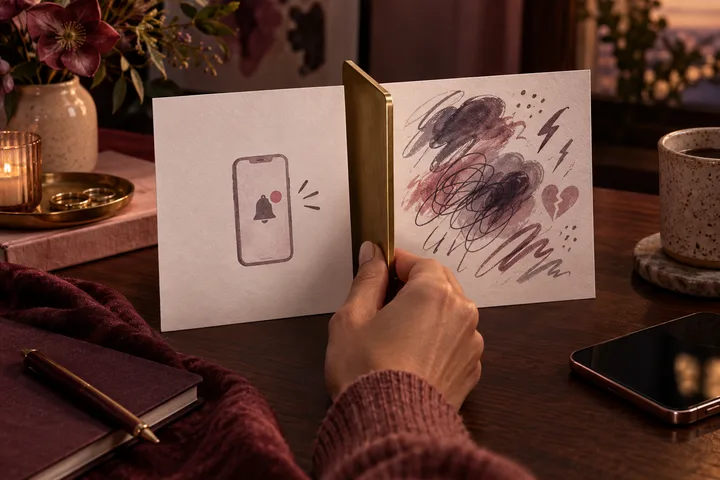
In a natal reading, the Moon describes your instinctive emotional needs, your sense of comfort, and the way you respond when you feel exposed. Saturn describes limits, duty, caution, and the inner rule that says you must earn what you want. When they meet by a major aspect, the heart can learn to protect itself through restraint.
A natal Moon-Saturn conjunction, square, or opposition may show a woman who expects rejection before she risks asking for care. She may look composed while privately measuring every sign of approval. She may choose controlled men because their reserve feels legible. Or she may choose difficult men because difficulty feels like the price of being loved. This is not a sentence. It is a pattern that can be brought into the light.
A flowing Moon-Saturn trine or sextile can give emotional steadiness and good judgment under pressure. It can also make you so capable that you forget to receive. You may call self-containment maturity while quietly starving the relationship of honest need. The same symbol has a gift and a shadow. Read both.
The house and sign refine the story. Moon in a water sign may seek emotional merging and reassurance in a way that differs from Moon in an air sign, which may need conversation and perspective before it can settle. Saturn in the fourth can make family history and private safety central. Saturn in the seventh can make commitment feel weighty, formal, or earned through tests. These are interpretive possibilities, not automatic diagnoses.
If your fear rises with every increase in closeness, look first at your own natal pattern. Does intimacy itself activate the alarm? Does the fear follow you even with kind, consistent partners? If yes, the work is not to talk yourself into trusting this particular man. It is to notice the old rule and give trust a slower, more deliberate path.
A natal pattern can also show the role you learned to play. Moon-Saturn may make you the reliable one who never asks for much. Venus-Saturn may make affection feel like a contract whose terms you must satisfy. Mars-Saturn may make desire meet inhibition, frustration, or a habit of waiting for permission. These readings become useful only when they lead to a question you can live differently: What would I ask for if I did not assume the answer was no?
Do not turn a natal signature into a label you carry like a diagnosis. The chart is alive. A difficult aspect can become discernment, patience, loyalty, and emotional craftsmanship. The shadow appears when protection becomes isolation. You are not required to erase caution. You are learning to aim it at the right thing.
Sources: Moon Conjunct Sextile Trine Square Opposition Saturn Aspects
Use synastry to see what this man activates
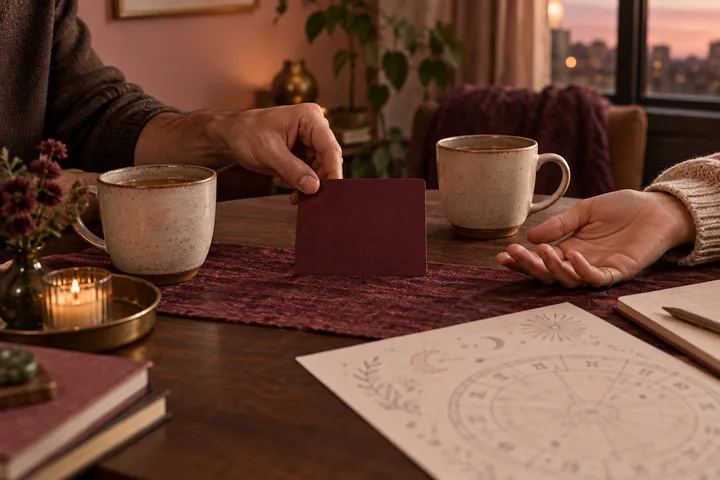
Synastry compares two natal charts. In the usual biwheel, one person’s planets are placed against the other person’s planets, angles, and houses. Astrologers read the contacts as a description of the relationship’s live exchange. You are not looking for a single stamp that says safe or unsafe. You are looking for the exact place where the two of you meet, press, soothe, or unsettle one another.
Start with the Moon because fear in dating often concerns safety, belonging, and the right to have needs. If his Saturn makes a close conjunction, square, or opposition to your Moon, you may experience him as serious, withholding, corrective, or older in emotional tone. He may not intend that role. You may still feel it in your body. The relationship can offer steadiness, but it can also make you censor tears, questions, pleasure, or dependency.
A trine or sextile can feel easier. He may help you regulate. You may trust his follow-through. Yet easy does not mean perfect, and a soft aspect does not erase a harsh pattern elsewhere in the chart. Read the contact in context. His Saturn might support your Moon if he listens and protects the bond. It might weigh on your Moon if he uses responsibility as a reason to control you.
Then check the personal planets and the angles. His Mercury to your Moon can show how his words reach your feelings. His Venus to your Moon can soften daily contact and make affection easier to receive. His Mars to your Moon can stir desire and defensiveness at once. His planets in your seventh house can make him look like a partner, while planets in your twelfth can leave parts of the connection hard to name. House overlays need reliable birth times, so do not treat uncertain house data as exact.
The chart tells you what may be activated. It does not excuse what he chooses to do with that activation. That distinction protects you from romanticizing pain.
A close contact deserves more weight than a loose one, but weight is not the same as destiny. Astrology.com’s introductory synastry guidance emphasizes degree-based contacts and notes that smaller orbs are stronger. In practice, that means you should not build a life decision on a vague sign resemblance while ignoring the clearer relationship contacts and the lived exchange between you. Use the chart with a disciplined eye.
Pay attention to who carries which planet. If his Saturn touches your Moon, you may feel him as the authority in that emotional exchange. He may feel responsible, cautious, or burdened. You may feel judged even when he thinks he is being practical. Ask both sides of the contact. Then ask the question that matters: does the role become more humane as the two of you speak about it, or does it harden into control?
You can make this concrete by describing a recent moment rather than asking for a personality verdict. “When I told you I was nervous, you changed the subject. I need a partner who can stay with a hard feeling for a few minutes. What happened for you?” His response will show more than a label such as avoidant, intense, or karmic. Labels close the case too soon. A real example keeps the door open to truth.
Sources: Synastry: Moon - Saturn Aspects; Saturn in Synastry; Overview chart types
Familiar is not the same as right
Consider an example. Lena meets a man who knows how to pull away at exactly the moment she begins to soften. The chemistry is immediate. She feels calm when he returns and restless when he disappears. She calls the relief love. Her South Node is tightly contacted by his personal planet in synastry, and the symbolism fits: an old emotional road, easy to enter, hard to leave.
Nodal contacts can feel magnetic. The South Node is associated in relationship astrology with familiar territory, while the North Node points toward growth that may feel less practiced. A partner’s planet on your South Node can make you feel recognized before you know much about him. You may finish each other’s sentences. You may share a private language. You may also repeat a role you were trying to outgrow.
That does not make the South Node person bad. Familiarity can hold tenderness, history, and genuine affection. The question is whether the bond leaves room for your next self. Do you speak more plainly with him, or do you become the version of yourself who waits, guesses, and accepts crumbs? Do you feel more capable of choosing, or more compelled to stay because leaving feels like losing a piece of home?
North Node contacts can bring a different fear. A man who supports your growth may feel less intoxicating because he does not reproduce the old highs and lows. You may call his steadiness boring. You may mistake your nervous system’s lack of drama for lack of attraction. Give that possibility a fair test. Desire can deepen when your body learns that peace is not abandonment.
Do not use “karmic” as a reason to endure disrespect. A powerful bond can be a lesson in leaving. It can also be a lesson in staying only where the relationship grows with you. Familiarity explains the pull. It does not decide the destination.
One way to spot the old road is to compare your inner state before and after contact. Familiar does not always feel peaceful. Sometimes it feels like relief after deprivation. If his attention arrives unpredictably, each return can feel enormous. You may experience the contrast as passion. The better question is whether you would still choose him if affection were steady enough that you no longer had to earn it.
A relationship that supports your North Node does not need to be constantly uncomfortable. Growth can feel quiet, practical, and even ordinary. You may become more direct. You may keep a promise to yourself. You may stop bargaining with a man’s ambivalence. Those changes can look less romantic than a dramatic reunion, but they point to a larger life.
The old pattern often asks you to prove that you can finally win the love that once withheld itself. The new choice asks a harder question: do I want this love on these terms? That question can feel less flattering because it removes the contest. It also gives you back your future. You are allowed to leave a bond that explains you beautifully but treats you poorly.

Sources: Relationship Astrology Tips; What’s Your Sign? An Intro to Synastry Charts and Astrological Compatibility
The same chart can describe safety or pressure
Astrological symbols work through expression. Take Moon-Saturn synastry. In one couple, Saturn shows up as patience. He remembers her difficult week, keeps the plan, and asks what would help. She can tell him she feels afraid without being shamed for it. His structure gives her Moon somewhere to rest.
In another couple, the same kind of contact becomes a courtroom. She must present her feelings in the correct tone. Her needs are called excessive. Her friendships are treated as threats. He insists that his silence is a boundary while demanding access to her private life. She begins to edit herself before she speaks. The aspect did not force either expression. Their maturity, choices, and circumstances gave it a form.
This is why you should never read one synastry aspect in isolation. Consider the sign, the orb, the house, the other contacts, and the condition of each planet in its natal chart. A close aspect deserves more attention than a loose one. A birth time matters for houses and angles. If the time is unknown, stay with what the chart can actually support. Precision strengthens an interpretation.
Also distinguish an activated wound from a present danger. You may feel rejected when he asks for a little space, but he may return when promised and remain affectionate. You may feel calm with a controlling man because control resembles the relationship you grew up around. Your feelings are real in both cases. They still need context.
The strongest reading is not the most dramatic one. It is the one that explains the feeling and survives the facts.
This gives you a simple comparison. If the chart is intense and his conduct is kind, keep studying the pattern without punishing the relationship for waking it. If the chart is gentle and his conduct is careless, believe the conduct. If both the chart and the behavior repeat an old wound, stop calling the repetition a spiritual assignment and decide what protection requires. Astrology gains power when it helps you see clearly.
Circumstance matters too. A long-distance bond, a demanding job, grief, family pressure, or a new separation can affect the expression of a chart contact. Context may explain a rough season. It does not erase the need for a repair plan. Compassion asks what is happening. Discernment asks whether the situation is changing.
Sources: Synastry: Moon - Saturn Aspects; Saturn in Synastry; Overview chart types
Ask for one clear change and watch the answer
Do not interrogate the chart when a conversation can give you better evidence. Choose one behavior that would help you feel secure. Make it specific, reasonable, and visible. “I need consistency” is a value. “If you need to change our Saturday plan, tell me by Friday night” is a request you can observe.
Say what the behavior means to you without making him responsible for your entire history. “When plans disappear without explanation, I start to feel shut out. I’m asking for a message if your availability changes.” Then stop. Let him answer. You are not delivering a closing argument. You are opening a door and seeing whether he walks through it.
A man who is right for your present may not answer perfectly. He may need clarification. He may have a different rhythm. What matters is whether he treats your need as real, works toward a workable agreement, and repairs the miss without making you beg for basic regard. Compatibility lives in those small negotiations.
A man who is wrong for your present may sound convincing. He may explain your fear back to you. He may call you dramatic, needy, jealous, or damaged so he never has to discuss his conduct. He may comply for three days and then punish you for noticing the change. Watch the pattern after the conversation, not the performance during it.
Astrology can help you choose the right question. It cannot have the conversation for you. Ask once with clarity. Observe twice. Then decide from the pattern you can actually see.
Keep the request proportionate to the relationship. A man you have dated for a month may not owe you a five-year plan, but he can answer whether he is open to building something. A man who wants exclusivity owes you a clear definition of that agreement. Do not ask for less than you need just because the connection is new. Ask for the truth that belongs to this stage.
If the conversation becomes circular, end the circle. “I’ve explained what I need. I’m going to watch what happens rather than argue about whether I’m allowed to need it.” That sentence does not threaten him. It tells you where your power sits. You are not trying to win a case. You are deciding whether the relationship has the conditions in which trust can grow.

Know when the fear is carrying present evidence
Sometimes the fear is about him. You do not need a dramatic betrayal to know that. A steady pattern of evasiveness is enough. So is contempt when you express a need. So is the quiet pressure to abandon your friends, work, money, privacy, or pace so he can feel secure. Your chart may explain why you are drawn to him. It does not turn a warning into a welcome sign.
Look for mismatches between words and access. He says he wants a serious relationship, but keeps you hidden and refuses any clear agreement. He says he respects your independence, but checks your phone and becomes angry when you make plans without him. He says he needs time, but expects your emotional and physical availability on demand. Those are not merely triggers. They are relationship facts.
A hard synastry contact can describe friction that two adults handle with care. It cannot redeem coercion. A South Node bond can feel sacred and still keep you in a smaller life. A Saturn tie can feel binding and still bind you to a man who wants authority without responsibility. Do not let spiritual language overrule your boundaries.
The clearest sign that fear has current evidence is repetition after you have spoken plainly. You told him what hurts. He understood enough to repeat it. You named the boundary. He tested it, argued with it, or made your enforcement costly. At that point, your task is not to become less sensitive. It is to become more decisive.
Leave room for an important exception. Some men are clumsy, private, inexperienced, or stressed. One poor response does not reveal the whole person. If he takes responsibility, repairs the harm, and changes over time, the story is different. Accountability is the hinge. Without it, intensity is just intensity.
You should also take your own behavior seriously without taking all the blame. An old pattern may make you test him, read hidden meanings into neutral events, or threaten to leave before you have asked a direct question. Repair that part. Say, “I reacted from fear, and I want to be clearer next time.” A good man can meet that honesty. A controlling man may use your admission as a permanent weapon. Notice the difference.
The strongest exception is not perfection. It is mutual repair. You may both miss a cue. You may both carry history. What makes the relationship viable is the ability to name the miss, protect each other’s dignity, and change the next encounter. If only one person keeps learning while the other keeps benefiting from the pattern, the relationship is not balanced enough for deeper investment.
Let a slow pace reveal the truth
When you cannot tell whether the alarm is old or current, slow the relationship down. This is not a test designed to make him chase you. It is a way to gather clean information before attachment makes every choice feel expensive.
Keep your normal life. See your friends. Protect sleep. Do not move your money, home, schedule, or body faster than trust has earned. Let him meet you in ordinary conditions, not only in the charged space of late-night confession and physical chemistry. The man you can invest in will have a place for your real life.
Name the next step instead of demanding the whole future. You might agree to exclusivity, or you might agree to keep dating while you learn each other’s rhythms. You might ask for a weekly plan and a direct conversation about what each of you means by commitment. Choose the smallest step that gives you more truth.
As you go, record what happened without turning it into surveillance. Did he follow through? Did he make room for repair? Did you feel free to say no? Did your fear settle after consistent care, or did it grow because he kept creating uncertainty? A simple record can show the difference between an old alarm and a present pattern when your emotions are loud.
In astrology, time belongs to Saturn for a reason. What lasts must take form. Let the relationship take form before you hand it a permanent place in your life.
A slow pace also protects the reading itself. Early chemistry can flood the chart with meaning. You may see every conjunction as proof, every difficult aspect as a test, and every coincidence as a message about the future. Give the symbols room to breathe. After several ordinary weeks, you will know more about the man than any first impression could tell you.
Set a review date for yourself, not as a secret exam for him. At that point, ask whether the agreement you made still feels mutual. Are you less confused? Are you more yourself? Has he become more available through action, or have you simply become better at explaining his absence? A relationship should not require you to become a full-time interpreter of another adult.
Sources: Saturn in Synastry; Aspects & Transits
Decide after the next honest pattern appears
The most useful chart question is not “Will he hurt me?” It is “What part of me becomes active with him, and what does that part need in order to choose well?” That question returns authority to you. It lets astrology name the emotional weather without asking the sky to make the decision.
If your natal chart repeats themes of guardedness, rejection, or over-responsibility, you may need a partner who welcomes honest need instead of rewarding your silence. If his chart strongly contacts your Moon, Saturn, Nodes, or angles, you may feel the relationship before you understand it. Go gently. Notice what feels known. Then ask whether the known feeling belongs in your future.
The chart can also show resources. Supportive Venus, Moon, Jupiter, or Mercury contacts may make affection, generosity, and conversation easier. Healthy Saturn can give a bond shape. Harmonious contacts are not a guarantee, but they can show where repair and mutual care have natural support. Use those gifts. Do not use them to cancel harder facts.
A report that gives you a soulmate verdict leaves you helpless. A good interpretation gives you language. It helps you ask why you tighten around a kind man, why you chase a withholding one, why you confuse urgency with intimacy, and what kind of relationship would let your desire stay awake without making you abandon yourself.
Your fear may be old. Your choice is happening now. That is the part no pattern gets to take from you.
You do not need to solve your entire history before you date. You need enough self-knowledge to name the fear, enough astrological context to understand what he activates, and enough patience to see whether his actions create safety or keep you in suspense.
Here is the order. First, write the concrete trigger and the story attached to it. Second, check whether the fear follows you across steady relationships. Third, read the relevant natal and synastry symbols in context, especially Moon-Saturn and nodal contacts when they are genuinely close and supported by reliable chart data. Fourth, ask for one clear change. Fifth, watch what happens after the talk.
If he responds with care and consistency, keep going slowly. Let your body learn a new answer. If he responds with contempt, manipulation, or repeated disregard, step back. Do not wait for a more impressive sign. The pattern is the sign.
You can seek a deeper Dating Clarity Report when you want six focused observations about his consistency, intentions, your pace, and your boundaries, followed by a practical conversation to bring the reading into real life. Get my dating clarity report when you are ready to replace guessing with a decision you can stand behind.
Then choose your next point of truth. Give the relationship a defined amount of time to show change. Have the conversation. Reassess. If the man meets you there, invest one step at a time. If he does not, protect the life your old pattern once taught you to abandon.
If you are still divided, rank what you know. His repeated conduct comes first. Your stated needs come second. The chart comes third as a map of meaning, timing, and activation. This order keeps astrology in its strongest role. It helps you understand the bond deeply while leaving the final authority with the woman who has to live inside the decision.
You can ask for support while you do this. Choose a trusted friend who knows the facts and will not feed the fantasy or the panic. Tell her the agreement you made with yourself, then report what happened. Clarity grows when another person can hear the whole sequence. Still, the decision remains yours. You are the one who knows what your life can hold, what your heart requires, and which pattern you are finally ready to end.
Sources: Synastry: Moon - Saturn Aspects; What’s Your Sign? An Intro to Synastry Charts and Astrological Compatibility; Relationship Astrology Tips
Sources & further reading
- Synastry: Moon - Saturn Aspects
Supports the interpretation of Moon-Saturn synastry as both binding and potentially censoring, with different expressions by aspect.
- Saturn in Synastry
Supports Saturn's themes of commitment, restriction, stages, control, and the need to read the contact through actual behavior.
- What’s Your Sign? An Intro to Synastry Charts and Astrological Compatibility
Supports synastry as comparison of two natal charts and explains the Moon, Venus, angles, Saturn, and degree-based aspect scope.
- Moon Conjunct Sextile Trine Square Opposition Saturn Aspects
Supports the natal Moon-Saturn reading around guardedness, fear of rejection, trust, emotional restraint, and steadiness.
- Relationship Astrology Tips
Supports the interpretive role of the Moon, Saturn, Nodes, South Node familiarity, North Node growth, and chart context in synastry.
- Overview chart types
Supports the technical scope of synastry as two partner horoscopes with interchart aspects and house placements.
- Aspects & Transits
Supports distinguishing natal chart aspects from current transits when interpreting timing and emotional activation.
Dating Clarity Report
Six observations about the man you are dating. A clear view of the patterns, plus a conversation for your next decision.
Get my dating clarity report