
The first disagreement asks one hard question
The first disagreement rarely begins with the subject that started it. A late reply becomes a question about care. A changed plan becomes a question about reliability. A joke that lands badly becomes a question about whether you can be safe while telling the truth. That is why the first disagreement can feel larger than the facts on the table. Something has been revealed, and you want to know what it means.
Here is the clearest answer. It tells you how he behaves when attraction no longer does all the work.
A charming man can make plans. A thoughtful man can apologize. A compatible man can remain present when your experience differs from his own, take in what happened, and change a behavior that hurt the connection. Those are not the same thing. You are not testing him for perfect wording. You are watching for a pattern of attention, honesty, and follow-through.
Start with the moment after the disagreement. Did he come back to the conversation? Did he ask what you meant before defending himself? Did he acknowledge the part he could own without attaching a small insult to the apology? Did his next action match the promise he made? The answer sits there, in the sequence. Not in the intensity of the chemistry. Not in the fact that the fight felt fated. Not in the number of attractive synastry aspects on a page.
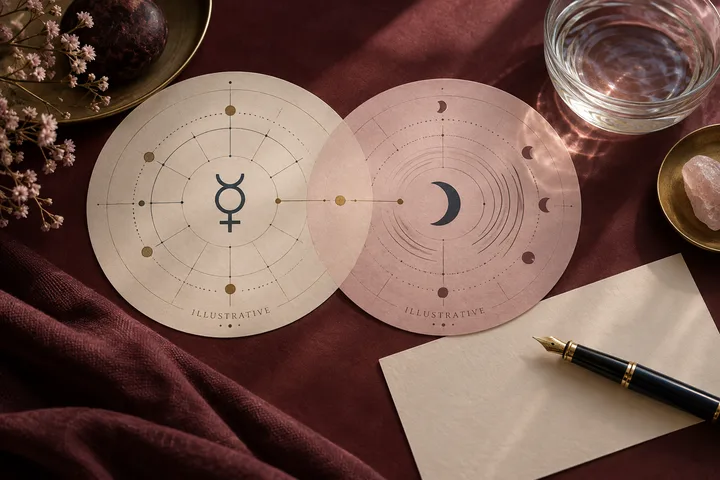
Astrology gives you a way to name the moving parts. Mercury describes how the two of you think, speak, interpret, and make sense of a problem. The Moon describes the needs and habits that rise when you are hurt, tired, or seeking comfort. Mars brings heat, assertion, desire, and the instinct to push. Saturn brings pressure, limits, fear, responsibility, and the question of what can last. When astrologers compare these planets between two birth charts, they are not handing down a verdict. They are reading the pattern of contact.
That pattern matters because the same disagreement can feel completely different in different relationships. In one bond, a missed message opens a calm talk about expectations. In another, it becomes a three-day punishment. The event is small. The relationship's way of handling it is not.
So ask yourself three questions before you ask whether he is right for you. What did I actually need in that moment? What did he do when I said it? What changed afterward? Your answers form the first reading. The chart adds depth, language, and timing. Your lived experience remains the final authority on whether the bond is nourishing enough to continue.
There is a difference between a hard conversation and a harmful one. A hard conversation may include defensiveness, an awkward pause, or a clumsy first attempt at an apology. Two people are learning each other. A harmful pattern makes you pay for bringing up a need. You leave the conversation more confused than when you entered it, while he gains the comfort of never having to answer for what he did.
Give the first kind of conflict a little room to become information. Do not give the second kind endless chances to become a relationship. The first disagreement is not a prophecy. It is an invitation to watch the next choice.
Sources: Love, Relationship Astrology: Mercury in Synastry; What Is a Synastry Chart? Birth Chart Compatibility; Synastry: Moon-Mercury Aspects Between Two Charts
Name the question before you read the chart
You do not need a complete relationship history before you ask what the first disagreement means. You need the facts of this one. Write down the trigger, the request underneath it, his first response, and what happened next. A changed dinner plan may hide a need for reliability. A sharp joke may expose a need for respect. Keep the event concrete before you give it a symbol.
This article uses a general interpretive scope, not a calculated personal chart. No birth details for you or the man you are dating have been supplied, so every placement in the example is illustrative. It shows how to reason through a conflict. It does not claim that either person has those placements.
If you later consult your own synastry, use the birth details you actually know and mark uncertainty where it exists. A recorded birth time gives a fuller picture of angles and houses. An unknown time narrows what can be read confidently. That is enough to set the scope. You do not need to turn your dating question into a lesson on chart mechanics.
Start with the question you want the chart to illuminate. Are you trying to understand why facts and feelings keep missing each other? Why does one person push while the other retreats? Why does a serious conversation become a test of loyalty? The question determines which layer deserves attention. Sun signs alone cannot answer a conflict question. Mercury, Moon, Mars, and Saturn speak more directly to the pattern described here.
A useful question is narrower than Is he my person? Try, What would help us handle this exact kind of moment? That wording keeps the reading close to real life. Mercury may point you toward clearer language. The Moon may show the reassurance beneath the complaint. Mars may show where the exchange heats up. Saturn may show the boundary or promise that needs to hold after the conversation ends. You are looking for a practice, not a prophecy.
Also separate a mismatch from a refusal. You may need different amounts of detail, time, or reassurance. That difference can be workable when he stays curious about your experience and you stay curious about his. It becomes a willingness problem when he understands the request and still treats your need as an inconvenience he should not have to consider. Synastry can describe the tension. His response tells you whether he will work with it.
You can make the first record more precise by separating four moments. Write what happened before either of you was upset. Write the sentence that changed the temperature. Write what you asked for once the real issue became clear. Then write what happened after the conversation ended. This keeps one cutting remark from swallowing the whole scene, but it also stops a pretty apology from erasing the part that still needs attention. The sequence matters because conflict is not one instant. It is a beginning, a turn, and an aftermath.
Look for the difference between a repair that arrives freely and one you have to extract. A man may need you to explain the impact once. That is ordinary learning. But if he asks you to prove every feeling, makes you repeat the request until you are exhausted, and then calls your exhaustion evidence that you are unreasonable, the exchange has changed shape. You are no longer solving a misunderstanding together. You are carrying the whole relationship's emotional administration.
Then return to the lived sequence. What did you need? What did he hear? What did he do with the impact? A chart can give language to a mismatch, but it cannot supply evidence that the relationship has not produced. Let astrology sharpen your observation. Do not let it overrule it.
Sources: What Is a Synastry Chart? Birth Chart Compatibility; Synastry: Love and Relationship Astrology; Mars-Saturn Aspects in Synastry
Read Mercury and the Moon before you judge the fight
The first chart layer asks, How did the two of you make meaning out of what happened? This is where Mercury and the Moon matter most.
Mercury describes speech, thought, timing, interpretation, and the words each person reaches for under pressure. The Moon describes instinctive feeling, memory, comfort, and the private need underneath the stated complaint. When his Mercury touches your Moon, his words do not stay in the realm of ideas. They enter your emotional body. You may feel understood before he has said very much. You may also feel cut open by a practical answer when what you wanted was tenderness.
Imagine you tell him, I felt pushed aside when you changed our plan without asking me. Your Moon is speaking about security and consideration. His Mercury may hear a logistical question and answer, I told you I got busy. He has answered the schedule. You have not yet been met in the feeling. That does not make the aspect doomed. It shows the translation the two of you need to learn.
A flowing Moon-Mercury contact can make that translation easier. You may find it natural to talk about private feelings, small memories, and daily concerns. He may know when you need a listening ear rather than a solution. You may help him give words to an emotion he can sense but cannot name. The disagreement can become a path back to closeness because language and feeling can travel together.
A tense Moon-Mercury contact can make minor differences feel personal. One person hears criticism in a question. The other hears accusation in a feeling. You may argue about the exact sentence because the sentence seems to prove whether you are loved. The useful move is to step behind the wording. Say, The sentence is not the whole problem. I need to know whether you understand why it hurt. Then listen for his response.
Mercury-Mercury contacts show another layer. Strong contact can keep conversation alive, but conversation alone is not the same as emotional understanding. Two people can talk for hours and still avoid the vulnerable point. Challenging contact can bring interruptions, word games, or arguments about who said what. If every disagreement becomes a courtroom, you are not receiving communication. You are receiving combat in a clever disguise.
This is also where sign and element matter. Mercury in fire may speak quickly and directly, while Mercury in water may speak through mood, memory, and implication. Mercury in air may need to examine every angle. Mercury in earth may want a useful plan before the discussion feels complete. None of these styles is automatically better. The problem begins when one person treats his own style as the only adult form of communication.
Ask what he does with your emotional language. Does he slow down? Does he ask a second question? Does he reflect your point accurately before adding his own? Or does he label you dramatic, sensitive, confusing, or impossible whenever you describe an impact he did not intend? The chart may explain why the two of you miss each other. It cannot turn dismissal into care.
Your first reading, then, is not Does Mercury promise easy conversation? It is Can our words carry both facts and feelings? If the answer is yes, the relationship has a workable bridge. If the answer is no, notice who keeps trying to build one.
Pay attention to the difference between explaining and translating. Explaining says, I was busy, so I missed your call. Translating says, I was busy, and I can see that the silence left you unsure where you stood with me. The second sentence does not confess to an intention he never had. It recognizes the impact. That is the skill a tense Moon-Mercury connection needs.
There is another useful distinction here: curiosity is not the same as agreement. He does not have to accept your interpretation of every detail. He does have to show enough interest to understand why the detail mattered to you. A partner can say, I remember it differently, and still ask, What did that moment bring up for you? That answer leaves room for two inner worlds. A partner who says, That never happened, you are too sensitive, closes the door before either world can be known.
When you read Mercury by sign, notice the kind of translation the relationship asks for. A quick fire-Mercury response may need a pause before it becomes a verdict. A water-Mercury response may need direct wording instead of hints. An air-Mercury partner may need to stop analyzing long enough to reassure you. An earth-Mercury partner may need to hear that a feeling is not a demand for an immediate solution. These are interpretive possibilities, not excuses. The useful question stays concrete: what adjustment lets both people speak without one style ruling the room?
You can offer the same skill without doing all the work. Try, I am not saying you meant to hurt me. I am telling you what the moment meant to me. Can you stay with that for a minute? His answer will tell you whether he can hold two truths at once: his intention may have been harmless, and your experience may still need care.
Sources: Love, Relationship Astrology: Mercury in Synastry; Synastry: Moon-Mercury Aspects Between Two Charts; Synastry: Love and Relationship Astrology
Then read Mars and Saturn for the conflict pattern
Once you understand how the disagreement was interpreted, look at how the energy moved through the room. This is the Mars and Saturn layer.
Mars describes the way a person asserts, pursues, protects, desires, and fights. In synastry, Mars can bring attraction and movement, but it can also turn an ordinary discussion into a contest. Mars-Mercury contacts may make conversation lively and brave. Under strain, the same contact can send a sharp thought straight into a sharp word. Mars-Moon contacts can stir the body and the emotions at once. That can feel intimate. It can also feel volatile.
Do not confuse heat with truth. A man who becomes passionate during a disagreement may care deeply, or he may simply care about winning. Watch the direction of the energy. Does Mars move toward the problem, or toward you as the problem? Does he name his desire and make a request, or does he punish you for having a need that interrupts his preference? Healthy assertion has a point. It does not need to make you smaller.
Saturn tells you where the bond meets consequence. It can show commitment, patience, boundaries, and the ability to carry weight over time. It can also show fear, inhibition, criticism, withholding, and a cold rule that nobody gets to ask for too much. In a relationship, Saturn is not automatically bad because it feels serious. Some seriousness is exactly what makes trust possible. But the serious tone must serve responsibility, not control.
A Mercury-Saturn contact may make one person feel studied, corrected, or judged when she speaks. At its best, it gives form to an idea. He helps you slow down and clarify what you mean. You help him turn a worry into a real conversation. At its worst, he interrupts, belittles, or treats your feeling as an argument he can grade. You start editing yourself before you speak. That is the lived result to watch.
Mars-Saturn is a stronger pressure point. Mars wants movement. Saturn applies the brake. In a mature bond, that difference can create timing, patience, and durable action. In an immature bond, it can become pursuit and punishment, provocation and withdrawal, or one person continually trying to make the other behave. The aspect does not decide which version you get. The choices do.
This is why the first disagreement can be so revealing. You see whether he uses restraint to stay respectful or to make you anxious. You see whether he uses directness to be clear or to wound. You see whether he returns after taking space with a real plan, or whether space becomes a fog in which you carry all the uncertainty.
Astrologers also read the aspect type. A square may create a repeating task. An opposition can make each person feel that the other is blocking the natural expression of a need. A trine may bring a gift, but it can also make the couple assume they will always understand one another without naming expectations. A conjunction concentrates the planets. It can feel powerful, immediate, and hard to ignore. In every case, the behavior after the trigger ranks higher than the aspect's reputation.
Here is the practical test. After the disagreement, does he become more precise or more punishing? More available or more elusive? More willing to carry his share or more determined to make you prove that your need is reasonable? Those answers show you how Mars and Saturn are being lived.
Notice how he handles a pause. A pause can be wise if he says, I am too activated to speak well. I need an hour, and I will call tonight. That is Saturn giving Mars a container. A pause becomes avoidance when he vanishes, leaves you to guess, and returns only when he wants the pleasant parts of the relationship back. The words around the pause matter. So does the promised return.
The same action can carry a different meaning depending on what comes around it. Silence before a stated return time may be a deliberate effort not to say something cruel. Silence after you ask for clarity may be a way to make you chase him. A firm boundary can protect a relationship when it names what the speaker will do. It becomes control when it dictates what you may feel, whom you may see, or how quickly you must recover. Read the whole pattern, not the most flattering label attached to one moment.
Ask what happens when you disagree about something that benefits you more than him. Maybe you want to slow the sexual pace, keep separate homes, or protect a work commitment he finds inconvenient. This is where Mars and Saturn leave the abstract chart language and enter the dating decision. Can he tolerate a limit that reduces his immediate access to you? Can he negotiate without sulking, bargaining past your no, or treating your independence as a personal insult? A relationship earns trust when your boundary survives his disappointment.
Notice the aftermath in his body and yours. Do you feel more grounded because the two of you found a plan? Or do you feel that you must become easier, quieter, and less specific to keep the connection? Astrology can show a bond with intense Mars and Saturn signatures. It cannot ask you to call chronic dread a growth opportunity. A useful reading makes your standards clearer. It never asks you to lower them.

A first disagreement tells you less about whether a man can keep the peace and more about whether he can stay honest, curious, and accountable when peace disappears. Watch what happens after the first spark. Does he want to understand the real issue, or does he turn the conversation into a trial of your character? Does he repair the missed call, the sharp comment, or the broken plan without making you beg for basic care? In synastry, Mercury and Moon contacts can describe the way words meet feelings. Mars shows how desire and anger move through the bond. Saturn shows where fear, duty, restraint, and responsibility become part of the pattern. None of these placements gives him an excuse. They give you a sharper question: what kind of repair does this relationship ask you to build, and is he building it with you?
Sources: Synastry: Love and Relationship Astrology; Mars-Saturn Aspects in Synastry; Synastry: Mercury-Saturn Aspects
Combine the layers instead of hunting for one perfect aspect
A good synastry reading does not crown one aspect king. It compares the signals. The question is not whether you have a difficult contact. Most substantial relationships contain friction somewhere. The question is whether the chart's friction has a conscious form of repair available to both people.
Consider an example. Imagine Maria is dating Daniel. He cancels dinner two hours before they are due to meet. He says work ran late, then stops answering for the evening. The next day he sends a light message as if nothing happened. Maria tells him the cancellation was disappointing, but the silence made her feel unimportant. Daniel says she is making a small issue dramatic. The subject is dinner. The real issue is whether inconvenience excuses disappearance.
Suppose their illustrative synastry shows Daniel's Mercury square Maria's Moon. His first instinct is to explain the facts. Her first instinct is to describe the emotional meaning. If they stay at that level, he will call her reaction excessive and she will call his answer cold. The chart gives language for the mismatch. Mercury is trying to close the case. The Moon is asking whether the bond can hold her feeling.
Now add a tight Mars-Mercury square. Daniel speaks faster when challenged. Maria hears the speed as aggression. He hears her pause as refusal to be reasonable. The argument can become a loop: he pushes for a clean answer, she retreats to protect herself, he pushes harder because the retreat feels like rejection, and she becomes even less willing to speak. That is the chart's tension in motion.
But the example also includes a supportive Venus-Saturn contact and a workable Moon-Mercury sextile elsewhere in the synastry. Those contacts do not erase the clash. They give the couple resources. Daniel can choose steadiness over speed. Maria can name the need before the hurt hardens into a verdict. Both can use the bond's capacity for loyalty and listening.
The first repair conversation might sound like this: When the plan changed, I could have handled the cancellation. What hurt was not knowing whether you still intended to talk to me. Next time, send one clear message and tell me when you can reconnect. I am not asking you to be available every minute. I am asking for a clean handoff instead of silence.
His reply becomes the next piece of evidence. A strong response could be, I see the difference. I treated the cancellation as the whole issue and missed the silence. I can text you when work takes over and give you a time to call. A weak response could be, Fine, I guess I can never have a bad day around you. That second line does not repair anything. It moves the spotlight from his choice to her need.
Now read the same example if Mars and Saturn are prominent. Perhaps Daniel's Mars falls on Maria's Saturn. He experiences her request as a brake on his freedom. She experiences his spontaneity as pressure on her stability. If they are willing to grow, he learns that a boundary is not a rejection, and she learns to state the boundary without managing every detail of his movement. If they are not willing, he pushes and she polices. The relationship turns into a tug-of-war.
The strongest exception matters here. If the first disagreement includes threats, intimidation, deliberate humiliation, coercion, stalking, property damage, or fear for your physical safety, do not use synastry to explain the behavior into something romantic. Step back and seek support. No Saturn lesson requires you to endure punishment. No Mars contact makes cruelty passionate. No difficult Moon aspect asks you to abandon your sense of safety.
For ordinary conflict, the integrated reading has four parts. First, name the trigger. Second, identify the emotional need beneath it. Third, see how each person applies pressure. Fourth, look for the available repair and whether both people choose it. This comparison is more useful than asking whether the chart says yes or no. It tells you what yes would require.
You can turn this into a simple comparison table in your notes. On one side, write the chart's invitation: speak more plainly, slow down, separate impact from intention, make a plan. On the other, write the behavior you need to see: he confirms the change, listens without mocking, returns when he says he will, and repeats the better choice. If the invitation and the behavior never meet, the interpretation remains theoretical.
Also separate a pattern from a single stumble. He may use the wrong phrase and then correct it. He may need coaching once and remember the next time. That is different from a polished apology followed by the same disappearance. Synastry describes tendencies and tasks. Repetition tells you whether the task is being met.
When the signals compete, rank them by what they ask of you. A tender Moon connection may explain why you feel quickly understood, but it cannot cancel a pattern of contempt. A strong Mars contact may explain the pull and the speed, but it cannot make volatility a form of devotion. Saturn contacts may make the bond feel weighty, yet weight becomes trustworthy only when it produces dependable action. Read the chart as a set of invitations, then ask which invitation he actually accepts.
You can make the comparison more exact by writing two sentences. The first begins, The dynamic seems to invite us to... The second begins, In real life, I need to see... For Maria, the first might be, slow down and translate facts into feeling. The second might be, send a clear message when plans change and return to the conversation that night. If the second sentence keeps asking for the same basic courtesy, the issue is no longer interpretive complexity.
Try the comparison with two possible futures, not two competing men. In the first future, he makes the promised adjustment and the next disagreement has a shorter recovery. You still have differences, but you do not have to reopen the same case every week. In the second, he agrees in the moment and resets the pattern as soon as the tension passes. You become more skilled at explaining, while he remains free to remain unchanged. The first future asks for practice from both of you. The second asks you to become more persuasive than the problem requires.
A chart layer can also tell you what kind of repair may feel natural. Moon contacts may respond to warmth, reassurance, and a quiet return to closeness. Mercury contacts may need a precise account of what was said and what will happen next. Mars contacts may need movement, a direct request, or a physical break before the conversation can continue. Saturn contacts may need a promise with a time attached. Name the form that helps you, then see whether he is willing to offer it. The reading becomes useful when it turns atmosphere into a request you can test.
When the next opportunity arrives, look for ease rather than theater. He does not need to stage a grand apology or repeat your preferred language word for word. A quiet message before a schedule change, a calmer tone, or a promised call that actually happens can carry more meaning than a long declaration after another rupture. Small evidence is still evidence. It is often the kind that survives ordinary life.
This is the useful distinction between potential and capacity. Potential describes what the relationship might teach or awaken. Capacity describes what the man can reliably do now. A chart can show a rich field for growth, but you are dating in the present tense. Invest according to capacity. Let potential earn a larger role later.

Sources: Love, Relationship Astrology: Mercury in Synastry; Synastry: Moon-Mercury Aspects Between Two Charts; Mars-Saturn Aspects in Synastry; Synastry: Mercury-Saturn Aspects
Turn the reading into one clear dating decision
You do not need to solve the whole relationship after one disagreement. You need a proportionate next step. Ask him about the pattern, not just the incident: When we disagree, I need us to stay with the real issue instead of defending our intentions. What do you need from me when you feel criticized, and what will you do next time? Then stop talking. His answer should have room to be his.
He may not answer perfectly. A ready man can need a moment, admit that he does not know, or ask to return to the subject later. The point is not polished language. It is whether he treats the conflict as shared, names his part without turning your need into an attack, and asks something of you without making you responsible for all of his feelings.
Listen for three parts in his answer. Does he understand the event as you experienced it, even if his intention was different? Does he name a change he can make without promising a vague new personality? Does he leave room for your part without making the whole problem yours? I will try harder sounds kind. I will tell you before I change the plan and call when I can talk sounds usable.
Choose one behavior to watch over the next few weeks. Make it visible and ordinary: he confirms a changed plan, returns to a hard conversation when he said he would, or stops using a label that shuts you down. Notice the next two or three moments in which that need appears naturally. A short window gives both of you a fair chance to act without turning you into a full-time monitor.
Keep your own life moving while you watch. See your friends. Keep your work, rest, and routines. Do not speed up commitment to soothe the uncertainty, and do not withdraw from everything you value while you wait for his answer. A compatible relationship should make room for the woman who is deciding, not require her to become a full-time interpreter of the man she is dating.
Now rank what you see. First comes real repair: he understands the impact, makes a specific change, and repeats it without being chased. Keep dating, but let trust grow at the pace of evidence. Second comes warm agreement without change. Pause deeper investment and see whether his conduct catches up. Third comes contempt, retaliation, disappearance, or the same injury dressed in a new apology. Step back. Repetition has answered the question.
This is the Saturn test in ordinary clothes. Attraction opens the door. Consistency tells you whether you should stay in the room. Keep financial, sexual, domestic, and emotional commitments in proportion to what you have actually seen. If the bond feels immediate, slow your investment enough to see whether his calendar and conduct support the future he describes.
Let a repair count when it is real. He need not use your exact words or respond as you would. He does need to listen, change something concrete, and leave you free to remain honest. A softer evening is welcome, but it is not proof by itself. Look for the change when the same pressure returns.
Start here: I liked what we have before this got hard. Now I need to know how we handle hard things together. When we disagree again, what will you do differently, and what can I count on from you? Hear his words. Then watch the change.
If he meets you there, keep your routines and let the relationship earn its next stage. If he refuses, do not build an astrological argument on his behalf. A man who cannot discuss a small rupture may not be ready for the larger intimacy he says he wants.
If you want a focused view of the communication, emotional needs, pressure points, and pacing between you, get my dating clarity report. Bring one question to it: what would a healthy next step require from both of us? Let the reading sharpen your choice, not replace it.
So, is he right for you? Choose the man who can face the meaning beneath the event, repair without being dragged, and respect a boundary even when he dislikes it. The first disagreement has done its work when you can answer one practical question: does being close to him make your life steadier, or smaller?
Sources: Synastry: Mercury-Saturn Aspects; What Is a Synastry Chart? Birth Chart Compatibility; Synastry: Love and Relationship Astrology; How Do Arguments Affect Relationships Over Time?
Sources & further reading
- Love, Relationship Astrology: Mercury in Synastry
Supports the distinction between lively Mercury contact, miscommunication, emotional understanding, and the need to read beyond words.
- Synastry: Mercury-Saturn Aspects
Supports the interpretation of Mercury-Saturn as structure, criticism, reserve, listening, and possible communication inhibition.
- What Is a Synastry Chart? Birth Chart Compatibility
Supports reading synastry through house placement, elements, aspects, planets, and the differing meanings of supportive and tense contacts.
- Synastry: Moon-Mercury Aspects Between Two Charts
Supports the Moon-Mercury reading of emotional expression, rational replies, sensitivity, clear listening, and conflict over wording.
- Synastry: Love and Relationship Astrology
Supports the roles of Mercury, Mars, Saturn, aspect types, and growth through friction in relationship astrology.
- Mars-Saturn Aspects in Synastry
Supports the Mars-Saturn reading of action versus restraint, control, insecurity, patience, and the need for considerate growth.
- Synastry: Mercury-Saturn Aspects
Supports the article's caution that serious chart contacts need conscious handling and should be judged through lived behavior.
- How Do Arguments Affect Relationships Over Time?
Supports the practical distinction between escalation, contempt, timely discussion, and repair after a disagreement.
Dating Clarity Report
Six observations about the man you are dating. A clear view of the patterns, plus a conversation for your next decision.
Get my dating clarity report