Different needs can fit, but not every difference deserves patience
You may want regular contact, clear plans, and affectionate reassurance. He may need more solitude, prefer spontaneous dates, and show care by solving practical problems instead of sending warm messages. That difference can mean two things. It can be a translation problem between two people who are willing to learn each other's language. Or it can reveal that one person wants a relationship the other person is not prepared to build. The surface looks similar at first. The outcome is not.
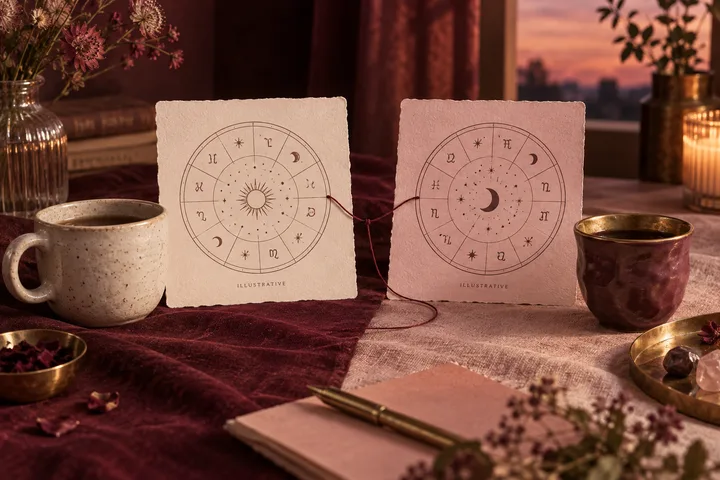
Astrology gives you a strong way to sort the pattern. It doesn't flatten both people into a sign label. Synastry compares two birth charts and studies the contacts between planets, points, and house areas. Astrodienst describes synastry as a comparison of two horoscopes, with each person's planets placed against the other's so astrologers can read their interaction. The technique shows where the relationship catches, warms, presses, or asks for work. It doesn't hand you a soulmate verdict.
That distinction matters because compatibility is not sameness. Two people can have very different Moon signs and still make a caring home together. They may comfort each other in different ways. One may want to talk immediately; the other may need an hour before words come. One may say, “I missed you,” while the other cooks dinner, remembers an appointment, or makes a plan for next week. The difference becomes healthy when both people can recognize the love underneath the unfamiliar form and still make practical adjustments.
But some differences carry a cost that attraction can't pay. If you need an exclusive relationship and he wants an undefined arrangement, you're not dealing with a style difference. If you need repair after conflict and he disappears every time you raise a concern, the problem isn't that your Moons speak different dialects. If you need steady affection and he offers intense closeness followed by long silence, the rhythm may keep your body in a state of waiting. You don't have to call that destiny just because it feels powerful.
A useful way to sort the difference is to ask what happens if nothing changes. Could you live with his present pace for six months without becoming resentful? Could he live with your present level of closeness without feeling managed? Don't answer from the best weekend you have had together. Answer from the ordinary week, when nobody is trying to impress anyone and both of you are tired. Compatibility has to survive ordinary life. In fact, ordinary life is where it proves itself.
You can also separate the need from the strategy you first chose to meet it. You may need reliability, but not necessarily a text every morning. You may need affection, but not necessarily public declarations. You may need commitment, but not a proposal on a particular schedule. This flexibility is not self-abandonment. It is discernment. The line is crossed when you keep changing the need itself because the man won't engage with any form of it.
It helps to sort your needs into three rooms. In the first room are preferences: the way you like to text, plan dates, or mark affection. In the second are relationship conditions: honesty, exclusivity, repair, sexual respect, and a pace that doesn't leave you guessing. In the third are personal limits, the actions you won't keep accepting because they cost too much of your peace. A man doesn't have to copy every preference. He does have to meet the conditions you require, and he has to know where your limits are. This simple sorting keeps a symbolic difference from receiving the same weight as a broken agreement.
Begin with a clean separation. Which need is flexible? Which one protects your dignity? A preference may be met in more than one form. A condition must be present for you to stay open. Make that distinction before you interpret the chart, and you won't mistake self-erasure for flexibility.
Yes, a man can be compatible with you when your relationship needs differ. Compatibility doesn't require identical habits, the same pace, or matching ways of showing love. It requires enough shared ground, honest translation, and a real willingness to respond. In synastry, the Moon describes emotional safety, Venus shows affection and values, Mercury shows how you make meaning together, and Saturn tests whether care becomes dependable over time. Those symbols help you name the pattern. His choices tell you whether the relationship can live inside it. The important question isn't whether he needs less contact than you, or whether you want more reassurance than he naturally gives. Ask whether he can hear the need without shaming you, negotiate a form of care he can actually sustain, and follow through after the conversation. If he can, difference may become a workable rhythm. If he calls your need excessive, offers promises without change, or asks you to become smaller so he can stay comfortable, the issue isn't a fascinating chart contrast. It's a poor fit for the relationship you want.
Sources: Comparative Astrology, Astrodienst AstroWiki; Partner horoscopes, Astrodienst FAQ; Synastry, Cafe Astrology
Read the Moon first when the argument is really about feeling safe
The Moon is where relationship needs become personal. It speaks to instinct, comfort, memory, protection, and the kind of response that lets someone soften. In synastry, Moon contacts often show why one person feels immediately familiar to the other, or why a small behavior carries far more emotional weight than an outsider would expect. You might think you are arguing about a missed call. Your Moon may be asking, “Can I rely on you when I reach for you?”
Moon-Moon differences don't automatically cancel a relationship. They show two emotional climates. A water Moon may need emotional presence before practical advice. An air Moon may need words, perspective, and room to think. A fire Moon may recover through movement and directness. An earth Moon may trust what can be repeated, prepared, and touched. None of these needs is wrong. Trouble starts when one person treats the other's climate as childish, dramatic, cold, needy, or inconvenient.
The most useful comparison isn't only the signs. Look at the exact aspect, its closeness, the houses involved, and the condition of each Moon in its own chart. A close Moon-Moon trine may create an easy instinct for comfort, while a square can create friction that forces both people to learn. A conjunction can feel intimate because the two Moons speak the same room, but it can also magnify a shared mood. An opposition can create recognition through contrast. There is no single aspect that decides the whole relationship.
Moon-Venus contacts often soften the field. Cafe Astrology describes them as a source of familiarity, tenderness, and a strong wish to share physical presence, while also warning that the Venus person may smooth over a problem with charm when the Moon person needs sincere emotional attention. That is a useful exception to the easy interpretation. Warmth helps, but warmth that avoids the real conversation leaves the Moon hungry. Feeling adored for a night is not the same as feeling held in the life you are building.
Moon-Saturn contacts are more demanding. They can create a powerful sense of responsibility, constancy, and long-term attachment. They can also make the Moon person censor feelings because Saturn seems critical, distant, or hard to please. Cafe Astrology's interpretation places both possibilities side by side: Saturn can offer reliability, but too much restraint can isolate the Moon and block the very intimacy the bond needs. This is not a “bad aspect.” It is a serious question about whether structure will protect feeling or suppress it.
The house overlay can tell you where the feeling lands. His Moon in your fourth house may make his presence touch home, family memory, and the private place where you recover. His Saturn in your fourth may feel like a stabilizing wall or a heavy rulebook, depending on the rest of the chart and the lived pattern. Your Moon in his seventh may make partnership feel central to him, while your Moon in his sixth may draw care into routines, errands, health, and practical service. These are symbolic descriptions, not excuses for behavior.
Pay attention to the difference between a need being met and a need being activated. A strong Moon contact can make you feel that he is essential before he has shown that he is dependable. A strong Saturn contact can make the bond feel serious before you have agreed on what serious means. Familiarity is not always safety. Sometimes it is the chart touching an old emotional pattern. Ask whether the relationship is helping you feel more honest and settled, or simply more attached to the hope of eventual relief.
Imagine Maria wants a goodnight call most evenings, while the man she is dating prefers to check in every few days and believes presence matters more than frequency. Their chart shows a close Moon-Saturn contact. That doesn't prove he is wrong for her. It describes a bond where steadiness and emotional timing may become the central lesson. Maria can ask for a smaller, concrete ritual: a short call on nights they aren't together, plus advance notice when he needs space. Then she watches. Does he make room without mocking the need? Does she accept a form of contact that genuinely settles her? The answer lives in that exchange.

Sources: Comparative Astrology, Astrodienst AstroWiki; Synastry: Moon-Saturn Aspects, Cafe Astrology; Saturn in Synastry, Cafe Astrology
Use Venus and Mercury to separate love language from actual values
A man may love you and still love in a way that doesn't reach you. Venus helps explain how affection, pleasure, attraction, and values move between two people. Mercury helps explain whether you can name the difference without turning it into a character attack. Together, they answer a question the Moon alone cannot: can you understand one another well enough to build a shared style of love?
Venus-Venus contacts can show compatible relationship values without producing identical romantic behavior. Cafe Astrology notes that flowing Venus-Venus aspects may leave partners with different styles of expressing affection while giving them enough common ground to feel appreciated. That is the useful middle. You don't need him to become a version of you. You need him to understand what his behavior means to you, and you need to understand what his behavior means when he offers care in a form you wouldn't naturally choose.
A difficult Venus contact deserves the same fairness. A square or opposition may show attraction mixed with frustration, especially when the two people want love to feel different. One may value privacy and loyalty; the other may need visible affection and frequent reassurance. One may see spending time together as proof; the other may see freedom and trust as proof. The aspect can make the mismatch vivid, but it doesn't make negotiation impossible. It tells you the negotiation won't happen by accident.
Mercury decides whether the negotiation has a chance. Mercury contacts can bring conversation, shared interests, and a desire to keep talking. Hard contacts can turn a simple request into a debate about who is more reasonable. You say, “I need clearer plans.” He hears, “You always disappoint me.” He says, “I need a quiet evening.” You hear, “You don't matter.” The words may be ordinary. The meaning underneath them is not.
Try translating the need before you defend it. Replace “You never make me feel secure” with “When plans stay vague until the day of the date, I start to pull back. I need us to set the next plan before we say goodbye.” Replace “You need me too much” with “I care about you, and I also need one evening alone each week so I can return present.” A workable request has a behavior, a rhythm, and a reason. It gives the other person something real to answer.
Then listen for whether he answers the request or argues with your right to have it. Those are different conversations. “I can't promise a call every night, but I can text when I know my evening is full and call on Tuesday and Thursday” is an answer. “You shouldn't need this much” is a judgment. The first may still be a mismatch, but it gives you a choice based on reality. The second tries to make your reality disappear.
Look at Venus in the natal chart as well as in synastry. A person's Venus sign and house can describe the kind of pleasure, pace, beauty, and exchange he naturally values. That context can explain why he shows care through practical help, private time, sensual touch, playful banter, or shared spending. It doesn't absolve him from learning your language. It does help you stop treating every unfamiliar gesture as proof that he doesn't care. You can recognize his style and still ask for translation.
Values become visible in the choices a person makes when the choices cost him something. He may say he values closeness, then protect every weekend for himself. He may say he values freedom, yet expect you to remain available without asking what you want. Watch where words meet sacrifice. Affectional style can differ and still feel generous. Values clash when one person's preferred arrangement repeatedly requires the other to give up clarity, time, money, sex, or self-respect. That is no longer a love-language puzzle. It is a question of terms.
Consider an example. She wants daily affection and a defined path toward partnership. He sends thoughtful messages, makes generous plans, and says he cares, but avoids any conversation about exclusivity. Their Venus contacts may be sweet. Their Mercury may be lively. None of that solves the value question. Is he offering the relationship she wants, or is he offering enough romance to keep the question suspended? The chart can describe attraction and conversation. His answer about commitment must still be plain.
Sources: Comparative Astrology, Astrodienst AstroWiki; Synastry, Cafe Astrology; Saturn in Synastry, Cafe Astrology
Let Saturn test consistency, not excuse emotional neglect
If you want to know whether different needs can survive real life, look for Saturn. Saturn is not the planet of instant reassurance. It is the part of a relationship that deals with time, duty, limits, commitment, and what happens after the first rush fades. Cafe Astrology describes Saturn interaspects as a kind of glue that can bind people while still being tricky to manage. That is the useful tension here. The same contact can steady a bond or make one person feel managed, judged, or trapped.
The clean reading is not “Saturn means marriage.” That shortcut creates false hope. A Saturn contact means the connection asks for maturity. The Saturn person may provide structure or carry authority. The personal-planet person may feel steadied in one moment and restricted in the next. Cafe Astrology describes a pattern in which Saturn can fear changes that threaten the original bond, while the other person begins to censor natural expression. That is a precise warning for women who keep editing themselves to preserve a man's comfort.
Saturn's question is simple: does the structure make room for both people? Healthy Saturn says, “Let's make this workable.” It may be slow, but it is clear. He takes the need seriously and helps design a rhythm he can keep. Unhealthy Saturn says, “Your need is the problem,” then uses busyness, commitment language, or supposed rationality to make you doubt your right to ask. He may call control stability. He may call withdrawal boundaries. The chart doesn't require you to accept either disguise.
Saturn also asks you to examine your own side of the bargain. Are you asking for a promise because you want a real agreement, or because you want anxiety to stop for one night? Are you keeping a boundary, or using a boundary to punish him for not reading your mind? Mature Saturn makes the request cleaner for both people. It turns vague fear into a limit, a time frame, or a responsibility. You can say, “I won't continue sleeping with you while we avoid discussing exclusivity,” and then honor your own sentence.
The pace question deserves care. Some men move slowly because they build trust through repeated experience. Some move slowly because they enjoy access without responsibility. What matters is direction. Is each month bringing more honesty, more integration, and more consistency, or does “not yet” remain the only plan? Moving forward might mean naming exclusivity, making room in his real schedule, or bringing you into more of his ordinary life. Time is informative when it has direction.
You can ask about that direction without demanding a guarantee. “What would becoming more committed look like to you over the next few months?” is better than “When will you finally choose me?” The first question invites a picture you can compare with your own. The second may produce reassurance without a plan. Listen for actions: meeting important people, making room in schedules, discussing exclusivity, handling conflict, and letting the relationship become visible in ordinary life. Saturn likes proof because proof can be repeated.
Give a slow-moving relationship a container. You might agree to revisit exclusivity after a month of regular dates, or decide that each of you will name one change that would make the connection feel more mutual. The point isn't to impose a deadline that manufactures intimacy. It is to stop an open-ended wait from becoming the relationship itself. A useful time frame has a question at the far end: What have we learned? What has changed? Do we want the same next step? If he refuses even that modest clarity, his refusal is part of the answer.
Don't mistake the difficulty of earning his attention for the value of the bond. A demanding chart can make the work feel meaningful, but meaning is not suitability. The test is whether the work produces a relationship in which both people have a secure place.
The strongest meaningful exception is this: a hard Saturn contact can become a durable bond when both people are conscious of the pressure and willing to change their habits. A square is not a sentence. A trine is not a guarantee. Flowing aspects can still carry reserve or self-consciousness, and difficult aspects can create a serious commitment when the people involved meet the tension honestly. Aspect quality matters, but so do the planets, the signs, the houses, the orb, the natal condition, and the choices made over time.
This is where chart precision matters. A responsible synastry reading needs both birth dates, exact or carefully estimated birth times, and birth places if you want to judge houses and angles. Without a birth time, the Ascendant, house cusps, and sometimes the Moon's exact sign or degree may be uncertain. The examples here are illustrative rather than a reading of either person's chart. Use these patterns to ask better questions, not to invent positions you haven't checked.
Sources: Synastry, Cafe Astrology; Synastry: Moon-Saturn Aspects, Cafe Astrology; Saturn in Synastry, Cafe Astrology
Compare the chart with the man in front of you
Before you ask what the chart means, decide what kind of answer you need. Synastry is useful for the pull between two people. A composite chart asks a different question about the relationship you create together. Choose the method that fits the question, then make the dating decision from what is actually happening between you.
Start with the need you keep repeating. Maybe you want him to initiate plans. Maybe you want him to introduce clarity before intimacy deepens. Maybe you need conflict to end with repair rather than a return to normal without an apology. Write the need as an observable action. “I need to feel valued” is true but too broad to test. “When we cancel, I need you to suggest a new day within two days” gives the relationship a door to walk through.
Then record the pattern across three settings: the calm conversation, the inconvenient day, and the weeks that follow. Does he listen and make a concrete offer? Does he keep it when work, family, travel, or irritation makes it inconvenient? Does the change become ordinary, or must you reopen the same conversation every week? Consistency is the quiet evidence that he has made your experience part of his decisions.
Now bring in the chart. Moon contacts can explain different comfort needs. Venus can show affection and value patterns. Mercury can show how easily you translate each other. Saturn can show the work of commitment and the risk of self-censorship. House overlays add another layer: one person's planets may activate the other's home, romance, partnership, work, or private inner life. Astro.com distinguishes synastry from composite and Davison relationship charts, which describe different ways of examining a bond. Use the method that answers the question you actually have.
If you are asking, “Why does he affect me this way?” synastry is the natural starting place. If you are asking, “What kind of couple do we become together?” a composite chart may add a different perspective. But don't let a composite chart replace a direct look at compatibility. Astrodienst's material on composite charts makes that distinction clear: the composite describes the relationship as its own field, while synastry compares the chemistry and interaction between the people. The two tools can complement each other. Neither cancels your lived experience.
A difference is workable when adaptation runs both ways. A man who needs space may give notice, make the next plan, and return when he says he will. A woman who needs reassurance may respect a quiet evening once the relationship has a clear rhythm. The question isn't who adapts. It's whether the adjustments make a shared life possible or merely protect his comfort.
You can make the comparison more precise with a two-column note. On one side, write what the chart seems to stir in you: longing, urgency, caution, comfort, fear, desire for certainty. On the other, write what he has actually done: planned, canceled, repaired, avoided, asked, remembered, changed. Add a third line beneath each event: did the result leave you more settled, or more dependent on the next reassurance? That small record catches a pattern that chemistry can hide. It also keeps one good weekend from arguing with six ordinary weeks.
Keep the record plain. Date the request, write his answer in a sentence, and note what happened next. If you ask for advance notice and he gives it twice, that is evidence. If he agrees warmly and then repeats the same last-minute cancellations, that is evidence too. Don't turn the page into a prosecution brief. You're looking for direction, not perfection. One missed effort can belong to ordinary human failure. A pattern of agreement followed by no change tells you the relationship is asking you to carry the whole lesson.
Also notice whether the relationship expands your life or narrows it. A bond can be intense and still leave you less available to friends, work, sleep, creativity, and your own decisions. A supportive synastry pattern should not require you to abandon the parts of yourself that existed before the connection. If the relationship asks for patience, let that patience have a limit and a purpose. If it asks for trust, let trust be built from evidence rather than demanded as a leap.
A chart can describe potential without describing readiness. He may have the capacity for devotion, emotional depth, or long-term loyalty and still be unwilling to practice those qualities with you now. Potential belongs to the future. Dating decisions belong to the present. You can honor what the connection awakens without funding a version of him that has not arrived. And your own chart needn't trap you either. Independence and commitment can coexist.

Sources: Comparative Astrology, Astrodienst AstroWiki; Partner horoscopes, Astrodienst FAQ; Synastry, Cafe Astrology
The answer arrives in one honest conversation
You don't need to present a courtroom case. You need to tell the truth early enough that his answer can still teach you something. Choose one need, not your entire history. Choose a calm moment, not the peak of a fight. Speak about the relationship you want to create rather than listing every way he has disappointed you. Then leave enough silence for him to reveal how he handles another person's reality.
You can say: “I like what is growing between us, and I want to understand whether we want the same kind of relationship. I feel close when we make clear plans and keep regular contact. I don't need us to communicate exactly the same way, but I do need consistency. What kind of rhythm can you genuinely offer, and what would you need from me to feel comfortable in it?”
That question does several jobs. It names your need without apologizing for it. It allows difference. It asks for a real offer instead of a vague promise. And it gives him room to state a limit that you may or may not accept. Pay attention to the difference between discomfort and refusal. A thoughtful man may need a moment to answer. He may admit that your request is new for him. He may suggest a plan and ask you to help refine it. That's conversation. A man who mocks the need, reverses the blame, or keeps you in indefinite ambiguity is giving you information too.
Astrology can help you name why the conversation feels tender. Moon-Saturn may make the request feel like a test of safety, while Venus-Mercury can make directness feel risky. Use the symbolism to find the pressure point. Then listen to his answer.
Your job is not to win him over to your exact emotional operating system. His job is not to become the man in your fantasy. The work is more grounded. Can you name the condition that lets you remain open? Can he meet it without resentment? Can you respect his limits without pretending they satisfy you? Can both of you change a habit while keeping your self-respect? When the answer is yes, different needs can become a relationship with range. When the answer is no, chemistry becomes a reason to delay the decision.
If he responds well, make the agreement small enough to keep. Don't negotiate an entire future in one emotional conversation. Choose one practice for the next two or three weeks. Set the next date before the current one ends. Send a brief message when plans change. Take an hour to cool down, then return to the issue. Call twice a week. The right practice depends on the need. What matters is that both of you can see whether the agreement is being lived rather than merely admired. Put the review date on your calendar. A promise deserves a chance to become a habit, not an endless extension.
If he responds badly, resist the urge to explain the same truth in ten more ways. More detail won't create willingness. You can clarify once, state the consequence, and step back. “I understand that this rhythm works for you. It doesn't work for me, so I won't keep dating inside it.” That is not a threat. It is a decision. Your dignity doesn't need a dramatic exit or a perfect astrological reason. It needs a line you are willing to keep.
Give yourself permission to be disappointed by a mismatch without making either of you the villain. He may be kind and still not be available in the way you need. You may be loving and still ask for more than he can give. Respect doesn't require continued access. Sometimes the clearest act of respect is to stop trying to turn a meaningful connection into a suitable partnership. That choice can hurt and still be right for you.
And if the conversation goes well, don't rush to call the difference solved. Let the new pattern earn your trust. Notice whether you feel less anxious, whether he seems less pressured, and whether the compromise remains mutual after the novelty fades. A relationship doesn't become compatible because you found the perfect sentence. It becomes more compatible when both people keep making room for the truth that sentence revealed.
You aren't choosing between a flawless man and a failed connection. You are choosing whether this particular man can meet you in a relationship that leaves both of you more honest and secure. The chart may explain the pull. Your conversation and your boundary decide what happens next. Clarity may disappoint you, but it gives your time a direction.
Get my dating clarity report if you want help sorting the pattern before you invest more of your time. Bring your questions about his consistency, his intentions, your pace, and the boundaries you keep negotiating away. Then have the conversation. Not the perfect conversation. The real one.
Sources: Comparative Astrology, Astrodienst AstroWiki; Synastry: Moon-Saturn Aspects, Cafe Astrology; Saturn in Synastry, Cafe Astrology
A little more clarity
Can different Moon signs still be compatible in synastry?
Yes. Different Moon signs can describe different emotional habits, not an automatic failure. Look at the exact aspect, the Moon's condition in each natal chart, supportive contacts from Venus or Jupiter, and the couple's ability to respond to each other's comfort needs. A Moon square may require more translation than a trine, but a trine can still leave important needs unspoken. The practical test is whether both people can ask for care clearly and offer it without contempt.
Does Moon-Saturn synastry mean the relationship will last?
Moon-Saturn can support loyalty, seriousness, and a feeling of dependable attachment, but it doesn't guarantee a lasting or happy relationship. The Moon person may feel safe with Saturn's steadiness and restricted by Saturn's criticism or reserve. The contact works best when Saturn protects the bond without controlling it and the Moon speaks honestly instead of censoring every feeling. His behavior after you name a need matters more than the aspect label.
How do I know whether our different needs are workable?
Turn your main need into a specific request, then watch his response in the moment, under pressure, and over time. Workable difference brings curiosity, negotiation, and follow-through. An unworkable mismatch brings contempt, repeated vagueness, one-sided compromise, or pressure for you to need less. Use synastry to understand the pattern, but use his observable choices to decide whether you want to keep investing.
Sources & further reading
- Comparative Astrology, Astrodienst AstroWiki
Defines comparative astrology and distinguishes synastry overlays from composite and Davison relationship charts.
- Partner horoscopes, Astrodienst FAQ
Defines synastry as two birth charts compared together and explains that aspects show how partners interact.
- Synastry, Cafe Astrology
Describes how Venus, Moon, Mercury, Saturn, Mars, aspects, and house overlays are interpreted in relationship astrology.
- Synastry: Moon-Saturn Aspects, Cafe Astrology
Supports the reading of Moon-Saturn contacts as both dependable and potentially restrictive when feelings become censored.
- Saturn in Synastry, Cafe Astrology
Supports the interpretation of Saturn as commitment, structure, pressure, control, and a test of mature relationship habits.
Dating Clarity Report
Six observations about the man you are dating. A clear view of the patterns, plus a conversation for your next decision.
Get my dating clarity report