
The pet is not the only question
Yes, a relationship can work without rehoming his pet. But it cannot work on the assumption that you should simply tolerate symptoms or vanish from his home. You have two real needs in the same room: he may be attached to his animal and home, and you need an arrangement that respects your health and gives you a place in his life. Neither need settles the decision by itself. What matters is what the two of you are willing to build around them.
The conflict often gets framed as a test: if he loves you, he will give up the pet; if you love him, you will endure the exposure. That is too narrow. The Adopt a Pet article, “What to Do When Your Partner Is Allergic to Your Pet,” describes how a dispute over rehoming can become a symbol of sacrifice. His response to your actual limit matters more than a dramatic proof of devotion.
There are three paths to consider. You might explore clinician-guided measures together. You might choose separate homes, with meeting places and effort that work for both of you. Or you might end your investment if he refuses any participation and leaves you to carry the symptoms, logistics, and exclusion. A Boston.com Love Letters column, “He’s Allergic To My Cats,” treats separate homes as one possible arrangement, not a promise that every couple will thrive that way. Ask instead: which living arrangement are you both choosing, and would you want that life?
Yes, a relationship can work without rehoming his pet, but not by asking you to tolerate symptoms or disappear from his home. The workable options are a clinician-guided plan, a mutually chosen relationship with separate homes, or ending your investment if he refuses to participate. Decide based on your health, shared effort, and whether you want the life that arrangement creates.
Sources: What to Do When Your Partner Is Allergic to Your Pet; He’s Allergic To My Cats
First, find out what your body is reacting to
Before you promise to keep visiting his home, find out what your body is reacting to. A clinician can help assess whether a pet is the likely trigger, whether another indoor exposure may be involved, and what kind of care fits your symptoms. That gives you a clearer limit to bring into the relationship conversation. It also keeps him from turning a medical question into a test of how much discomfort you can tolerate.
Start with what you notice, not with a diagnosis. After a visit, jot down where you were, how long you stayed, what symptoms appeared, and when they began. Include whether you were near the animal, in a particular room, or handling blankets or furniture, if you know. Note breathing symptoms too. This record is not a way to prove that the pet caused the reaction; it gives a healthcare professional details to assess alongside your history and an examination. You do not need to arrive with a perfect log or solve the cause on your own.
The American College of Allergy, Asthma & Immunology says an allergist can evaluate suspected cat or dog allergy and notes that other environmental exposures can cause similar symptoms. Its guidance describes skin-prick testing as a common diagnostic method for both. Mayo Clinic likewise explains that a healthcare professional may assess symptoms, examine the nose, and suggest a skin test; in some cases, a blood test may be used instead. The right assessment depends on your circumstances. A partner watching you sneeze cannot identify the trigger, judge its seriousness, or choose treatment for you.
That distinction matters before anyone proposes a trial at his house. The same symptom can have more than one possible explanation, and symptoms vary from person to person. If you have had breathing symptoms, include that history when you seek care rather than letting a date decide what is safe. Ask the clinician what the findings mean for visits, what options are appropriate for you, and what signs should prompt you to stop or seek help. This is a conversation for your healthcare professional, not a threshold you and he have to invent together.
Then tell him the practical truth in plain language: “I’m getting medical advice so I understand what triggers my symptoms and what visits I can manage. I’m not agreeing to push through a reaction while we guess.” He can support you by listening, sharing what he knows about the home, and joining a planning conversation if you want him there. He does not have to decide whether your symptoms count. You do not have to offer a treatment, promise of exposure, or timetable before you know what your clinician recommends. First establish the constraint; then you can discuss what kind of relationship fits it.
Why a clean corner may not make his home safe
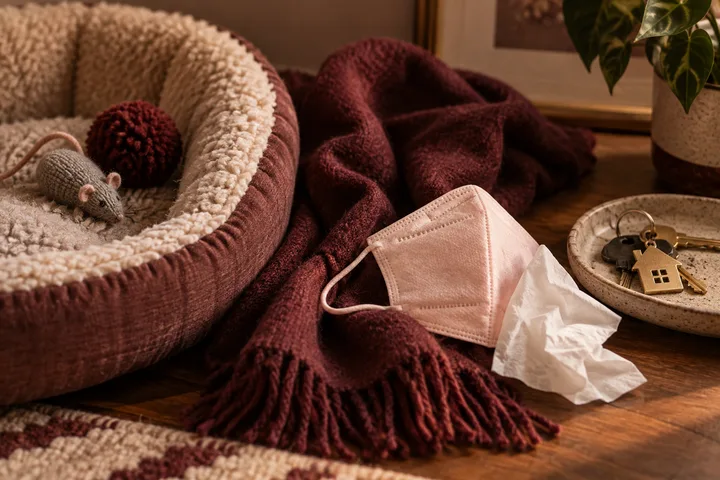
Keeping the pet out of one room, cleaning, and filtering may lower some allergen levels. None guarantees you can spend time in his home without symptoms. Pet allergens don’t always respect a closed door.
The American College of Allergy, Asthma and Immunology’s “Pet Allergies” guidance explains that restricting a cat or dog to one room won’t keep its allergens there. Cat allergens can be on fur and skin and in saliva; dog allergens can be in hair, dander, saliva, and urine. People can encounter pet allergens indoors where the animal isn’t present.
The guidance lists steps that may help limit exposure, including keeping the animal out of the bedroom, using a high-efficiency vacuum, and running a HEPA cleaner continuously. “May help” matters. These measures are for discussion with an allergist, not a promise that a pet-free room will be symptom-free.
A controlled trial shows why the distinction matters. In “A placebo-controlled trial of a HEPA air cleaner in the treatment of cat allergy,” 35 people with cat allergy who lived with cats took part in a double-blind study. For three months, researchers compared active bedroom air cleaners with placebo cleaners. The active group had lower airborne cat-allergen levels. Yet researchers detected no differences in measured symptoms, sleep disturbance, lung measures, or rescue medication use. The intervention also included mattress and pillow covers and keeping cats out of bedrooms, so its result cannot be credited to a filter alone.
That finding doesn’t mean exposure controls never help. It means lower airborne allergen did not translate into detectable improvement in this small, older, cat-specific trial. A room measurement and how your body feels are different outcomes.
A second study makes the measurement issue concrete. “Air filtration units in homes with cats: can they reduce personal exposure to cat allergen?” examined five cat-owning homes using nasal samplers to estimate inhaled allergen. It found a significant reduction when the cleaner operated in the room with the cat. When the cat was elsewhere, reduction appeared only after three hours. Researchers concluded personal exposure fell less than standard air samplers suggested. With five homes and short sampling periods, it can’t tell us what every person or setup will experience. It shows why a purifier’s room reading may not capture your exposure.
Together, these sources support a careful conclusion: room restrictions, cleaning, and filtration can change some exposure measures, but can’t certify that his home is workable for you. Both studies focus on cats and have limits in size or scope. They don’t settle what will happen with another pet, home, or your symptoms. The practical test belongs to your experience and, where needed, a clinician’s guidance. A plan counts as a trial only when measures are specific, a qualified clinician considers them suitable, and you can change course if symptoms say it isn’t working. His confidence in a purifier is not the result.

Sources: Pet Allergies; A placebo-controlled trial of a HEPA air cleaner in the treatment of cat allergy; Air filtration units in homes with cats: can they reduce personal exposure to cat allergen?
What his response can tell you—and what it cannot
His response matters most as evidence of whether he will take part in solving this with you. Keeping a beloved pet is not, by itself, proof that he does not care. He may feel responsible for the animal or unwilling to change a home built around its needs. Asking him to rehome it is a serious request. You can recognize that without agreeing to enter a home that makes you ill.
What happens after he understands your limit? Does he ask what your clinician recommends and help explore arrangements you could both accept, even if rehoming is off the table? Or does he wave away your symptoms and leave you to manage medication, cleaning, travel, and missed time together? One response protects a preference while making room for negotiation. The other assigns you the cost of keeping the relationship convenient for him.
The two studies described in “Perceived Partner Responsiveness and Its Role in Relationship Satisfaction” found that people who generally saw their partners as more responsive tended to rate responsive acts as more responsive. That baseline did not shape ratings of unresponsive acts. This research does not show that one refusal reveals someone's character or hidden intentions. It did not study allergies or dating ultimatums.
So look at the pattern you can observe. If he usually listens, follows through, and shares inconvenience, a firm no to rehoming may be one limit within a mutual conversation. If he repeatedly treats your needs as a nuisance, leaves you the work, or avoids discussion, this conflict adds another example. Neither reading tells you what he secretly feels. It helps you judge the partnership he offers.
The reported couple in “What to Do When Your Partner Is Allergic to Your Pet” shows how this disagreement can take on symbolic weight. Its account of conflict over rehoming cats and allergy shots came to stand for love and sacrifice. One person may hear “change your home” as “give up something you love”; the other may hear “nothing will change” as “my comfort does not matter.” This single case cannot tell you what your boyfriend means.
Separate the practical request from the meaning you fear it carries. You might say, “I understand rehoming isn't something you're willing to consider. I need us to discuss my health and find an arrangement we can both live with. I can't be the only one managing this.” Then listen for a specific response. He may plan around separate homes or discuss clinician-guided steps. He may not. Either answer tells you more than testing his love with an ultimatum.
You don't have to call him uncaring to decide his offer doesn't fit. And he doesn't have to rehome a pet to show he takes you seriously. Judge whether he listens, shares the effort, and accepts that your health sets a real limit. If every sacrifice remains yours, ask whether this relationship has room for you.
Sources: Perceived Partner Responsiveness and Its Role in Relationship Satisfaction; What to Do When Your Partner Is Allergic to Your Pet
Which arrangements are actually available to you?
There are three honest paths: try a clinician-guided exposure-reduction plan if appropriate; keep separate homes and meet in places that work for both; or end the relationship if no acceptable arrangement exists. Rehoming may be discussed if medically needed, but neither partner should treat it as the automatic test of love. The first path keeps his pet in the home while both of you find out whether a workable level of exposure is possible. The American College of Allergy, Asthma & Immunology (ACAAI) describes avoidance as the best way to manage pet allergy, while also listing steps that may help limit exposure when a household keeps its cat or dog. Its guidance does not promise that those steps will make a home symptom-free. A clinician can help decide whether this route makes sense for you and what care belongs in the plan. The question is whether your health allows it and whether he will share its ongoing work and cost. The second path keeps both the pet and his home as they are, while you build a relationship that does not depend on your spending time there. You might meet in pet-free places or at your home, if that works for you. Separate homes also mean travel, planning, and possibly no shared household later. A Boston.com Love Letters response presents separate homes as one possible way to keep a relationship while a partner keeps cats. It is one advice-column case, not evidence that this arrangement suits every couple. Ask whether you want it as your real future, and whether he will travel and adapt too. If you are always the one crossing town, arranging pet-free time, and carrying the inconvenience, the address is separate but the effort is not shared. The third path is not really an accommodation: he changes nothing, while you absorb symptoms, treatment decisions, travel, cleaning, or exclusion. You may decide that this is not enough for you, even if he has reasons to keep his pet and home. That conclusion does not require calling him cruel or the animal disposable. It says the arrangement does not meet your needs. Compare the paths on four questions. First, what does your clinician consider suitable, and how do you feel? Mayo Clinic's “Pet allergy - Diagnosis & treatment” explains that limiting exposure can reduce how often or severely reactions occur, yet complete avoidance can be difficult. Second, who pays for and performs recurring tasks? Third, who travels, hosts, and works around the pet's needs? Finally, does the arrangement fit the future you want, including whether you hope to live together? Rehoming can be considered as a medical measure, but it is consequential and does not guarantee immediate relief. A trial can also fail. The fair choice is the one you both understand and freely accept, not one that quietly assigns all the sacrifice to you.

Sources: Pet Allergies; Pet allergy - Diagnosis & treatment; He’s Allergic To My Cats
What would a fair trial actually ask of both of you?
A fair trial is specific, shared, and allowed to fail. It names only measures her clinician considers suitable, who will do and pay for each task, where they will meet during the trial, and what symptoms or practical limits mean they stop or change course. The point is not to prove that she can endure his home. It is to learn whether an arrangement can work for both of them. Start with her clinician's advice, not a shopping list of devices or medicines. The American College of Allergy, Asthma & Immunology says allergy treatment varies with symptoms and recommends an allergist to help determine what may be appropriate. Mayo Clinic's “Pet allergy - Diagnosis & treatment” likewise describes diagnosis and treatment as matters to discuss with a healthcare professional. Those sources support a conversation tailored to her, not a do-it-yourself exposure test. She can ask whether any home visit is suitable, what changes are worth trying, and what signs mean she should leave or seek care. He does not get to set that threshold for her. Then turn “I’ll try harder” into observable agreements. If the clinician considers it reasonable, they might discuss keeping the pet out of a particular room, cleaning on an agreed schedule, or meeting somewhere else while they assess how she feels. These are examples for discussion, not a prescribed protocol or a promise of relief. ACAAI notes that keeping a pet to one room does not keep allergens there; its guidance also lists measures such as regular vacuuming and HEPA filtration as ways that may reduce allergen levels. So a clean bedroom or a new purifier cannot stand in for her actual experience. Write down who handles each task and who pays. If he owns the home and the pet, the plan should not quietly make her responsible for cleaning his rooms, buying equipment, or managing his animal. She may choose to contribute, but her contribution must be freely offered and practical. They should also decide where dates happen during the trial, so every visit does not require her to enter a space that may trigger symptoms. A plan that works only when she carries the labor is not shared. Finally, agree on a review point and what they will review: her symptoms, whether the agreed steps happened, and whether the arrangement still feels fair. Let her clinician guide the timing and any medical limits. If symptoms continue, effort alone has not made the home workable; they can revise the plan, choose separate homes, or accept that their needs do not fit. If he declines even a concrete discussion, that tells her something different from a trial that was tried and did not help. She can assess both outcomes separately: whether he shares the work, and whether the arrangement is livable for her body. Neither answer should be forced.

Can separate homes be a real future, not a waiting room?
Yes, separate homes can be a real future if you choose that relationship as it is, rather than accept it while waiting for an unspoken change. If you want a partner who shares a home with you, living apart indefinitely may leave a central wish unanswered. If you can feel close and secure without cohabiting, separate homes may suit you both. Neither preference is more loving. But each deserves to be said plainly before you invest more time. A Boston.com Love Letters exchange, “He’s Allergic To My Cats,” offers one example of a couple trying to hold a relationship alongside a pet allergy. The letter writer wanted to live together within a couple of years, while her partner struggled to spend time in her home; the columnist advised them to live separately while the cats remained. That is one advice-column response to one couple, not evidence that separate homes will work for you, that an allergy cannot change, or that cohabitation is impossible in every case. Its useful point is narrower: keeping a pet and caring for a partner need not always be forced into an immediate either-or choice. The harder question is whether the arrangement they can build matches the future each person wants. Make that future concrete. Who travels, and how often? Can you spend time overnight in places where you can be comfortable, or does every visit depend on entering his home? Would he come to your place or meet you elsewhere? How will you handle holidays, illness, busy weeks, and the ordinary desire to wake up together? If you carry all the travel and give up access to his home while he changes nothing, “we can live separately” may describe a one-sided arrangement, not a shared choice. Talk about money and effort, too. Separate homes can mean two sets of household costs, regular travel, and planning around the pet. You need to know whether both of you recognize those costs and expect to share the work fairly. Ask what each of you means by “for now.” Does he hope to live together later? Do you? What would have to change, and who decides whether that change is possible? Don’t treat a vague “maybe someday” as a plan. If you want cohabitation and he wants to keep the pet in a home you cannot comfortably enter, neither person has to be cast as the villain for your futures to conflict. You can care about him and still decide that a relationship organized around separate homes is not the relationship you want. You can also choose it freely, if it gives you enough closeness and inclusion now. Choose the life on offer, not the life you hope his circumstances will eventually produce. A separate-home arrangement is a future only when both people can name it, share its burdens, and want it without treating you as a guest forever.

Sources: He’s Allergic To My Cats; What to Do When Your Partner Is Allergic to Your Pet
Where synastry may help—and where it must stop
Synastry can help you reflect on how two people meet around home, care, attachment, and boundaries. It cannot tell you whether your allergy is manageable, whether he will change, or whether the relationship is destined to work. Those answers come from your health needs, his choices, and the life you are both willing to build.
In relationship astrology, synastry means comparing two natal charts and interpreting the relationships between their planetary placements. The Astrology University course description presents it as a practice of chart comparison and inter-chart interpretation. That gives us a useful symbolic frame, but no chart positions have been supplied or calculated for you and this man. So there is no honest basis here for naming a particular aspect, house, or placement as the reason for this conflict.
The symbolic question is still worth asking. What does home mean to each of you? For one person, home may be a refuge already shaped around a beloved animal; for the other, entering that space may bring discomfort or symptoms. What does care look like when neither person can simply erase the other’s need? And where is the boundary between honoring his bond with the pet and asking you to accept conditions that do not work for your body? These are interpretive prompts, not claims about what either chart contains.
Astrology can make a conversation more revealing when it helps you name the tension beneath the logistics. You might say, “I’m not asking you to prove your love by giving up your pet. I need us to talk about whether there’s a way for me to spend time with you that respects my health.” Then listen for the answer in both words and action. Does he ask what your clinician advised? Does he consider meeting at your home or another suitable place? Does he share the effort of finding an arrangement, even if he does not want to change his home?
Keep the layers distinct. A chart reflection may help you notice that you need a home life with shared access, or that a relationship across two homes could suit you. It cannot establish that either future is right for you. Your symptoms and clinical guidance inform what exposure is workable; his repeated behavior shows what he is willing to help create. A graceful interpretation cannot turn refusal into participation, and a difficult aspect, if one were present, would not make disregard inevitable.
Use synastry to deepen your questions, not to surrender your judgment. Once you know which arrangements are medically and practically possible, astrology may help you consider what belonging, care, and independence mean to you as a couple. The decision remains concrete: can you feel well, included, and at peace in the relationship he is actually offering?
Sources: Relationship Astrology 101: Synastry
Ask for a plan, then decide what you can live with
Talk calmly about your health and the relationship you want. Mayo Clinic’s “Pet allergy” says a healthcare professional can assess symptoms and discuss exposure management; let that advice shape any home trial. If you try changes at his home, agree on suitable measures, who will handle and pay for each task, and when you’ll review how it is going. Or discuss separate homes: who travels, where you’ll spend time, and whether that arrangement fits the future you want. Set the review point around your wellbeing and clinical advice. You might say, “I’m not asking you to give up your pet. I can’t keep visiting if I’m unwell. I’m willing to discuss a plan that works for both of us, including meeting elsewhere. What are you willing to do?” You don’t need to threaten a breakup to make that boundary real. Watch what he agrees to and follows through on. “Putting responsiveness in context” found that a partner’s perceived baseline shapes how responsive individual acts seem; it doesn’t reveal his motives here. For help reflecting on consistency, intentions, pace, and boundaries, get my dating clarity report. Decide whether the life he offers leaves room for your health and needs.
Sources: Pet allergy - Diagnosis & treatment; Perceived Partner Responsiveness and Its Role in Relationship Satisfaction
Sources & further reading
- What to Do When Your Partner Is Allergic to Your Pet
Offers a reported example of how a pet-allergy dispute over rehoming can take on symbolic weight around sacrifice.
- He’s Allergic To My Cats
Presents one advice-column case in which separate homes are considered alongside a partner's cats.
- Pet Allergies
Explains pet-allergy evaluation, allergen spread, exposure-reduction measures, and the limits of general guidance.
- Pet allergy - Diagnosis & treatment
Supports discussing assessment and individualized exposure management with a healthcare professional.
- A placebo-controlled trial of a HEPA air cleaner in the treatment of cat allergy
Reports lower airborne cat allergen but no detected improvement in measured disease activity in a small, three-month trial.
- Air filtration units in homes with cats: can they reduce personal exposure to cat allergen?
Reports limited personal-exposure reductions in a five-home cat-allergen study and contrasts them with standard air sampling.
- Perceived Partner Responsiveness and Its Role in Relationship Satisfaction
Reports two studies on perceived partner responsiveness; the research does not assess allergy disputes or establish motives.
- Relationship Astrology 101: Synastry
Describes synastry as comparing charts and interpreting relationships between planetary placements.
Dating Clarity Report
Six observations about the man you are dating. A clear view of the patterns, plus a conversation for your next decision.
Get my dating clarity report