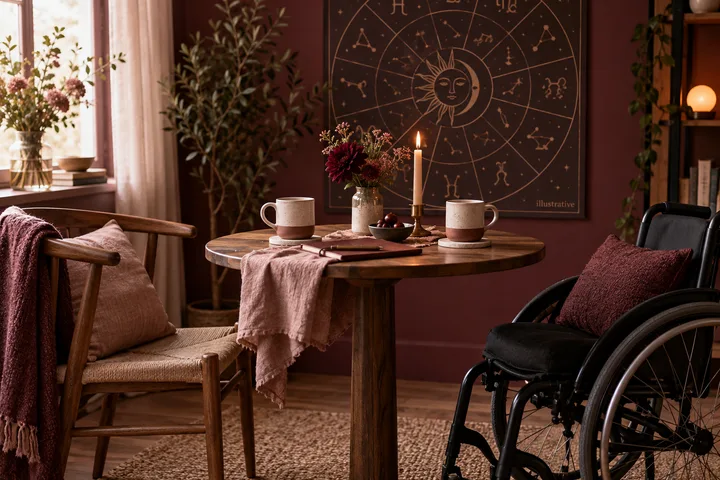
The assumption is simple, but it is wrong
You see that he has a disability. You imagine the future. Appointments. Ramps. Bad days. Help with ordinary tasks. Then a second fear arrives: if you fall in love, will you become responsible for everything?
That fear deserves a straight answer. A disability can shape a relationship. It does not automatically make one partner the parent, nurse, driver, scheduler, advocate, or emotional shock absorber. The danger isn't care itself. Couples care for each other all the time. The danger is care without choice, without limits, and without a plan that includes both people's needs.
The strongest position is this: don't judge his worth by the help he needs, and don't volunteer your life away because he needs it. Hold both truths. A disabled man may be capable, sexy, ambitious, difficult, generous, avoidant, funny, selfish, tender, or all of those things in one week. His impairment is part of his life. It isn't the complete explanation for his behavior.
The UK government's 2025 qualitative review of disabled people's relationships describes a real tension around roles. Disabled people may face increased dependency and caregiving inside relationships, while also facing assumptions that they are incompetent. Those pressures can distort dating before the couple has even made a choice. He may expect rejection. You may overcorrect by proving you're accepting. Either response can pull you away from the actual man in front of you.
So begin with the ordinary question. What does he want from dating, and what does he do to make room for it? A man who wants partnership will usually show you where he is responsible, where he needs help, and where he is still figuring things out. He won't need you to pretend there are no practical issues. He also won't ask you to pretend they are all yours.
This is the assumption your dating life needs to reject: love does not require you to become indispensable. Mutual dependence can be intimate. Forced dependence is a trap. The difference appears in daily choices, long before a crisis makes it dramatic.
Notice, too, what happens to your own feelings when you name the issue. If you immediately feel guilty for wanting ordinary romance, that's information. You are allowed to want spontaneous plans, sexual ease, quiet weekends, shared ambition, and someone who asks how you are doing. None of those wants become shallow because his life includes disability.
You also get to decide what kind of care feels loving to you. Maybe you want a partner who checks in, shares domestic work, and stands beside you when life gets hard. Maybe you don't want hands-on care in a romantic relationship at all. Both answers are valid. Compatibility includes the shape of care you can give with a free heart.
Yes, you can date a man with a disability without becoming his caretaker. The question isn't whether he needs support. The question is who carries that support, how clearly you both name it, and whether he remains an active partner in building a life with you. Watch what he already manages. Does he arrange his care, communicate access needs, make plans, repair mistakes, and respect your no? Or does every inconvenience become your emergency? Disability rights guidance centers autonomy, choice, and independence, while relationship guidance stresses consent, pacing, and open talk about intimacy. Astrology can sharpen the pattern you are seeing, especially through Saturn, the Moon, Venus, and the sixth and seventh houses. It can't excuse pressure or replace observation. Date him as a whole man. Keep your own life whole, too. Before you deepen the relationship, ask what support belongs to professionals, what belongs to him, what you freely want to offer, and what you will not take on.
Sources: Disabled people's experience of relationships and loneliness; Intimacy, disability and relationships
Why the rescuer role can feel like love at first
Caretaking can feel intimate because it creates instant usefulness. You know what to do. He needs something. You provide it. The bond seems deep before you have tested whether you actually like each other in the quiet spaces between problems.
That rush is especially strong when you are compassionate, competent, or used to earning closeness by being helpful. You may tell yourself that you are simply being thoughtful. You may also notice that he praises you most when you solve something. Be careful. Praise can become a reward system, and a reward system can train you to keep giving past your limit.
Imagine Maria dating a man who uses a wheelchair. On the third date, she pushes his chair up a steep entrance because the staff has placed a table in the accessible route. He thanks her. Fine. On the sixth date, she starts calling restaurants, checking bathrooms, arranging transport, and apologizing to friends when he cancels. He says she's the only person who understands. Maria feels chosen. She also feels tired, though she doesn't say it.
The problem isn't that Maria helped. The problem is that the relationship has started rewarding her for carrying access failures that belong to the venue, the care system, or a shared planning conversation. Her kindness has become infrastructure. Once that happens, refusing the next task can feel cruel even when it is reasonable.
The same UK review describes how disabled people can be treated as an 'other' and assumed incompetent. A rescuer role can repeat that harm while appearing loving. If you speak for him, decide what he needs, touch his equipment without asking, or treat every inconvenience as proof that he cannot manage, you may be helping him physically while shrinking him socially.
Ask yourself what the help is doing. Is it opening a door so the date can continue? Or is it making you the person who keeps the whole relationship alive? The first can be generous. The second is not romance. It is unpaid management with kissing attached.
You can interrupt the pattern without accusing him. Say, 'I want to help with this one thing, but I don't want us to build our relationship around me solving every practical problem.' His response will tell you whether he hears a limit or only hears rejection. That distinction matters more than how grateful he was the last time you stepped in.
Don't let the word caretaker do all the thinking, either. You might become a caretaker because he asks you to do tasks, or because you silently take them over, or because an inaccessible system leaves both of you scrambling. The remedy changes with the cause. Sometimes you need a boundary. Sometimes you need outside support. Sometimes you need to stop treating every broken system as a personal test of your love.
Sources: Disabled people's experience of relationships and loneliness; Personal Assistance Principles
Read his independence as a practice, then ask what care means
You don't need him to prove independence by doing everything alone. That standard would be harsh and unrealistic. Independence can mean directing his own support, making informed choices, asking clearly for what he needs, and finding another route when a plan fails.
Disability Rights California's principles on personal assistance place autonomy at the center. They describe the right to direct services, choose providers, and receive help in ways that maximize independence. The exact services available will vary by country, income, impairment, and system. The principle still gives you a useful lens: support should strengthen a person's agency, not quietly transfer their life to a romantic partner.
Watch how he handles logistics. Does he tell you what makes a date accessible? Does he check the details himself? If a venue fails, does he propose a new option, or does he wait for you to rescue the evening? If he needs a personal assistant, family support, mobility aid, medication routine, communication accommodation, or rest day, does he treat those as parts of his life that he can discuss without making you the default provider?
Consider an example. He tells you that crowded rooms worsen his pain and asks for a quieter restaurant. He has already chosen two places, checked the seating, and says he can change the plan if his symptoms shift. That's not helplessness. That's preparation. It gives you something important: a partner to respond to, not a problem to manage.
Now consider the opposite. He repeatedly chooses inaccessible plans, refuses to ask anyone else for help, and then blames you when the evening collapses. His disability may explain why a particular task is hard. It doesn't explain why he makes you responsible for the consequences without a conversation.
You are looking for active participation. He doesn't have to perform toughness. He does have to show ownership of his life. And you have to show ownership of yours. If your schedule, money, friendships, sleep, or work keep shrinking around his needs, pause. A good relationship adapts. It doesn't require one person to disappear.
Don't wait for a crisis to discover that you and he use the word care differently. Ask early, and ask in plain language. What support does he receive now? Who provides it? What does he expect from a girlfriend? What happens when his usual support is unavailable? What would he never ask a partner to do?
You aren't conducting an intake interview. You are learning whether the relationship has room for an honest future. He may not want to disclose every medical detail. He controls his private information. You still have the right to understand the practical shape of a relationship before you commit to it.
Scope's guidance on intimacy and disability recommends open discussion about what partners want, what they can do, and what may change. It also recognizes that care support can affect privacy and time alone. If a personal assistant, family member, or support worker is part of his routine, ask how privacy works before you assume closeness will happen spontaneously.
Try questions like these: 'What kind of help do you want from a partner, and what help do you already have?' 'If you need to cancel, how do you like us to handle it?' 'Would you want me involved in appointments or care decisions later, or would you keep those separate?' 'How do we protect my time when your needs are high?' 'What does a fair weekend look like for both of us?'
Listen for substance, not a perfect answer. He may be embarrassed. He may have been mistreated before. He may need time to think. But he should be able to stay in the conversation. A man who says, 'I don't know yet, but I want us to work that out together,' is giving you something real. A man who says, 'If you loved me, you wouldn't ask,' is turning care into a loyalty test.
Write down your own answers, too. You may offer a ride sometimes. You may not provide personal care. You may share household tasks, but you won't manage medication. You may be present in an emergency, but you won't become his only emotional outlet. Boundaries work best when you name them before resentment has to name them for you.
The practical test is whether the conversation produces a shared map. It might include a list of tasks, a backup contact, a limit on last-minute requests, or a plan for private time. It needn't be formal to be real. You should leave knowing what you are choosing, not merely what you are afraid to refuse.
That map should include your ordinary needs, not just his emergencies. When will you see friends? How will you divide planning? What happens if you need rest, care, or reassurance? A relationship becomes more equal when both people can ask for accommodation without one request being treated as the real need and the other as an inconvenience.
A plan can change when his condition changes. Flexibility is part of love. But flexibility should not mean that only you stay flexible. If every adjustment comes from your side, the couple has no shared structure. Revisit the plan together, and make sure the new version still leaves you with time, money, privacy, and a sense of yourself.
Sources: Personal Assistance Principles; Disabled people's experience of relationships and loneliness
Let Saturn show you the difference between duty and devotion
Astrology gives this question a powerful symbol: Saturn. Saturn speaks to responsibility, limits, time, structure, and the work required to make something last. Those meanings can describe a relationship with real practical demands. They can also expose the moment when devotion starts masquerading as duty.
Astrology.com describes Saturn through limitation, boundaries, discipline, hardship, structure, and responsibility. That is useful here because Saturn doesn't ask, 'Can you endure more?' It asks, 'What structure would make this sustainable?' A bond can be serious without making one woman carry every serious thing.
In synastry, a strong Saturn contact can make a bond feel serious quickly. One person may feel held, judged, protected, restricted, or made responsible by the other. Saturn to the Moon can bring a heavy emotional tone, but it can also create reliable practical care when both people respect each other's inner life. Saturn to Venus can make affection steady and loyal, while also tempting someone to give more than love freely asks of them.
The difference lives in the verbs. Healthy Saturn says, 'Let's make a plan.' Unhealthy Saturn says, 'You must carry this.' Healthy Saturn says, 'I can help on Saturday.' Unhealthy Saturn says, 'Your needs are now my permanent assignment.' Healthy Saturn accepts renegotiation. Unhealthy Saturn treats an old yes as a lifetime contract.
If you know both birth dates, times, and places, a synastry reading can compare the two natal charts and examine contacts among Saturn, the Moon, Venus, Mars, the Sun, the angles, and relevant houses. Without accurate birth times, house and angle conclusions become limited. Without chart data, don't pretend a specific aspect exists. Use the symbolism as a question, not as a fabricated verdict.
Ask the Saturn question directly: what are we building, and what must remain outside the relationship? A bond that can answer that question will feel grounded. A bond that keeps adding obligations without naming them will feel like a sentence.
Saturn also asks whether the pace matches the promise. Don't move in, merge money, or become the emergency contact simply because the connection feels intense. Let time show you the structure. A man who is ready for partnership will not need you to prove devotion by making a life-changing sacrifice in the first bright season of attraction.
This is not a demand for a flawless support network. Systems fail. Families disagree. Funding changes. Bodies surprise us. The meaningful question is what he does next. Does he tell you what happened, seek another option, and include you in a choice? Or does he wait until you are cornered, then call your exhaustion a lack of compassion? Saturn measures response over time.

Sources: Synastry: The Astrology of Relationships; Saturnian Aspects and Practices: Stay Strong With Some Support; Moon Sextile Saturn Aspects Natal and Transit
Use the Moon and Venus to check whether care still feels mutual
The Moon tells you how safety, comfort, and emotional need move between two people. Venus shows affection, pleasure, values, and the way love is expressed. In a relationship shaped by disability, those layers matter because practical help can become so loud that tenderness gets hard to hear.
Ask what happens after the task is done. Do you two laugh? Flirt? Rest together? Talk about music, work, sex, family, or the future? Does he ask about your day with the same attention you give his? Does he make room for your disappointments, or does every conversation return to his crisis? Care should support intimacy. It shouldn't replace it.
Astrology.com's Moon-Saturn material points toward supportive resources, emotional steadiness, and a careful review of where your time and energy are going. Its Saturn-Venus interpretation makes the sharper question: can you take on a longer duty and still feel genuine love and interest in the life you are building? When you help him, do you feel warm and willing? Or do you feel watched, obligated, and afraid of what happens if you stop?
Imagine Maria again. Her boyfriend has a difficult pain flare on the day of her work presentation. She checks in, sends food, and tells him she can't come over because she needs sleep. He says he understands, arranges support, and asks how her presentation went the next morning. The care moved both ways, even though it wasn't identical. That is mutuality.
Now imagine he responds by saying her presentation proves she cares less. He makes her comfort him about her boundary. The flare may be real. His reaction still matters. A health event can explain distress. It doesn't give him the right to punish you for having a life.
Moon and Venus do not promise easy love. They help you notice whether the bond contains softness as well as labor. You need both. You need a man who can receive support without turning you into a service, and who can offer love in forms that reach you, too.
Pay attention to the private atmosphere, not only the public story. Does your body relax around him? Can you be tired without becoming the bad one? Can he be vulnerable without making you responsible for fixing the feeling? Emotional safety often arrives in small exchanges: a question asked twice, a pause respected, a plan adjusted without drama.
You should be able to feel desire without feeling like a volunteer. You should be able to receive care without competing with his needs. If affection disappears whenever you stop helping, take that seriously. Venus needs pleasure that is chosen, not gratitude that is demanded.
Sources: Moon Sextile Saturn Aspects Natal and Transit; Saturn Trine Venus Aspects Natal and Transit; Intimacy, disability and relationships
Test the relationship with small boundaries first
A boundary is not a speech designed to make him behave. It is a clear statement of what you will do. 'I can drive you tonight, but I can't be your regular transport.' 'I won't discuss private medical information with your family.' 'If you cancel, tell me as soon as you know. I won't keep the whole day open without confirmation.'
Small boundaries reveal more than grand promises. Set one while the stakes are low. Decline a last-minute request. Keep your plans with a friend. Ask him to arrange a support person. Say that you want affection without a care task attached. Then watch the response.
A compatible man may feel disappointed. He may need to solve a practical problem. He may ask whether your limit is permanent or specific to this week. He can do all of that without making you cruel. He respects that your no has meaning.
An incompatible man may sulk, shame you, threaten withdrawal, accuse you of ableism, or turn his condition into proof that you owe him. The issue isn't whether he has a hard day. Everyone has hard days. The issue is whether his hard day becomes permission to erase your choice.
Scope's relationship guidance is clear that consent and boundaries can change with different situations. A previous yes isn't a permanent agreement. That applies to touch, sex, time, money, transport, disclosure, and care. Keep checking in. Keep the right to change your mind.
You can say, 'I care about you, and I can't do that.' You can say, 'I want to keep dating, but this arrangement isn't working.' You can say, 'Let's find another source of support before we take the next step.' Short sentences help when guilt makes you overexplain. Your boundary doesn't need a courtroom brief.
Give the boundary a consequence you can keep. If you won't provide late-night transport, don't negotiate against yourself at midnight. If you won't discuss his care with relatives, end that conversation. Consistency makes a boundary kind because it removes the guessing game. He knows what you offer. You know what you can survive.
If he says your limit is discriminatory, stay precise. You are not rejecting him because he is disabled. You are deciding what role you can consent to. A boundary about driving, money, medical care, or emotional availability can be necessary in any relationship. Speak about the task and the impact. Don't argue about whether you are a good person.
Sources: Intimacy, disability and relationships; Disabled people's experience of relationships and loneliness
Compare effort, not identical ability
Fairness does not mean you both perform the same tasks in the same way. A disabled man may not drive, lift, work the same hours, or move through a city as you do. If you measure love by identical output, you'll miss the deeper question: does each person contribute serious effort toward the relationship's shared life?
He may plan the accessible date while you handle the booking. You may cook while he manages the budget. He may have less energy for a long outing but use that energy to call you, repair a disagreement, or make a plan for next week. Contributions can differ and still be fair.
The unfair pattern is not difference. It is unilateral adaptation. You always travel. You always reschedule. You always explain the relationship to friends. You always pay for the costly workaround. You always absorb his anger when systems fail. He calls your effort love and his lack of effort unavoidable.
Look at the whole picture across several weeks. Is he curious about your needs? Does he follow through? Does he offer what he can without waiting to be praised? Does he make decisions with you instead of handing you the consequences? Is he willing to spend money, time, pride, or effort to protect your experience too?
The disability rights principles stress that support should be based on actual needs, not stereotypes. Bring that same discipline to dating. Don't assume he can do everything. Don't assume he can do nothing. Ask. Observe. Let him tell you what he wants to own.
A relationship can contain unequal tasks. It cannot thrive on unequal regard. If the balance keeps moving in one direction, name it before you move in, combine finances, leave work, or make a promise that will be hard to unwind.
This is where many women talk themselves out of what they know. They compare his hardest day with their easiest day and decide the imbalance is fair. Compare patterns instead. One difficult week deserves compassion. A repeating structure deserves a conversation and, sometimes, a different decision.
Fairness also includes recognition. He should notice the work you do, thank you without making gratitude the end of the discussion, and look for ways to reduce the load. You shouldn't have to present a spreadsheet of sacrifices before he believes you are tired.
Sources: Personal Assistance Principles; Disabled people's experience of relationships and loneliness
Know the strongest exception: sometimes you really will provide care
Here is the exception you shouldn't romanticize away. Some couples do become care partners. An accident, progressive illness, surgery, mental health crisis, or changing access system can alter what one person can do. Love may include bathing, transfers, medication help, advocacy, or night care. Those tasks can be meaningful. They can also be exhausting and intimate in ways that change the relationship.
If that is the life you want, choose it with open eyes. Don't let a beautiful connection make the decision for you. Ask what training is needed, what paid support exists, how respite works, how money will be handled, and what happens if your body or mind cannot continue. Ask whether you can say no without losing housing, affection, or safety.
Scope notes that care support can affect privacy, intimacy, and time alone. That isn't a minor detail. A couple may need separate spaces, scheduled privacy, outside assistance, or a new way to express desire. You may need to grieve the version of romance you expected while making room for a real one.
The strongest counterargument to strict role separation is that love has never been a ledger. True. People don't stop being partners when one has a fever. They don't calculate every kindness. But a temporary act of love is not the same as an assumed permanent job. A shared care role becomes safer when both people name it, value it, resource it, and revisit it.
Astrologically, Saturn can describe the vow to stay through reality. It does not command you to stay in a role that destroys your health or identity. Venus must remain alive. The Moon must have somewhere to rest. The seventh house must still contain two people.
If you do want to provide substantial care, say the sentence that protects love: 'I can be your partner and sometimes your caregiver, but I cannot be your entire care system.' Then build the outside support before you need it.
Also ask what happens to desire when care takes over. Can you both pause a care task and return to being lovers? Can he accept help without expecting access to your body, time, or attention? Can you say that you need a night away and still be met with respect? These questions may feel blunt. They are gentler than discovering the answers after burnout.
Sources: Intimacy, disability and relationships; Personal Assistance Principles; Synastry: The Astrology of Relationships
Let synastry refine the question, never answer it for you
Synastry compares two birth charts to describe the dynamic between two people. It can give language to a pattern you already feel: one person carries the emotional weight, one pushes for structure, one wants space, or both people keep returning to the same duty and desire conflict.
The Astrology Podcast's discussion of synastry makes an important distinction. A contact can feel different to the planet person and the house person, and Saturn contacts can support long-term work while also bringing real difficulty. That complexity is exactly why you should read a chart as a map of interaction, not a sentence handed down about the relationship.
For this question, start with the lived facts. Then, if the data is available, compare Saturn with the other's Moon, Venus, Sun, Mars, Ascendant, and the rulers of the sixth and seventh houses. Look for repetition. A single contact shouldn't carry the whole story. Several contacts may describe a shared theme of duty, protection, dependence, desire, or negotiation.
A Saturn-Moon contact may show that one person's emotional needs meet the other's caution or responsibility. It can mature into steadiness. It can also feel cold or parental if the couple doesn't speak plainly. Saturn-Venus may show loyalty and endurance. It may also reveal where affection becomes obligation. Contacts to Mars can show how you act under pressure. Contacts to Mercury show whether you can talk through the plan before resentment takes over.
Don't use a chart to infer that he is secretly manipulative, that you are destined to save him, or that a difficult aspect makes leaving impossible. Those are not readings. They are ways of surrendering judgment. The chart can help you ask better questions. His conduct supplies the answer.
If you have no birth details, keep the astrology general and honest. Without those inputs, there are no personal placements to interpret in this discussion. You can still use Saturn's teaching: define responsibility, make it sustainable, and refuse any vow that requires you to abandon yourself.
A useful reading should return you to choice. If a chart makes you feel trapped, guilty, or obligated to tolerate harm, put it down and return to the facts. Notice what repeats. Notice what changes after you speak. The stars can illuminate a pattern, but your consent remains the doorway through which the relationship must pass.
Sources: Synastry: The Astrology of Relationships; Saturnian Aspects and Practices: Stay Strong With Some Support; Moon Sextile Saturn Aspects Natal and Transit
Make the decision in one honest conversation
You don't need to decide whether you can handle his entire future. You need to decide whether the relationship you're actually in deserves another step. That decision should rest on patterns, not pity and not fear.
Before you invest more, have one calm conversation. Choose a time when neither of you is in crisis. Tell him what you enjoy. Name what concerns you. Describe the tasks you have started carrying. Separate the support you freely offer from the support you cannot promise. Then ask what he expects, what he can arrange, and what he wants the relationship to become.
You might say: 'I care about you, and I want to keep seeing where this goes. I also notice that I have started organizing your transport and changing my plans around cancellations. I won't become your primary caregiver. I can help sometimes, but I need you to own your care arrangements and communicate early. What support can you put in place, and what would a fair rhythm for us look like?'
Then stop talking. Let him answer. The answer may be awkward. Give it room. Listen for accountability, curiosity, and a willingness to build a practical structure. You are not asking him to promise perfect health or unlimited capacity. You are asking whether he can meet you as a partner.
Your strongest recommendation is to continue only if three things are true: he owns his support needs, he respects your boundaries, and your connection contains pleasure and care in both directions. If one is missing, slow the pace and require a concrete change. If two are missing, step back. If he punishes you for asking, leave the role before it becomes your life.
That's the Saturn answer, the Venus answer, and the plain human answer. Love can make room. It must not take the room away from you.
After the conversation, don't grade his words in isolation. Give the new agreement a little time and watch what he does with it. Does he arrange the support he promised? Does he remember your limit when he is stressed? Does he make affection easier instead of making you earn peace? Behavior is where a relationship becomes real.
If you want a structured reflection before that talk, a Dating Clarity Report can help you sort six observations about consistency, intentions, pace, needs, and boundaries. Use it to clarify your decision, not to outsource it. The next move still belongs to you.
You don't need permission to protect the life you have built. Bring warmth to the conversation, but bring a clear limit too. A compatible relationship will have room for both. It will ask him to show up, and it will let you remain fully present in your own life. You can love him and still choose your own future.
Sources: Disabled people's experience of relationships and loneliness; Intimacy, disability and relationships; Synastry: The Astrology of Relationships
Sources & further reading
- Disabled people's experience of relationships and loneliness
Supports the discussion of autonomy, assumed incompetence, dependency, sexual identity, and caregiving roles in disabled people's relationships.
- Intimacy, disability and relationships
Supports practical guidance on discussing intimacy, privacy, consent, pacing, changing boundaries, and care support without blame.
- Personal Assistance Principles
Supports the autonomy-centered distinction between directed personal assistance and assumptions about disability-related needs.
- Article 23: Respect for home and the family
Supports the principle that disabled people have equal rights in marriage, family, parenthood, and personal relationships.
- Synastry: The Astrology of Relationships
Supports reading synastry as a two-person relationship practice and treating Saturn contacts as potentially durable, difficult, or supportive rather than as a single verdict.
- Saturnian Aspects and Practices: Stay Strong With Some Support
Supports the astrological meanings of Saturn as responsibility, limits, structure, patience, and boundary work.
- Moon Sextile Saturn Aspects Natal and Transit
Supports the astrological framing of practical emotional support, accountability, and boundaries in Moon-Saturn symbolism.
- Saturn Trine Venus Aspects Natal and Transit
Supports the Saturn-Venus reading of patience, loyalty, commitment, and the need to distinguish steady affection from obligation.
Dating Clarity Report
Six observations about the man you are dating. A clear view of the patterns, plus a conversation for your next decision.
Get my dating clarity report