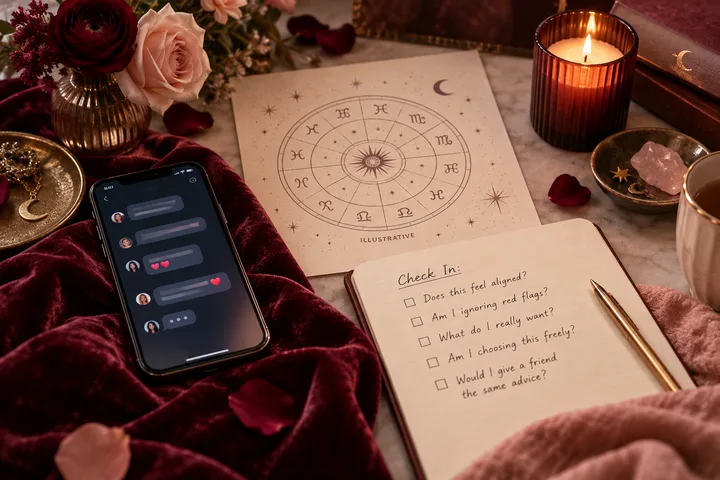
Use a dating clarity check to decide your next step, not whether he is destined for you. Name the caution you’re minimizing, ask for one clear, low-pressure action, and compare his response and follow-through with what he said. Frequent messages can feel intimate while leaving his availability, intentions, and everyday compatibility unknown. Consider synastry as a reflective layer after you record observable behavior. If someone you haven’t met asks for money or gifts, don’t send them.
What is the clarity check meant to decide?
A dating clarity check should decide what you do next, not whether this man is destined for you. Keep your pace. Name one thing that makes you cautious, ask for one clear step that could help answer it, and compare his response with what he said he would do. His attention may be welcome. It may make you feel hopeful, wanted, or eager to know him better. Those feelings matter because they are yours. They still don't settle what remains unknown about him. That distinction gives the check its purpose. You aren't trying to catch him out, prove that your worry is right, or talk yourself into being more trusting. You're choosing how much time, access, and emotional energy to offer while you learn. Perhaps the next choice is whether to have a short call, make a plan to meet in public, ask what he means by a relationship, or simply keep talking at the current pace. The right question is smaller than “Is he right for me?” It is “What would help me make my next choice with more clarity?” To answer that, keep two simple ledgers. The first holds observations: what he said, what he did, when he did it, and what happened next. The second holds your response and your interpretation: how the exchange felt, what you hope it means, what you fear it means, and what astrological symbolism brings to mind. Both ledgers deserve attention. They just answer different questions. An observation is specific enough that you could describe it without claiming to know his motive. “He sent several messages last night” is an observation. “He is deeply committed because he messages so often” is an interpretation. “He has not said whether he wants a relationship” names an open question. Keeping those statements apart doesn't make your feelings less real. It gives each feeling room without asking it to carry facts it can't provide. The same care applies to caution. “I feel uneasy” is important information about your experience. It can be a reason to pause and look more closely. By itself, it doesn't tell you exactly what he intends or what will happen. Try to name the moment that brought the unease: perhaps he changed a plan without explaining, asked you to trust him before answering a straightforward question, or moved the conversation faster than feels comfortable. Then ask what you know, what you inferred, and what you still need to ask. This is a working note, not a scorecard. You don't need to award points for each message or turn a single awkward exchange into a verdict about his character. You need enough detail to make a decision you can revise. If he answers your question and follows through, you can choose another small step while continuing to notice how the connection feels. If he can't offer what you need, you can slow down or decide not to continue without proving that he is a bad person. If his response brings new pressure, you can protect your boundary rather than keep negotiating with your own discomfort. Astrology can have a place in the second ledger. It may help you reflect on the kind of closeness you want, the tensions you notice, or the questions you want to bring into a conversation. Those meanings can be rich and worth exploring. They don't replace the first ledger's account of what has actually happened between you. A symbolic reading is not a substitute for asking whether he is available, whether your expectations align, or whether he respects the pace you have named. Keep the layers distinct, and each can be useful in its proper place. Start with one line: “The caution I keep explaining away is…” Finish it in your own words. Then write one next step you control, one question that step may help answer, and the evidence you will look for afterward. You don't have to resolve the relationship before you are ready. For now, the check only needs to help you decide whether the next step feels clear, proportionate, and yours to choose.
Why can messages feel like more evidence than they are?
Online messages carry real information about how he communicates, but text alone leaves identity, everyday behavior and follow-through only partly visible. Because the available cues are curated and mostly verbal, a vivid exchange can feel complete before the relationship has been tested in ordinary life. The messages show one part of it. When a man remembers a detail, asks a thoughtful question or checks in after a hard day, you have learned something: he noticed, responded and chose to make contact. Your enjoyment is real. The leap comes when those moments stand for qualities they haven't shown. A warm message can feel like steadiness. A long conversation can feel like emotional availability. A quick reply can seem to promise that he will make room for you in his actual week. Those meanings may prove right, but the message itself cannot establish them. A useful way to understand the gap is to notice how much work you do with the cues that remain. In the 2006 qualitative study “Managing Impressions Online: Self-Presentation Processes in the Online Dating Environment,” researchers interviewed 34 active users of a dating site. Participants described paying close attention to small details, including spelling, message timing and length, while also shaping their own profiles and messages with an eye to how they might be read. The study shows how people make judgments from limited material. It does not show that those judgments are always wrong, or that online daters as a group are dishonest. Its interviews took place in 2003 among volunteers in California, in an earlier dating-site setting, so they explain a process rather than measure how common any behavior is today. That process is easy to recognize. If he sends thoughtful messages late at night, you might read the care in the words and the hour as a sign of closeness. You might also wonder whether his attention fits only into the part of the day when nobody else can see it. Neither reading is proved by the timestamp. It is a cue worth placing beside other evidence: whether he makes plans, communicates when they change and shows up in ways that fit what he has told you. Online communication can also give both people room to choose their words. The 2006 study describes asynchronous, mostly verbal communication as more open to control and self-editing than face-to-face interaction. A pause before replying may mean he is busy, or that he is choosing what to say. A carefully written confession may be sincere and still show only what he chose to disclose in that moment. Control isn't the same thing as deception. It can help someone express a side of himself that feels difficult to voice in person; it can also leave you without the less planned cues that come with sharing ordinary time. The authors describe participants balancing a wish to appear desirable with a wish to be authentic. Those motives can sit together. A newer profile study makes that point in a different way. In “Who Did I Swipe On? Accuracy and Self-Presentation in Online Dating,” 180 online daters submitted profiles, personality descriptions and the impressions they hoped to make; 196 judges rated the profiles. The abstract reports that targets wanted to be seen both accurately and positively, and could convey the personas they wanted to present. This was a profile-judgment task, not a study of conversations or relationship outcomes. It doesn't show that profiles are lies; it shows that impressions reflect chosen presentation as well as what viewers infer. That distinction matters when you like what you see. Wanting to make a good impression is ordinary. So is hoping the other person will understand the best, truest parts of you. The problem is asking a short exchange to answer questions it can't settle. Messages can show humor, curiosity, conversational ease and a willingness to keep talking. They reveal less about how he handles an inconvenient plan, whether he has space for the kind of relationship you want, or whether his conduct matches his promises over time. High-volume contact can make the missing moments harder to notice. A steady stream of messages gives the day a rhythm: a morning hello, a midday joke, a late-night exchange. You may begin to feel that he is woven into your life before you have made a plan together or seen how the connection works outside the chat. Repetition and personal disclosure can make an exchange meaningful. But contact and shared life aren't the same measure. One can grow while the other remains unknown. So keep the evidence proportional. A kind message shows he sent one. Several thoughtful conversations show that you can talk with ease so far. They are not yet proof of a stable intention, practical availability or compatibility in daily life. Enjoy the attention, but leave room for what you don't know. Ask what the messages have shown and what ordinary action would help you learn more.
Sources: Managing Impressions Online: Self-Presentation Processes in the Online Dating Environment; Who Did I Swipe On? Accuracy and Self-Presentation in Online Dating
How do you separate emotional momentum from relational progress?
Track whether words turn into shared, workable actions: a plan made, a change communicated, a boundary respected, a commitment clarified. Message volume and intimate disclosure can make you feel close, but they leave a question open: what have the two of you managed to do together? Look for movement from contact to coordination, then mutual adjustment and follow-through over time. This sequence is an editorial guide, not a validated measure of compatibility. It helps you notice when the feeling of progress has outrun the evidence you have.
A lively exchange can be real and incomplete at once. You can value his thoughtfulness, but intimacy in conversation doesn't yet tell you whether your schedules fit or how you handle a difference together. An unmade plan doesn't prove bad intent. A clarity check asks what you know and what remains to be learned.
The 2006 study “Self-Presentation in Online Personals” offers a useful distinction. Its national random sample included 349 Match.com members; the survey measured self-reported experience and perceived success. The researchers separated strategic success, a participant's sense of how well they could pursue their dating goals, from self-presentation success, the sense that they could make a favorable impression. Feeling effective at presenting yourself doesn't establish that two people have built a workable relationship. The study did not measure whether a particular connection would become reliable or compatible.
The findings also complicate any claim that sharing more is simply good or bad. Greater amount and intent of disclosure were associated with higher perceived strategic success; amount, intent and positive tone were associated with higher perceived self-presentation success. These are participants' reported associations, not an experiment showing disclosure causes closeness or that an expressive man is performing. He can sincerely share while you are both still learning who you are together. Notice what happens when you make a plan, adjust it, or state a limit.
The study found that anticipating future face-to-face interaction was positively related to online self-disclosure. People may share online while expecting to meet offline. This doesn't mean a date verifies character; a call or meeting simply lets you learn how conversation and coordination work beyond the message thread.
One more finding cautions against using duration as proof. In “Self-Presentation in Online Personals,” total time participants had spent using dating sites had no significant relationship to either type of perceived success. That concerns months of site use, not the days you've messaged one man. Count information gained, not only hours passed or affection expressed.
Consider two versions of the same week. In both, you exchange affectionate messages each day and share personal details. In the first, he says he wants to see you, but no time is chosen. When your caution surfaces, you soothe yourself with the warmth of his words. You may enjoy the contact, yet you haven't learned whether you can make a feasible plan. Keep your investment where it is and ask for one concrete next step.
In the second version, the messages are just as frequent. You suggest a short call or public coffee, and he offers a workable time. A conflict comes up, one of you explains and suggests another option, and the other adjusts too. The plan happens, or a change is communicated and the replacement follows. Now you know more about coordination, flexibility and follow-through. It isn't proof of lasting compatibility. It's a real, limited step in getting to know him.
This comparison doesn't reward one dating style. Work, distance, health, caregiving and comfort can shape what's feasible. Ask whether he communicates his limits, whether an alternative exists, and whether the pattern fits what you need. A respectful no may reveal a mismatch in timing or availability. That can matter even when no one has acted cruelly.
Use four steps to keep your footing: contact, concrete coordination, mutual adjustment, repeated follow-through. Coordination shows whether interest becomes a shared plan; adjustment shows how you handle different needs; repeated follow-through helps distinguish one good moment from a pattern. Don't score the steps or treat one delay as a verdict. Notice what each stage adds.
A promise can remain unfulfilled without becoming a lie. If he cancels, notice whether he explains and helps make another plan. If you state a boundary, see whether he respects it. One exchange won't reveal his whole character; repeated behavior is more informative. Avoid investing more than the connection has earned so far.
When you reread an affectionate message to decide whether things are progressing, ask what new fact the week gave you. Did you make and keep a plan? Did a change get handled with care? Did each person have room to say what worked? If not, that doesn't erase the pleasure of the conversation. It tells you what you don't know yet. Choose one proportionate next step and let the next shared action add evidence before you raise the stakes.

Sources: Self-Presentation in Online Personals: The Role of Anticipated Future Interaction, Self-Disclosure, and Perceived Success in Internet Dating; Self-Presentation in Online Personals: The Role of Anticipated Future Interaction, Self-Disclosure, and Perceived Success in Internet Dating
What does your own caution need you to ask?
Turn the caution you keep minimizing into one specific question about your next decision. Start with what made you pause. Then separate what happened from the meaning you gave it, and ask what small, ordinary step could answer the missing question without asking you to abandon your pace. The check should help you choose what to do next, not force you to prove or dismiss your unease. Write down his exact words, or describe the action as plainly as you can. “He said he wants something serious” is a fact about what he said. “He is ready to build a relationship with me” is a conclusion that still needs evidence. “He only messages after midnight” records a pattern if it has happened more than once; “he is hiding me” assigns a motive. Keep those sentences apart. One is observable; the other may be true, but you don't know yet. This distinction matters in online dating because people work with partial cues. In “Managing Impressions Online: Self-Presentation Processes in the Online Dating Environment,” interviews with 34 active online daters explored how participants shaped profiles, judged credibility and read small signals in others’ presentations. The study describes a tension between presenting an appealing self and seeming authentic. Its small, volunteer sample comes from an earlier dating-site era, so it cannot tell you how often current app users mislead one another. It does show why limited details can carry more meaning than they prove. A polished profile, quick reply or confession is still one piece of information. Now write the story you are tempted to add. Perhaps you think his vague answer about exclusivity means he wants the benefits of a relationship without choosing one. Perhaps you read repeated late-night messages as proof that he has no room for you in daylight. A postponed meeting may leave you wondering whether he is avoiding you. These concerns deserve attention. But each leaves a fact unknown: what exclusivity means to him, whether he can make plans at another time, or whether he will offer a new date and follow through. Don't fill the gap with either the most hopeful or painful explanation. Then write the smallest fair request that would help you decide. You might say, “When you say you want something serious, what does that look like for you right now?” Or, “I enjoy talking with you. Late-night messages don't give me a sense of how we'd date in everyday life. Would you like to plan a coffee this weekend?” If he postponed, you can ask, “No problem that Tuesday didn't work. Are you free another day this week?” Each request is direct. None demands a promise about the future; each lets him answer while keeping your needs in view. Your intuition belongs in the check, but it has a particular job. Treat unease as a signal to slow down and look closer, not as a verdict about his character. It may be responding to something real in his conduct; it may also be shaped by an old hurt or by uncertainty itself. Protect your time while you consider it. Name the trigger and choose a step that gives you more information while preserving your boundary. Keep a second ledger for what the interaction means to you: excitement, hope, attraction, fear, and the kind of connection you want. If astrology is part of how you understand the bond, let that reflection live here too. Those meanings matter. They help you ask what affection, desire, steadiness or emotional safety mean to you. But they don't turn a guess about his motives into a fact. Ask instead: what did he do when I asked clearly, and what happened next? After the request, record his response and the follow-through separately. A warm answer followed by a concrete plan is different from a warm answer that leaves everything vague. A respectful no may reveal that your needs or schedules don't fit; it doesn't prove bad intent. If he needs time or offers another option, decide whether that pace suits you. If he mocks the question, pushes past your limit or repeatedly avoids an answer, reduce contact or stop. One exchange is information; a pattern gives you more to weigh. Your caution doesn't need a courtroom case. It needs a clear question and an answer you can observe. Ask for the next ordinary step, keep your pace, and let his response add evidence before you invest more. Stay open to being pleasantly surprised without handing over the decision. The point is not to eliminate uncertainty before dating; it's to avoid letting attention make the choice for you.
Sources: Managing Impressions Online: Self-Presentation Processes in the Online Dating Environment
What changes when the connection moves beyond text?
A call, video conversation or public meeting adds different cues and a chance to see whether plans become real. It can update your impression; it cannot guarantee honesty, safety or long-term compatibility. Choose the next step that feels both useful and comfortable. Text lets you notice how he expresses himself and whether he responds to what you say. A voice call adds tone and the give-and-take of live conversation. Video adds a visual, present-time exchange. Meeting in a public place lets you experience how the two of you share space and handle the ordinary details of a plan. Each step gives you something new to consider. None gives you everything.
That distinction matters because online dating often begins in one medium and may move into another. The study titled “Self-Presentation in Online Personals: The Role of Anticipated Future Interaction, Self-Disclosure, and Perceived Success in Internet Dating” surveyed a national random sample of 349 Match.com members. It found a positive relationship between participants’ anticipation of future face-to-face interaction and online self-disclosure. The researchers studied what people reported about disclosure and perceived success in online dating. They did not test whether a call or meeting verifies someone’s identity, predicts safety, or proves that a lasting relationship will follow. The sample also came from one dating service in 2003, so it cannot stand in for every current app or every woman’s experience.
The useful point is narrower: when a meeting is a real possibility, online communication can be part of a path toward meeting, rather than the whole relationship. A thoughtful message may tell you that he can write a thoughtful message. It doesn’t yet show how he listens when you speak, whether he can make a workable plan, or how he responds when your preference differs from his. A move beyond text can help answer one of those open questions. That’s a reason to consider it, not a reason to hurry.
You can choose the format that fits the question you want answered. If you wonder whether conversation feels mutual, a short phone or video call may give you a first impression of the live exchange. If you want to know whether he will make and keep a simple plan, suggest a brief public date at a time that works for you. If you would rather speak once before meeting, say so. These are practical choices, not a ladder everyone must climb in the same order. Your comfort and circumstances matter; a call is useful only if you want one, and a public meeting is useful only if you feel ready for it.
Pay attention to what each step can show. In a live conversation, notice whether there is room for both of you to speak, whether he responds to the point you made, and whether you feel able to be yourself. These impressions are yours; one conversation can’t establish how he will act over time. During planning, notice whether he helps find a feasible time and place, communicates a change, and respects the limits you have stated. A public date lets you see more of how an interaction feels in person, but it still tells you about that meeting, not the whole future. Treat every new cue as one part of a developing picture.
Keep safety and choice in the plan. If you decide to meet, choose a public place, arrange your own way there and back, tell someone you trust where you’ll be, and keep the freedom to leave. You can share only the personal information you’re comfortable sharing. These steps preserve your options; they don’t accuse him of anything. A video call may feel like a useful earlier step, but it is not proof of identity or a promise of safety. You’re allowed to take precautions without turning them into a verdict about his character.
A delay needs context. He may have work, care responsibilities, distance, a disability-related access need, or another practical constraint. You can ask what kind of contact works and offer an alternative that still meets your needs. Then consider his response and what happens afterward. A respectful explanation paired with a concrete alternative gives you different information from a vague postponement that repeats while he keeps asking for trust. Even then, you don’t have to prove bad intent to decide that the pace or format doesn’t work for you. A mismatch can be enough.
Keep the question small. You’re not asking a call to tell you whether he is right for you forever. You’re asking whether this next interaction feels comfortable, whether he can meet you in it, and whether his actions match the plan you both made. If the answer is encouraging, you can take one more step and keep noticing. If it’s mixed, pause or ask a clear follow-up. If you don’t want to continue, you can stop. The connection has moved beyond text only if you choose to move it; your caution still belongs in the conversation.

Sources: Self-Presentation in Online Personals: The Role of Anticipated Future Interaction, Self-Disclosure, and Perceived Success in Internet Dating; Self-Presentation in Online Personals: The Role of Anticipated Future Interaction, Self-Disclosure, and Perceived Success in Internet Dating
What does his response to a boundary actually tell you?
A boundary gives you information about how he handles your stated terms in that moment. Respect, curiosity or a workable alternative can support another small step; ridicule, retaliation, repeated pushing or coercion supports stepping back. One response is an observation, and a repeated pattern carries more weight. Start with the condition itself. A useful boundary says what you are and aren't willing to do, in words he can understand. “I’d like to keep our plans in public places while we get to know each other.” “I’m not ready to share my home address.” “I can talk tonight, but I can’t stay on the phone for hours.” Then look at three parts of his response: what he says, how he says it, and what he does afterward. The content may be a yes, a no, an alternative, or an evasion. A no can be disappointing and still be clear. An alternative may show that he heard the need and is trying to find a workable way forward. Evasion leaves the question open. If he changes the subject, answers with a joke, or gives you affection instead of a reply, you can bring the request back once. The manner matters because a boundary is also a moment of contact between two people with different preferences. Respect can sound simple: “That works for me,” or “I can’t do that, but I could meet for coffee Saturday.” Look for whether he leaves you free to choose. Pressure has a different shape. He may mock your concern, call you difficult, make affection conditional, keep asking after you've answered, or treat your no as an opening offer. A boundary names a real condition you need. If he dislikes it, that is his right; if he keeps pressing, you can end the conversation or contact. Follow-up is where the answer becomes more useful. Does he keep the plan you agreed on? If something changes, does he tell you and offer another time, or leave you waiting while expecting you to remain available? If you say you want to move more slowly, does the pace change in practice? A thoughtful response in one conversation matters. Repeated conduct gives you a fuller basis for deciding whether this arrangement works for you. Consider a short call before meeting. He might prefer a video call, explain that evenings are difficult, and suggest two other times. That is a difference in preference with room to coordinate. He might say he understands, agree to Saturday, then cancel and propose a new public time with notice. Or he might dismiss the request, insist that you prove you trust him, and keep asking for your address. Those responses don't carry the same meaning just because each began with a conversation about a boundary. A respectful no deserves its own place in the picture. If you ask for a regular weekly call and he says he can't offer that, he may be telling you something important about his availability. He isn't automatically cruel or dishonest. But you still get to conclude that the connection can't offer the consistency you want. One awkward answer doesn't always reveal a pattern. He may misunderstand what you meant, react defensively, or need a moment to think. You can clarify once if you feel safe and want to: “I’m not asking you to promise anything. I’m saying I’m not comfortable with that yet.” Then notice whether he can hear the distinction. If the exchange feels threatening, you don't owe another conversation. You can keep the record plain. Write down the request, his answer, and what happened next. Separate those observations from your interpretation: “He suggested a public café” is an observation; “he will always respect me” is a prediction. So is “he hesitated, therefore he must be hiding something.” The facts may support continuing one step, pausing to ask a question, or ending contact. In astrological reflection, a chart may help you name how you experience closeness, desire, communication, or limits. It cannot change what he said or make an evasive answer clear. Keep the two readings side by side: what the boundary response shows about fit now, and what your chart reflection helps you understand about your needs. Your next choice belongs to you. If his answer respects your terms and his actions follow it, you may choose another small step. If the pattern leaves no room for your terms, you may step back without proving that he is a bad man.
When does caution call for a hard stop?
A request for money or gifts from someone you have not met is a hard financial boundary. The Federal Trade Commission's guide, “What To Know About Romance Scams,” describes a pattern in which someone builds trust through frequent contact, says they cannot meet in person, invents an urgent need, and asks for money. That combination deserves a different response from ordinary uncertainty about a new connection. You don't need to prove what he intends before you protect your money. Don't send funds to settle the story, pay a fee, or make a visit possible. If you suspect a romance scam, the FTC advises you to stop communicating, talk with someone you trust, and report the suspected scam. Chemistry, affectionate language, and a compelling explanation don't change the financial boundary.
The order matters. First comes attention: he may message several times a day and make the connection feel close. Then comes a reason he cannot meet, perhaps a distant job or travel. Next, a sudden problem needs money now. The FTC lists examples including medical expenses, a plane ticket, a visa, or fees to get out of trouble. It also warns about requests to invest in cryptocurrency. Scammers may direct payment through a wire transfer, a money-transfer app, gift cards, or cryptocurrency because those methods can make money hard to recover. Urgency is part of the pressure: you may feel that paying is the only way to keep the relationship or prevent harm. Pause there. A story can be emotionally vivid and still not make sending money a safe choice.
Notice what makes this sequence more than a disappointing dating exchange. Each part serves the same demand: trust him, accept that an ordinary meeting cannot happen, then solve an urgent problem with your money. The FTC says scammers adapt their stories to what they think will work, so the details may change. One person may speak of a medical emergency; another may describe travel costs or a visa. The variation doesn't make the request safer. You don't have to investigate whether the job, illness, or travel story is real before deciding not to pay. Nor should you send a small amount to see what happens next. A hard boundary works because it removes the financial decision from the emotional bargaining: no transfer, no gift card code, no investment, and no payment to unlock a promised visit.
Keep the rule narrow and clear. A man postponing a date is not, by itself, proof of fraud. Plans can change, and a credible alternative gives you something ordinary to assess: does he propose another time, communicate plainly, and accept your pace without asking you to finance the meeting? A late reply, a move to another messaging service, or intense attention alone also doesn't establish a scam. The concern becomes a hard stop when the request for money or gifts appears, especially alongside repeated excuses for not meeting, an urgent story, or pressure to pay in a particular way. Those details fit the pattern the FTC describes; they do not give you a reason to test him with more money or private information. You can end the exchange without debating the story or announcing a challenge. Safety doesn't require a courtroom standard of proof. The form of payment matters too: a request for a gift card code or cryptocurrency is still a request to move value, even if he calls it temporary help or an investment you can share. Judge the action, not the tenderness of its framing.
If money has already gone out, act quickly. The FTC says to contact the bank or company that handled the payment right away, explain that you paid a scammer, and ask whether they can return it. That applies to a gift card, wire transfer, credit or debit card, and cryptocurrency, though a request for help cannot guarantee recovery. Report the suspected scam at ReportFraud.ftc.gov and notify the dating app or social site where you met. If you feel shaken, tell someone you trust; the FTC specifically recommends bringing friends or family into the picture. Don't let embarrassment delay those steps. The next conversation isn't with him. It's with the payment provider, the platform, or a trusted person who can help you act.
This is the exception to the slower clarity check. In other uncertain moments, a reasonable question or a small plan may show you whether the two of you can communicate and follow through. A money request from a person you haven't met calls for protection, not another compatibility observation. Astrology, attraction, and the hope that his next message will explain everything cannot make payment prudent. You can still honor the feelings the connection brought up while choosing not to send money, gifts, account details, or payment codes. The boundary is about the action in front of you; it doesn't require you to label every online suitor a scammer. When the financial ask comes, stop contact and seek practical help. Don't negotiate your caution away.

What can synastry add after you have written down the facts?
That distinction gives astrology a useful place in a dating clarity check. First, write down what has happened: what he said, what he did, how he responded to your request, and what remains unknown. Then ask what the connection brings up in you. Are you feeling welcomed, hurried, understood, unsettled, or eager to make his attention mean more than it has shown? Astrology.com’s “What Is a Synastry Chart? Birth Chart Compatibility” describes synastry as comparing two or more birth charts, often by layering them in a bi-wheel. It discusses planetary placements, houses and aspects as ways astrologers interpret how two people may affect one another. That gives you a symbolic language for examining the bond. A helpful way to use that language is to turn each symbol into a question you can carry back to the relationship. The Moon can invite reflection on emotional comfort: what helps you feel safe enough to be yourself, and does the pace between you leave room for that? Venus can open a conversation about affection, values and what each of you enjoys giving or receiving. Rather than asking whether you have the “right” Venus contact, ask whether his way of showing interest feels generous to you, and whether your own way of receiving care is clear to him. Mars can bring desire, initiative and the way each person pursues what they want into focus. If the connection feels fast or charged, use that theme to ask whether the pace is exciting by mutual choice or difficult to slow down. The chart cannot answer that on its own. His response when you ask for a slower pace is the useful observation. Mercury offers another reflective lens: how do you each speak, listen, make plans and handle a misunderstanding? But compatibility in communication also shows up in ordinary exchanges. Can you ask a direct question without having to decode every pause? Can he tell you when a plan changes? Can both of you repair a small misunderstanding without turning it into a contest? Let Mercury suggest what to notice; let the actual conversations supply the answer. Saturn can focus attention on responsibility, boundaries, time and what a relationship asks each person to carry. Astrology.com describes Saturn contacts as part of how astrologers consider challenge and commitment themes. In your own reflection, ask whether promises are matched by patience and dependable effort. Notice whether he honors the pace you set, keeps a plan, and takes responsibility when he cannot. These planetary themes are prompts, not a checklist of required placements. A chart may help you name a tension you already sense, such as one person wanting more spontaneity while the other needs plans, or one person showing affection through words while the other looks for practical care. The useful next move is to make that difference speakable: “I like hearing from you, and I also feel more comfortable when we make a plan and follow through. How does that work for you?” And the order matters. If you begin with an appealing interpretation, it can be tempting to bend every behavior to fit the promise you hope the chart contains. If you begin with the facts, astrology can deepen your understanding without taking your judgment away. A sweet contact cannot make repeated cancellations feel like consistency. A tense one need not make a respectful difference in style seem doomed. In this tradition, ease and challenge both deserve thoughtful reading, but neither should be used to excuse pressure or to invent devotion where his conduct has not shown it. You also need the right birth information for a specific synastry reading. A date, time and place are inputs used to establish chart placements, and missing or uncertain details can limit which parts of a comparison can be considered. No such information is supplied here, so this is a general interpretive framework, not a reading of your chart or his. So write two short notes. In one, list the observable facts and the question still open. In the other, name what the connection awakens in you and which astrological themes help you understand that response. Then choose one conversation that joins the two: “I’m enjoying this, and I want to understand how we each approach pace and follow-through. Would you be open to making a plan for this week?” Synastry can make the question richer. His reply, his respect for your terms, and his next actions remain the evidence you use to decide whether to invest another step.
Sources: What Is a Synastry Chart? Birth Chart Compatibility
How do you choose the right next level of investment?
Imagine Maria. A man she met online sends affectionate messages throughout the day. He remembers small details, says he feels close to her, and talks as if trust should arrive quickly. She likes hearing from him, yet the pace makes her hesitate. What changes her decision is what happens when she makes one ordinary request. In the first version, Maria says she would like to keep getting to know him, but she wants to move slowly. He responds warmly, offers a time that works, and confirms the plan. This doesn't prove he is safe in every circumstance or a lasting match. It does give her more than messages alone: he heard her request, made a feasible plan and followed through. Maria can choose one further step. She need not reward one decent response with instant trust. Repetition shows whether consideration is part of how he relates. If she still feels uneasy, she can wait or ask another question. The check should inform her caution, not overrule it. Now keep the messages, the unease and Maria’s request exactly the same. In the second version, he says he does not want a call or a public date, gives no alternative, and insists she should trust him because they have already shared so much. He may have a real reason, dislike calls, have an access need, or want a different kind of dating. A refusal alone doesn't reveal his character, and a scheduling problem isn't proof of manipulation. He can explain a constraint without asking her to abandon her terms. If he declines any step and keeps pressing for trust, she has learned that this connection cannot presently offer the pace she needs. She can leave without accusing him. Their timing or desired connection may differ. He need not be a bad man to be the wrong person to invest in now. Maria does not have to establish a harmful motive before she is allowed to say no. Compatibility includes whether two people can build a relationship in a way that leaves both free to choose. When one person treats a clear limit as an obstacle to defeat, the other can protect her time and attention even if the full explanation remains unknown. The third version changes the stakes. After the same stream of affectionate messages and Maria’s same request to meet, he describes an urgent crisis and asks her to send money or buy a gift card. She has not met him. Here, the relevant question is no longer whether his texting style signals interest or whether she should give him another chance to explain. The Federal Trade Commission’s “What To Know About Romance Scams” describes a pattern that can include frequent contact, excuses for not meeting, an urgent story and a request for money. Its guidance draws a clear financial boundary: do not send money or gifts to a sweetheart you have not met in person. This is fraud guidance, not a label for every man who postpones a date. A delay, platform change or frequent messaging alone doesn't establish a scam. The urgent request for money is different. Maria should not transfer funds to relieve pressure or prove that she cares. If she has already paid, the FTC advises contacting the bank or payment service promptly and reporting the suspected scam. A vivid story and a strong bond do not make a payment safer. This is a point for protection, not a test to see how the man reacts to one more boundary. These versions show why attention cannot carry the whole decision. The same messages can precede a workable plan, a genuine mismatch, or financial pressure. Messages are evidence, but they don't decide the next step. Online dating research also gives a reason to keep impressions in proportion. Her comparison must stay with the behavior she can observe. Astrology can deepen reflection on the bond Maria experiences, but it does not change the evidence in these three versions. Astrology.com’s “What Is a Synastry Chart? Birth Chart Compatibility” describes synastry as a comparison of two birth charts, where astrologers read planetary contacts for relationship themes. That tradition can help Maria ask what kind of closeness feels nourishing, how she understands desire and pacing, or what responsibility means to her. It cannot make a financial demand prudent, turn pressure into care, or show that a plan will be kept. She should keep the symbolic reading beside her feelings and questions, while she makes the practical choice from his words, actions and follow-through. A useful way to weigh the next step is an editorial decision aid, not a validated scale: words, action, repair, repetition. Words tell Maria what he says he wants. Action shows whether he can take a mutually workable step. Repetition shows whether respect holds across more than one convenient moment. Each layer adds information, but none predicts the future. One missed plan may have a good reason; a charming promise may remain only a promise. Past hurt can make caution louder, especially when a new connection resembles an old one. Maria may be wary because someone else once rushed her, vanished, or treated her limits as negotiable. Her history deserves care, but it needn't decide what this man is like. A steady response over time may earn more room. But the possibility that an old experience colors her reaction does not erase present pressure, and she need not stay to prove she is open-hearted. So Maria’s next level of investment follows the new evidence, not the intensity of the inbox. With a feasible plan and respectful follow-through, she can continue slowly and keep observing. With an ordinary mismatch, she can decline without assigning blame. With an urgent request for money or coercive pressure, she should step away from the demand and protect herself. One interaction needn't give him a permanent label. The question is whether the next exchange leaves her better informed, freer to choose and able to keep her pace. Attention neither convicts nor acquits him. His conduct gives her the next piece of the answer.

Sources: What To Know About Romance Scams | Consumer Advice; Managing Impressions Online: Self-Presentation Processes in the Online Dating Environment; What Is a Synastry Chart? Birth Chart Compatibility
What is the next question to ask him?
Ask for one concrete step that answers the caution you named. You might say, “I enjoy talking with you. I want to keep getting to know you at a pace that feels comfortable. Are you open to a short call or a public coffee this week?” You’re not asking him to prove his character; you’re finding out whether you can make one plan that respects your pace.
Before you send it, write down the concern, the facts you have, and the question still open. Notice his answer and what follows. A workable plan followed by follow-through supports one next step, not a promise about the future. If he can’t meet this week but offers another clear time, you can decide whether that works for you. If he evades the question, pressures you to move faster, or treats your boundary with contempt, pause or stop. And if he asks for money or gifts before you’ve met, the FTC’s “What To Know About Romance Scams” advises against sending them; don’t turn that request into another compatibility question.
Choose among three responses: continue one step at a time, pause and clarify, or end contact. Let the evidence set the pace. The Dating Clarity Report can organize six observations about consistency, intentions, and boundaries, and a practical conversation. It can help you prepare your own questions; it doesn’t calculate synastry or reveal his private intentions. You don’t have to solve the relationship tonight. Ask the question, keep your boundary, and decide what his answer and next action earn.
A little more clarity
Does frequent messaging mean he is serious about me?
Frequent messages show that he is choosing to contact you. They don’t establish his availability, intentions, or follow-through. Notice whether conversation leads to a workable plan, respectful adjustment, and actions that match his words.
Should I meet him in person to know whether he is right for me?
A call or public meeting can add new cues and show how you coordinate, but neither guarantees honesty or long-term compatibility. Choose a next step that feels useful and comfortable, and keep control of your pace and plans.
What if he says no to my boundary?
A clear, respectful no may reveal a difference in availability or needs without proving bad intent. Consider what he says, how he responds, and what follows. You can decide the connection doesn’t fit without labeling him a bad person.
Can synastry tell me whether he intends to commit?
Synastry offers an astrological language for reflecting on relational themes and needs. It cannot establish his private intentions. Consider it after writing down what he has said and done, and ask him directly what commitment means to him now.
Sources & further reading
- What To Know About Romance Scams | Consumer Advice
Supports the narrow financial boundary and describes scam patterns that can combine frequent contact, excuses for not meeting, urgency, and requests for money or gifts.
- Managing Impressions Online: Self-Presentation Processes in the Online Dating Environment
Interviews with 34 active online daters describe how people shape self-presentation and interpret cues such as message timing, length, and wording; the small historical sample supports a mechanism, not a current prevalence estimate.
- Self-Presentation in Online Personals: The Role of Anticipated Future Interaction, Self-Disclosure, and Perceived Success in Internet Dating
The publisher abstract reports a national random sample of 349 Match.com members and associations between anticipated face-to-face interaction, disclosure, and perceived success; outcomes were self-reported rather than actual relationship quality.
- Self-Presentation in Online Personals: The Role of Anticipated Future Interaction, Self-Disclosure, and Perceived Success in Internet Dating
Accessible study text distinguishes perceived presentation and strategic success from actual outcomes, and reports no significant relationship between total time on dating sites and either perceived success type.
- Who Did I Swipe On? Accuracy and Self-Presentation in Online Dating
The abstract reports a profile-judgment study with 180 targets and 196 judges in which targets sought to be seen positively and accurately and conveyed desired personas; it does not address extended messaging or relationship outcomes.
- What Is a Synastry Chart? Birth Chart Compatibility
Describes synastry as comparing birth charts and discusses planetary placements, aspects, and houses as interpretive ways to consider relationship themes; it supplies no personal chart reading or evidence of a particular man's intentions.
Dating Clarity Report
Six observations about the man you are dating. A clear view of the patterns, plus a conversation for your next decision.
Get my dating clarity report