
Yes, you can build a real relationship with a man whose health needs shape the pace, plans, or intimacy. Don't judge the diagnosis. Judge the partnership around it. Does he explain what support he needs? Does he follow a care plan and keep other support in place? Can he hear your limits without calling you selfish? Astrology can help you name the pattern. Moon and Saturn contacts may describe care, duty, and emotional weight. Mercury speaks to how you discuss changing needs. The seventh house shows the partnership you are being asked to build. None of that excuses poor behavior. Start with one honest conversation, then watch whether his actions make room for your life too.
His health is part of the relationship, but it cannot become the whole relationship
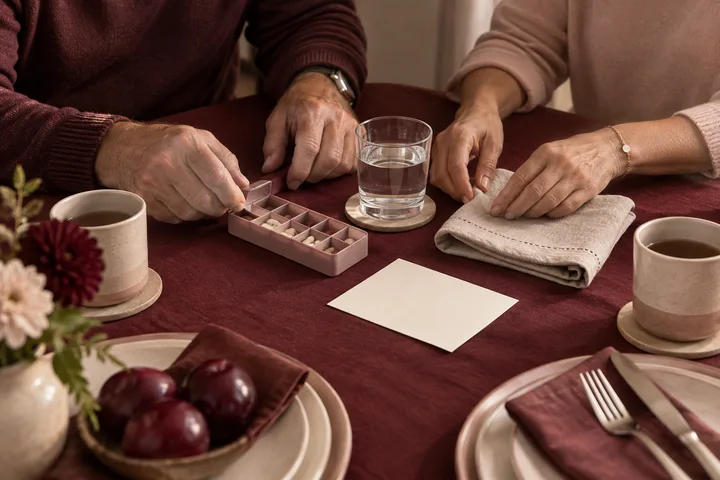
A health need can change a relationship quickly. A date may need to happen at home. A trip may need more planning. Sex may need a slower pace, a different form, or a conversation neither of you expected to have so soon. He may tire easily, miss work, manage pain, take medication, attend appointments, or need help during a flare. None of this makes him less desirable. It does make the relationship more specific.
That distinction matters. You are not deciding whether a man deserves love because he is ill, disabled, recovering, or living with a condition that changes from week to week. You are deciding whether the relationship he can offer fits the life you want to live. Those are different questions. The first asks you to judge his worth. The second asks you to protect your future.
The strongest sign is not that he stays cheerful. Some days he will not. The strongest sign is that he takes responsibility for the effect his needs have on the shared life. He tells you what he knows. He tells you what he does not know. He updates the plan when his health changes. He does not make you discover the truth through cancelled dates, unpaid bills, silence, or a crisis that could have been discussed earlier.
Consistency doesn't mean identical energy every day. It means the same basic respect across different days. On a good day, he doesn't promise a future his body cannot sustain just to keep you interested. On a hard day, he doesn't make you prove your love through exhaustion. He keeps the thread between you. That thread may be a message, a rescheduled plan, an honest update, or a simple thank-you. Small reliability matters because it tells you what will happen when the stakes rise.
A serious condition can put pressure on everything couples usually treat as romantic background. Time, money, sex, transport, household work, family obligations, privacy, and future plans all come forward. Johns Hopkins describes this plainly in its guidance on relationships after a Parkinson's diagnosis: illness affects the relationship, not only the person who has the diagnosis, and it can change responsibilities, finances, intimacy, and shared pleasures. That does not predict your relationship. It tells you where the real conversation belongs.
So ask yourself a clean question. If his health stayed roughly as it is for the next two years, would the relationship still contain affection, desire, laughter, rest, and room for your ambitions? If the answer is no, don't punish yourself for knowing it. If the answer is yes, don't rush past the practical work that would make it possible. A loving answer needs a livable shape. You need room to be loved, not only room to be useful. That is the beginning of fairness.
This also protects him from being reduced to a diagnosis. When you ask about the actual shape of his days, you meet the person rather than the label. What does he enjoy? What makes him feel capable? What kind of affection does he want? What does he never want a partner to assume? A man can have serious needs and a rich identity at the same time. Your relationship should be able to hold both.
Keep the next step small. Ask about the next month before you ask yourself to imagine ten years. A man who can discuss a real adjustment is giving you better information than a man who offers a grand promise.
Sources: Steps for Creating and Maintaining a Care Plan, CDC; Healthy Habits: Caring for Yourself When Caring for Another, CDC; Your Relationship: Staying Strong Despite a Diagnosis of Parkinson's Disease, Johns Hopkins Medicine
Watch how he carries responsibility before you offer more care
A man can need help and still be responsible for his life. Those facts belong together. The question is not whether he can do every task alone. The question is whether he participates in solving the problem, or whether he quietly transfers the problem to you.
Look for ownership in small moments. Does he arrange his appointments, refill prescriptions, track the limits that matter to him, and tell you when a plan may be too much? Does he know who else he can call? If he cannot do those things right now, can he explain why and name the support he is building? You are looking for a pattern of engagement, not a perfect performance.
Then watch consistency. He may cancel because his body changed. That is not the same as cancelling because he never planned with reality in mind. A considerate man gives notice when he can, suggests another plan, and stays connected after the disappointment. He does not use the condition as a blanket excuse for every broken promise. He also does not pretend nothing is wrong until you are standing in the fallout.
Ask what he expects from a partner. The answer may be modest: patience when symptoms interrupt a date, flexibility around energy, help with transport once in a while, or a willingness to learn how he communicates during a flare. It may be large: daily hands-on care, financial rescue, moving in, managing family conflict, or giving up work. Neither answer is automatically wrong. The wrong answer is the one he hides until you are already attached.
Healthy relationships need more than good intentions. The CDC recommends a care plan that keeps conditions, treatments, care needs, provider contacts, and emergency information organized, and it stresses that caregivers need breaks and support of their own. You don't need to turn a new romance into a medical file. You do need to notice whether he has any structure around the reality he is asking you to enter. If all structure begins with you, the relationship is already assigning you a job.
Ask about privacy too. His health belongs to him, but a shared life still needs enough information for shared decisions. You don't need every clinical detail. You do need to know what affects plans, sex, travel, money, safety, and your own consent. Privacy should protect dignity, not force you to accept risks you weren't given enough information to judge.
Sources: Steps for Creating and Maintaining a Care Plan, CDC; Healthy Habits: Caring for Yourself When Caring for Another, CDC
What synastry can show about care, pressure, and partnership
Astrology gives you a way to look at the emotional weather between two people. It does not decide whether a diagnosis makes a relationship possible. For a real synastry reading, you need both people's birth dates, exact birth times when available, and birth places. The astrologer then compares the two natal charts, studies inter-chart aspects and house overlays, and identifies the relationship themes that repeat. Without those inputs, no one can honestly claim that you have a particular Moon, Saturn, or seventh-house contact.
That scope protects the reading from becoming a story pasted over the facts. The Astrodienst Astrowiki describes synastry as a comparison of two horoscopes, including aspects between planets and the houses activated by one person's planets in the other's chart. It also makes a useful point for this question: each natal chart should be understood on its own before the comparison begins, and maturity cannot be read from a horoscope. That last part belongs in your decision. You must watch the man in front of you.
Moon contacts are the first place I would look for the felt experience of care. The Moon speaks to safety, habit, comfort, and the body's changing rhythms. A strong Moon connection can make tenderness feel instinctive. It can also make one partner absorb the other's moods so quickly that care becomes worry, monitoring, or overprotection. Ask whether the emotional bond helps both people settle, or whether it pulls you into constant alertness.
Saturn adds duty, time, limits, endurance, and the weight of reality. In a health-shaped relationship, Saturn can describe the work of building a dependable structure around difficult circumstances. It can also feel like the relationship has turned into an obligation before affection has had room to grow. A Saturn contact isn't a sentence. It is a question about how each of you handles responsibility. Do you become steadier together, or does one person become the authority and the other the dependent?
Mercury matters because care fails when people cannot speak plainly. Look at how the charts connect around communication, then test that symbolism in life. Can you ask for details without being punished for asking? Can he say I don't know? Can the two of you change a plan without turning the change into a character attack? Venus and Mars matter too. A relationship can be kind and still need desire. It can be sexually alive and still need tenderness. Health may alter the form of intimacy, but it does not remove the need for mutual pleasure and choice.
The seventh house and its ruler help frame the partnership you are making, while the sixth-house symbolism can bring daily maintenance, routines, service, and health into view. These are interpretive lenses, not labels for a man. Use them to ask better questions: What kind of work does partnership require here? What counts as devotion? Where could service become resentment? The Astrology Podcast's discussion of synastry makes the same practical turn. Saturn appears often in lasting relationships because lasting relationships require people to work on what is difficult, but the purpose is to understand the dynamic and make it easier to live, not to hunt for a destined match.
That distinction matters when health enters the picture. A hard aspect may describe the place where you feel pressed, tested, or made serious. A harmonious aspect may show where care flows more naturally. Neither one tells you who should give more. The chart becomes useful when it reveals the question beneath the reaction. If his need activates your Saturn, are you becoming dependable or controlling? If your Moon is touched, are you offering comfort or trying to regulate his body? If Mercury is strained, are you asking for clarity or waiting for him to read your fear?
Read the whole pattern. A single placement cannot carry the meaning of a relationship, and a striking aspect cannot cancel the natal condition of either person. Look for repeated themes across the Moon, Mercury, Venus, Mars, Saturn, the seventh-house ruler, and the houses that receive the other person's planets. Then bring the interpretation back to a sentence you can use in life: We need a clearer plan when symptoms change. I need affection that isn't only caretaking. You need to tell me before a crisis, when you can. That is astrology doing useful work.
Let the symbolism sharpen your awareness, then bring it back to a lived question. You are not required to perform a planet for another person. He is not required to become your wound, your project, or your proof that you can endure anything.
Sources: Synastry: The Astrology of Relationships, Episode 165 transcript; Synastry, Astrodienst Astrowiki; Partner Horoscope, Astrodienst; Predicting for Relationships, Astrodienst
Use three conversations to test whether care can stay mutual
The best compatibility test is not a dramatic promise. It is a series of clear conversations followed by ordinary evidence. Have them before you merge homes, money, schedules, or medical responsibility. You are not interrogating him. You are finding out what kind of life the relationship would ask you to build.
First, talk about the next difficult day. Ask what a flare, relapse, treatment cycle, panic episode, or low-energy week usually looks like. What can he still do? What becomes impossible? How much warning does he get? What helps, and what makes things worse? Then ask the question that protects your agency: If this happens while we have plans, what will you handle, and what would you ask me to handle? A good answer includes limits. It does not require him to know everything. It does require him to think with you.
Second, talk about the support system. Who knows what is happening? Who can drive, cook, listen, stay overnight, or help with paperwork? What professional or community support exists? Is he willing to use it? A relationship becomes dangerous to your energy when the sick partner has a wide circle of resources but decides the romantic partner should be the only one who proves love. Care can be intimate without being exclusive.
Third, talk about your life. Don't ask only what he needs. Say what you need. You may need a quiet morning, uninterrupted work, travel, children, time with friends, sex that isn't organized around illness, or the freedom to leave your phone unanswered for an evening. Ask how he imagines making room for those things. If he responds with curiosity, you have something to work with. If he treats your needs as a betrayal of his, believe the pattern early.
Set one small experiment. Try a weekend plan with two versions: the original plan and the lower-energy plan. Decide how you will communicate if his condition changes. Decide how you will communicate if your capacity changes. Then see what happens. Does he participate? Does he remember the agreement? Does he punish you for using the backup plan? Does the experiment leave you feeling closer and more informed, or tense and responsible for every detail? Compatibility appears in the adjustment, not the fantasy of never needing one.
Keep one boundary in plain language. I can help with a ride sometimes, but I can't be your only transport. I can listen tonight, but I can't manage your treatment. I want to be your partner, not your full-time carer. I can be flexible about plans, but I need notice when you can give it. A boundary is not a threat. It is information about the conditions under which you can stay generous without disappearing. ACOG describes healthy boundaries in the same direct spirit: you decide what you will and won't do, you tell the other person, and a healthy partner respects the limit rather than making you feel bad for having it.
Pay attention to his first response, not only the answer he gives after a long debate. Respect may sound like, I hadn't understood that limit, let me think about another plan. Pressure may sound like, If you loved me, you wouldn't need one. A title, an emergency contact, or a promise of permanent access should never smuggle in a duty you didn't choose.
A first experiment should stay reversible. Try a month of planned check-ins or one trip with a rest day. Small agreements show the shape of a larger life.
Sources: Your Relationship: Staying Strong Despite a Diagnosis of Parkinson's Disease, Johns Hopkins Medicine; Healthy Habits: Caring for Yourself When Caring for Another, CDC; Synastry, Astrodienst Astrowiki; Healthy Relationships, ACOG
Imagine Maria: the same health need can create two different relationships
Imagine Maria is dating Daniel. He lives with a condition that sometimes leaves him exhausted and sometimes lets him move through a full week normally. At first, the uncertainty feels romantic in a strange way. They learn to improvise. They eat at home when he is tired. They take a walk when he has more energy. Maria tells herself that love means staying flexible.
In the first version of the story, Daniel tells her when he has a medical appointment and what the next few days may involve. He doesn't make promises his body cannot keep. When he cancels, he apologizes for the change without apologizing for existing, and he offers a new plan when he has enough information. He has a friend who can drive him, a family member who understands the condition, and a clinician he trusts. He asks Maria what support feels good to her. He wants her close, but he doesn't make her responsible for his stability.
Maria still has hard feelings. She sometimes mourns the ease she imagined. She sometimes wants to be cared for instead of being the flexible one. Daniel can hear that. He doesn't call her cold. They protect a part of the relationship that has nothing to do with symptoms. They flirt. They see friends. They argue about ordinary things. Their bond contains illness, but illness has not taken every room.
In the second version, Daniel avoids the subject until a plan collapses. Then he says Maria should have known. He asks her to drive him, but resents her questions about timing. He tells her she is the only person who understands, while refusing other forms of support. When she says she needs a night alone, he says she is abandoning him. He uses a bad week to excuse a pattern of disappearing, and he uses her compassion to keep the relationship vague.
The diagnosis did not create the difference. The structure did. In the first version, care moves in both directions. Daniel remains an adult participant in his life, and Maria remains a woman with a life of her own. In the second, the relationship quietly turns her into a resource. She may love him deeply and still need to leave. That is not a failure of devotion. It is a recognition that love cannot flourish where one person's needs erase the other's personhood.
Astrologically, a synastry reading might help Maria notice why the bond feels so binding, why she becomes protective, or why his limits activate her fear of being needed only for what she can provide. It might point to Moon-Saturn tenderness, a sixth-house emphasis, or a Mercury pattern that makes practical conversations especially charged. But the reading must return her to the same ground: what happens after the conversation? Does he change the plan? Does she feel freer to tell the truth? A chart can name a pattern. Only lived behavior can show whether the pattern is workable.
Maria's experience shows why you shouldn't confuse being needed with being chosen. Daniel chooses her when he makes room for her desire, asks about her work, remembers plans that matter to her, and lets her say no without making the bond disappear. She chooses him when she offers care freely, not when fear tells her that leaving would make her cruel. Both people remain visible.

Sources: Synastry: The Astrology of Relationships, Episode 165 transcript; Synastry, Astrodienst Astrowiki; Partner Horoscope, Astrodienst
The strongest exception is a crisis, but a crisis still needs a plan
There is an important exception to every neat dating rule. Sometimes a man has just received a diagnosis. Sometimes he has no stable treatment yet. Sometimes a sudden injury, mental health crisis, or worsening condition leaves him with less capacity than he had last month. You may not get a tidy support system or a confident answer on the first conversation. Don't demand a finished care plan from someone still standing in the shock of change.
But compassion during a crisis does not mean signing an invisible contract. You can offer one defined act of help and ask what happens next. You can say, I can come with you to this appointment, but I can't become the person who manages everything. You can give the relationship time without giving away your home, savings, work, or health. The question becomes whether he uses the temporary support to build a wider structure or lets the temporary arrangement become the permanent one.
This is where pace matters. Don't make a forever decision from one intense week. Don't make a forever promise because the crisis made you feel essential. Let the relationship pass through a few ordinary cycles. Watch how he behaves when symptoms improve. Watch how he behaves when they worsen again. Watch whether gratitude lasts, whether anger is repaired, and whether your limits remain allowed when he is afraid.
You also need a line you will not cross. If he threatens you, controls your movement, uses medical needs to demand constant access, refuses consent, humiliates you, or makes you responsible for preventing every bad outcome, this is not a compatibility puzzle. Step back and seek support. His health may explain distress. It does not turn coercion into care. You are allowed to protect yourself without proving that you understand his pain.
For the relationship itself, rank the evidence in this order: safety and respect; his ownership of care; his honesty when plans change; his ability to make room for your needs, pleasure, and future; then the astrological pattern that helps you understand the bond. The chart belongs in the conversation. It doesn't outrank your experience.
The decision is not Is he good enough to love? The decision is Can we make a relationship where his health is real, my needs are real, and neither of us has to pretend? If the answer is beginning to be yes, choose one conversation and one small agreement. If the answer keeps becoming no, listen before attachment turns your clarity into guilt.
If you want an astrological next step, bring the actual question to a Dating Clarity Report. Don't ask for a soulmate verdict or a promise that the relationship will last. Ask for the pattern you need to work with: where care becomes pressure, how each person handles limits, what supports mutual desire, and which conversation should happen next. The value is not in outsourcing your choice. It is in seeing the choice clearly enough to make it yourself.
Before that conversation, write three sentences. I am willing to offer this. I am not willing to offer this. I need to know this before I invest further. Keep them concrete. Then listen to his answer and watch what follows. A man whose health changes the relationship can still be a devoted, sensual, accountable partner. He can also be a man whose needs exceed what you can give. Both truths can be real. Your job is not to make either one less true. Your job is to choose the life you can live with an open heart.
If the terms change, ask whether you're still choosing freely, sharing the work, and loving each other as whole people.
Sources: Steps for Creating and Maintaining a Care Plan, CDC; Healthy Habits: Caring for Yourself When Caring for Another, CDC; Your Relationship: Staying Strong Despite a Diagnosis of Parkinson's Disease, Johns Hopkins Medicine; Synastry, Astrodienst Astrowiki
A little more clarity
Can astrology tell me whether I should date a man with a chronic illness?
Astrology can help you study the relationship's patterns around care, duty, communication, intimacy, and shared limits, but it cannot make the decision for you. A real synastry reading requires both birth charts, ideally with exact birth times and places, and it should be read alongside each person's natal chart. The practical answer comes from his behavior: whether he takes responsibility, builds support, respects your boundaries, and makes room for your life. Use the chart to form better questions. Then test those questions in conversation and over time.
How do I avoid becoming my partner's caregiver?
Name the role before the relationship quietly assigns it to you. Ask what help he expects, what he already handles, who else can help, and what happens when you are unavailable. Offer specific support instead of unlimited access. For example, you may help with one ride or listen for twenty minutes, but you may not manage treatment, provide all transport, or give up your work and rest. Revisit the agreement when his health changes. A caring partner may need help, but he can still respect your limits and take part in building a wider care plan.
Sources & further reading
- Synastry: The Astrology of Relationships, Episode 165 transcript
Supports the interpretive use of synastry for relationship dynamics, communication, Saturn, and long-term effort.
- Synastry, Astrodienst Astrowiki
Supports comparing two natal charts, aspects, house overlays, Saturn contacts, and reading natal charts first.
- Partner Horoscope, Astrodienst
Supports a nuanced reading of Saturn in partnership as endurance, reality, responsibility, and possible restriction.
- Predicting for Relationships, Astrodienst
Supports examining the natal seventh house, its ruler, independence, compromise, and Saturn in relationship interpretation.
- Steps for Creating and Maintaining a Care Plan, CDC
Supports discussing care needs, treatments, contacts, emergency planning, privacy, and shared caregiving structure.
- Healthy Habits: Caring for Yourself When Caring for Another, CDC
Supports the need for caregiver breaks, outside help, respite, and protection of the caregiver's own wellbeing.
- Your Relationship: Staying Strong Despite a Diagnosis of Parkinson's Disease, Johns Hopkins Medicine
Supports separating the illness from the relationship, protecting intimacy, sharing care, and acknowledging changed responsibilities.
- Healthy Relationships, ACOG
Supports direct boundary-setting, mutual respect, sexual boundaries, and the right to decide what you will do.
Dating Clarity Report
Six observations about the man you are dating. A clear view of the patterns, plus a conversation for your next decision.
Get my dating clarity report