
Imagine Maria Says No and Watches the Room Change
Imagine Maria is three months into dating a man she likes. The evening has been warm. They have eaten together, talked about family, and kissed on her sofa. He wants sex. She doesn’t. She says, plainly, “No, not tonight.”
He stops. He asks whether she wants company or space. When she says she still wants to see him, he makes tea, changes the subject, and leaves when she asks him to. The next day, he texts as usual. No sulking. No scorekeeping. No little punishment hidden inside a joke.
Now imagine a different reaction. He says she has led him on. He turns cold. He asks what is wrong with him, then asks her to prove she wants him. Perhaps he leaves and returns at midnight with a dramatic apology. Or perhaps he agrees out loud but keeps touching her, bargaining, and waiting for her to give in.
The scene is fictional, but the question is real. What does his reaction tell you about future intimacy? It tells you whether he can hold his desire without making it your burden. That is the first answer, and it is the one you should trust before you study any chart.
Notice what Maria does not do. She does not reward his restraint with immediate sex. She does not promise that the next time will be different. She does not call his acceptance proof that he is secretly her perfect match. She simply lets one respectful moment become one piece of information. Trust grows by accumulation.
That is the rhythm you want in your own dating life. A boundary appears. He meets it. The relationship continues without a hidden bill arriving later. Then another boundary appears, because real life keeps asking for adjustments. A man who can meet those moments with steadiness is showing you something far more useful than a polished declaration of intent.
A small no can also reveal how he handles a change of plan. You may have wanted intimacy earlier and changed your mind. You may have flirted, invited him over, or kissed him, then decided to stop. He doesn’t need to understand every turn in your desire before he respects it. Your answer is enough.
Astrology gives language to the pattern. Mars shows how a person moves toward what he wants. Saturn shows how he handles limits, time, restraint, and consequence. The Moon describes the felt experience of safety and vulnerability. Mercury shows what happens when two people must talk through a charged moment. Read those layers together. Chemistry alone won’t protect your peace.
The point is not to inspect him for a flawless performance. It is to notice the direction of the relationship. Does each honest boundary make the next one safer, or does each boundary teach you to prepare for fallout? That movement is the real forecast.
The Question Under His Reaction Is Not Whether He Wants You
A man can want you intensely and still be a poor partner for intimacy. Attraction answers one question: is there desire? It doesn’t answer the harder one: can he let desire meet your freedom?
This distinction matters because many women are trained to treat male disappointment as a crisis. You say no, then rush to soften it. You explain your exhaustion. You offer another night. You reassure him that you still find him attractive. You start managing his feelings before you have checked your own.
Stop there. His disappointment belongs to him. Your boundary belongs to you. A mature man can feel frustrated and remain kind. He can want more and accept less. He can ask one honest question, hear the answer, and change course without making you pay for the answer later.
In relationship astrology, this is where a seductive reading can go wrong. Strong Venus-Mars contact may describe heat, and a powerful Mars contact may describe pursuit, sexual charge, or conflict. It doesn’t promise tenderness. Cafe Astrology’s synastry guide treats Mars as desire, sexual expression, assertion, and instinct, while also warning that difficult Mars contacts can bring arguments and battles of will. The aspect describes the energy. Your conduct gives it a home.
So ask a better question than “Does he want me?” Ask, “What does he do when my answer interrupts what he wants?” That question moves you from fantasy to evidence. It also brings the chart back to its proper place. Astrology can reveal the kind of pressure a connection may carry. It cannot make coercion romantic.
This also keeps you from over-reading a single warm night. A man may be attentive when he expects intimacy to follow. The deeper measure comes when your answer disappoints him, costs him time, or changes the plan. Does his care survive the loss of access? If it does, you’re seeing character in motion.
The question underneath the question is about mutuality. Can both people influence the pace? Can your need alter the evening without making you feel guilty for having one? Future intimacy needs that give and take. Without it, the chart may show fascination, but the relationship will keep asking you to surrender ground.
A man’s reaction to your no tells you more about future intimacy than his chemistry with you does. A respectful response shows that desire can live beside restraint. He may be disappointed, but he stays present, listens, and lets your answer stand. A punishing response points to a harder pattern: he treats access to you as something he should be able to negotiate, win, or take. In synastry, read this moment through Mars for desire and assertion, Saturn for limits and responsibility, the Moon for emotional safety, and Mercury for the conversation that follows. A personal synastry reading uses both people’s birth dates, birth times when available, and birthplaces to examine planetary contacts and house placements. The practical answer comes first, though. Watch what he does after you say no. That is where intimacy either becomes safer or starts to cost you too much. A single moment can open the question, but the pattern supplies the answer. Look at the next invitation, the next disagreement, and the next time you change your mind. If respect remains, trust has somewhere to grow. If pressure returns, the relationship has already told you what it will ask you to tolerate. Notice the details that follow: whether he asks before touching you, whether he keeps plans without using affection as payment, and whether he can hear a preference without turning it into a verdict on his worth. These details may look small. They are the daily grammar of a lasting intimate bond.
Sources: Synastry: Love and Relationship Astrology; Synastry: Moon-Mars Aspects
Mars Shows the Reach, Not the Right to Take
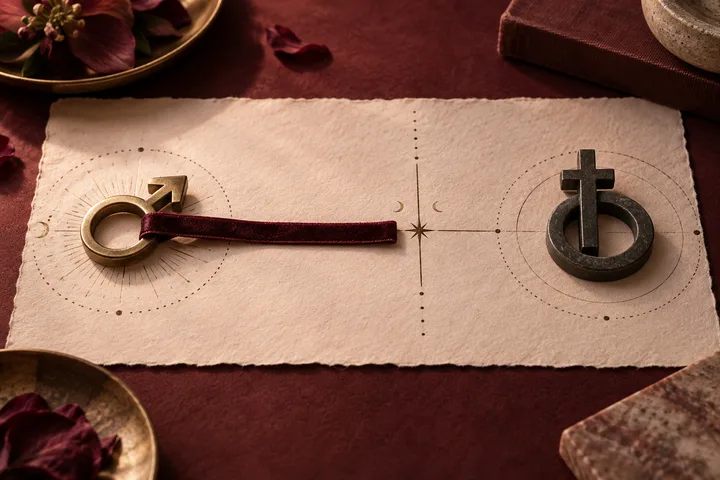
Mars is the first planet to consider because the moment has heat in it. Someone wants. Someone pauses. Someone acts. Mars describes the impulse that reaches across the space between two people, and the style of that reach can be direct, playful, urgent, strategic, or combative.
A well-held Mars can hear a limit and redirect its energy. It may say, “Okay. I wanted you, but I hear you.” Then it finds another way to stay connected, or it gives the evening back to you. The desire remains real. It simply stops treating desire as an instruction.
An unworked Mars presses. It asks again and again. It turns a no into a puzzle. It jokes until the boundary feels embarrassing. It invokes how much effort he made, how long it has been, or how certain he was that you wanted him. The words vary. The movement is the same. He keeps trying to move you instead of moving himself.
Cafe Astrology describes Mars-Moon contacts as potentially sexy and volatile, with emotionalism and domestic arguments becoming stronger when the aspects are difficult. That doesn’t mean a Mars-Moon connection makes a man unsafe. It means the contact can make instinct and feeling collide quickly. If he has the maturity to pause, the same intensity can become honesty and repair. If he doesn’t, every intimate disagreement may feel like a fight for control.
Don’t use Mars to excuse him. Use it to name the pattern. Is his pursuit alive but flexible? Or does it become forceful when you stop feeding it? The first can grow into passionate intimacy. The second will make your body brace before your mind has found the words. Believe that information.
You can often see this Mars pattern outside sex. Does he interrupt when you disagree? Does he turn a small preference into a contest? Does he admire your independence until it inconveniences him? Desire and aggression are not identical, but they use the same question here: can he act with force without acting against you?
A strong Mars person may need a clean answer because ambiguity frustrates him. That is workable when clarity helps him respect the line. It becomes dangerous when he treats your clarity as a challenge. The difference is visible in the next ten seconds. He either adjusts, or he begins a campaign.
You can appreciate his attraction without becoming responsible for satisfying it. That separation protects both of you. He gets to own his wanting. You get to own your willingness. When those two freedoms meet, physical intimacy can become more honest because neither person has to pretend.
Sources: Synastry: Love and Relationship Astrology; Synastry: Moon-Mars Aspects
Saturn Tells You Whether the Boundary Can Hold
Saturn is the planet of the line. It defines what must wait, what carries weight, and what a person is willing to practice over time. In synastry, Saturn can bind two people through responsibility and endurance, but it can also feel cold, restrictive, or punishing when fear takes over.
That makes Saturn essential when you study a reaction to no. A healthy Saturn response sounds ordinary. “Thanks for telling me.” “I don’t want you to feel pressured.” “We can slow down.” There is no performance in it. He accepts the limit because he understands that trust needs structure.
An unhealthy Saturn response often arrives disguised as seriousness. He says you are immature. He acts as if your boundary has damaged the relationship. He withdraws warmth until you reconsider. Or he makes you feel that access to affection depends on being more agreeable next time.
Cafe Astrology’s Moon-Saturn interpretation describes a bond that can offer constancy and dependability while also making the Moon person censor needs, fear disapproval, or feel blocked from emotional intimacy. That tension gives you a useful test. Does his steadiness help you speak more freely, or does his judgment teach you to become smaller?
Astrology.com likewise places Saturn beside structure, duty, responsibility, and endurance in synastry. That is the promise of Saturn at its best. A future relationship needs someone who can carry a limit without turning it into a private injury. If he cannot do that now, don’t assume commitment will magically make him gentler. Commitment increases the number of boundaries a relationship must hold.
Saturn also asks whether a man can wait. Waiting is not a dead space between what he wants and what he gets. It is a choice to let another person arrive freely. Watch whether he uses time to build trust or to create pressure. The patient man stays engaged without demanding a date for your eventual yes.
There is a difference between disappointment and punishment. Disappointment says, “I hoped for more.” Punishment says, “You should suffer because you refused me.” The first is human. The second turns intimacy into pressure. Saturn helps you name that distinction because it makes consequences visible: a boundary either creates respect or triggers control.
Sources: Synastry: Moon-Saturn Aspects; What’s Your Sign? An Intro to Synastry Charts and Astrological Compatibility
The Moon Records What Your Body Learns
The Moon is not only about whether you feel loved. It is about what your nervous system learns in the relationship. Can you relax? Can you disappoint him and remain welcome? Can you bring a changing need into the room without first preparing a defense?
When a man accepts your no with care, the Moon receives a quiet message: honesty doesn’t cost connection. You may still feel shy. You may still worry about being misunderstood. But each respectful response gives the relationship a deeper floor.
When he punishes your no, the Moon learns another message: keep him pleased if you want to stay safe. You start predicting his moods. You choose the easy answer. You offer intimacy to prevent distance rather than because your own desire is present. That is not closeness. It is self-abandonment wearing perfume.
In synastry, Moon contacts describe how emotional needs meet instinct, affection, communication, and responsibility. Astrology.com presents the Moon as the inner world, the needs that soothe us, and the place where we process emotion. Cafe Astrology’s Moon-Mars material also emphasizes the spontaneous, instinctive quality of that contact. Together, these teachings explain why one charged moment can reveal so much about the felt texture of a connection.
Check your body after the conversation. Do you feel more settled, even if the answer was awkward? Or do you feel compelled to repair his mood? The chart may show why a bond has a strong emotional pull. Your body shows whether the bond is giving you room to remain a full person inside it.
You don’t have to make your body into an oracle. Just notice the plain facts. Are you breathing normally? Do you want to see him again because you feel drawn to him, or because distance feels dangerous? Do you feel free to change your mind tomorrow? Emotional safety often announces itself through these small permissions.
A tender connection won’t eliminate every awkward feeling. You may still feel guilty because you care about him. You may still fear that a slower pace will cost you the relationship. The question is what happens when you tell the truth about that fear. A safe man makes room for the truth instead of exploiting it.
The Moon remembers whether you had to perform comfort for him. If every boundary ends with you hugging him, explaining yourself, or promising to make it up to him, the emotional work is already uneven. You may call that tenderness because you are good at soothing. Ask whether he soothes you, too.
If you find yourself rehearsing a no in advance, take that seriously. You may simply want to communicate well. Or you may already know that his feelings become your job when you disappoint him. The difference is easier to see after you speak. Does he make the next boundary easier, or harder?

Sources: Synastry: Moon-Mars Aspects; Synastry: Moon-Saturn Aspects; What’s Your Sign? An Intro to Synastry Charts and Astrological Compatibility
Mercury Shows What Happens the Morning After
The reaction in the moment matters. The conversation after it matters just as much. A man can freeze because he is embarrassed, then return with a real apology. Another man can sound calm at first, then punish you through days of distance. Mercury helps you read the story between those moments.
Look for a conversation with a beginning, a middle, and an end. He names what happened without rewriting it. He asks what would help you feel comfortable. He tells you what he felt without making his feeling your fault. Then he changes his behavior when the same situation comes around again.
A weak conversation circles the words while avoiding the point. He debates whether your no was clear enough. He focuses on the exact tone you used. He says he respects boundaries in general but thought you meant something else. You leave the talk knowing more about his defense than about his capacity for repair.
Cafe Astrology’s Mercury-in-synastry guidance says Mercury cross-aspects can stimulate conversation, while difficult contacts can produce interruptions, arguments, misread meanings, and exhaustion over who said what. It also makes a sharper point: easy communication can create the promise of understanding without reaching emotional or sexual understanding. That is why a charming discussion is not enough. Watch whether words become changed conduct.
Try one direct sentence: “When I say no, I need you to stop asking and stay warm with me.” Then be quiet. His answer will tell you whether he hears a request, a criticism, or an opening for another negotiation. The next move is his.
Good repair is not a speech contest. You don’t need him to use perfect language, and he doesn’t need to produce a grand confession. You need him to understand the event accurately, care about its effect on you, and make the next encounter easier. Simple words followed by steady conduct beat a beautiful apology every time.
If Mercury in the synastry is tense, the two of you may need extra care with timing and phrasing. That can explain why a conversation takes work. It cannot explain why only one person is expected to do the work. Communication becomes intimate when both people are willing to be changed by what they hear.
Ask yourself whether the talk creates clarity or fog. After a healthy conversation, you may still disagree, but you know what each person means and what will happen next. After an unhealthy one, you feel oddly responsible for a problem you didn’t create. You are still explaining the first sentence while he has moved the argument to your entire personality.
Mercury can be quick, clever, and persuasive. That makes it especially important to watch the outcome. A man may know exactly what to say about respect. The real question is whether those words govern his hands, his invitations, his tone, and his behavior when he hears an answer he dislikes.
You can make the conversation easier by describing the future, not litigating the past. Say what you need next time. “Ask once, accept my answer, and don’t punish me afterward.” If he wants to build with you, that sentence gives him something clear to practice. If he wants to win, he will argue with the premise.
Sources: Love, Relationship Astrology: Mercury in Synastry; Synastry: Love and Relationship Astrology
Read the Same Chart Differently When the Behavior Changes
Astrological symbolism becomes useful when you stop treating an aspect as a verdict. The same Mars-Saturn contact can describe discipline and dependable desire, or frustration, inhibition, criticism, and control. The difference is not a loophole in the chart. It is how the people carry the energy.
Consider three versions of the same intimate moment. In the first, he hears no, feels disappointed, and says he understands. He checks in the next day. Here, a charged Mars pattern may have a Saturn container. Desire meets restraint. The bond can deepen because both people remain present.
In the second, he hears no, goes quiet, and returns with an apology that changes nothing. He is sorry that you felt pressured, but he still argues that you caused the misunderstanding. The promise is weaker. Saturn has become a wall, and Mercury keeps repainting it.
In the third, he hears no and keeps going. He touches you after you ask him to stop, blocks the doorway, threatens to leave, or makes you afraid of his reaction. Don’t turn this into a synastry puzzle. Leave the situation if you can, contact someone you trust, and choose safety. No planet makes coercion a growth assignment.
This is the strongest exception to a chart-based reading: context can change a single response, but it cannot redeem a repeated pattern of pressure. He may be tired, ashamed, inexperienced, or frightened of rejection. Those facts can explain a poor first reaction. They do not require you to keep offering access while he learns. An explanation becomes meaningful only when it produces responsibility and change.
This is where many compatibility readings become too generous. They see a hard aspect and rush to call it a lesson. But a lesson is something both people can choose to learn. If he keeps making you pay for his lack of self-control, the lesson may belong to you: stop mistaking potential for partnership.
The good version is not bland. Respect does not remove passion. It lets passion stay alive without turning the room into a negotiation. A man can be hungry for you, visibly affected by you, and still take his hands off you when you ask. That combination is not less erotic. It is more trustworthy.
The three versions show why you should compare words with aftermath. In the first version, the next day confirms the respect. In the second, the apology fails because the same demand returns. In the third, there is no interpretive work left to do. His behavior has answered the question plainly.
This comparison also protects you from the romance of potential. You may see the man he could become if he healed, matured, or understood your needs. That man may exist one day. Your decision, however, concerns the man who is asking for your trust now. Give your investment to evidence, not a future version you must coach into being.

Sources: Mars Saturn Aspects in Synastry; Synastry: Love and Relationship Astrology
How to Use the Chart Without Handing It Your Decision
A personal synastry reading can add detail, but it should sharpen a question you are already living, not replace your judgment. The two birth dates, birth times when available, and birthplaces define the chart inputs and the level of detail the interpretation can support. Use the chart to name the pattern, then use his conduct to decide what the pattern means for you.
Use the symbolism as a set of questions. If his Mars touches your Moon, ask whether his pursuit leaves you more alive or more guarded. If Saturn contacts your Venus or Moon, ask whether his seriousness feels protective or withholding. If Mercury is under strain, ask whether the two of you can clarify a charged moment without turning the conversation into a trial. The aspect gives the theme. His conduct gives you the answer.
The signs show style, and the aspects show the kind of friction or ease the connection may carry. A flowing aspect can make cooperation easier. A square or opposition can demand practice. A conjunction can intensify the meeting of two planets. Cafe Astrology’s synastry overview treats these patterns as relationship energies to understand and work with, not as automatic verdicts. That is the useful middle ground: interpret the pattern, then test it in life.
You can make that test concrete. Write down what happened, what you said, how he responded, and what changed afterward. Give the behavior more weight than the explanation. A chart may help you name why the moment feels charged, but it cannot turn a repeated violation into a promising aspect. Nor does a warm aspect cancel a cold pattern.
Then ask three plain questions. Can I change my mind without losing warmth? Can I state a limit without defending my character? Does he adjust when I tell him the effect of his behavior? These questions translate Mars, Saturn, Moon, and Mercury into a dating decision. They also protect you from using astrology to argue against your own experience.
The strongest exception is a single clumsy reaction followed by real accountability. He may be embarrassed, disappointed, or inexperienced. If he listens, names the pressure accurately, apologizes without making you comfort him, and changes the next time, the moment can become information about growth. But the exception has a test. Change must arrive in his conduct, not only in his vocabulary.
If the reaction frightens you, corners you, or continues after you say stop, skip the interpretive work. Move toward safety and support. No birth time, house overlay, or difficult aspect outranks what your body and the situation are telling you. A reading can help you reflect on a relationship you choose to continue. It should never persuade you to remain where your freedom is being worn down.
Bring the chart back to the choice in front of you. What pace protects your peace? What does consistent respect look like this week? What will you do if the same pressure returns? Those answers make the astrology practical. They keep the meaning of the connection in your hands, where it belongs.
Here is a simple comparison to keep nearby. A respectful man may need a moment, but he gives your answer room, stays honest about his feelings, and makes the next invitation easier to refuse. A conflicted man may apologize and still need practice, so look for a visible change before you restore trust. A coercive man keeps treating your answer as unfinished business. Those are different relationship climates. Don’t collapse them into one chart phrase such as intense, karmic, or challenging. Name the climate you are actually living in, then choose the pace that lets you remain free inside it.
Sources: Synastry: Love and Relationship Astrology; What’s Your Sign? An Intro to Synastry Charts and Astrological Compatibility
The Answer Is in the Pattern You Can Live With
Return to Maria. She isn’t asking whether the man who accepted her no will always respond perfectly. She is asking whether she can invest without abandoning herself. That is a wiser question, and it has a practical answer.
If he accepts the boundary, stays warm, talks honestly, and changes when you give him feedback, keep observing the relationship at its current pace. Let trust earn the next step. You don’t owe him faster intimacy because he behaved well once. You’re allowed to notice the good and still move carefully.
If he apologizes but repeats the pressure, stop treating the apology as the main event. The pattern is the main event. You can say, “I’ve been clear about my boundary, and you keep pushing it. I’m stepping back from this relationship.” You don’t need a chart to authorize that decision.
If he scares you, corners you, touches you after you tell him to stop, threatens you, or retaliates when you refuse, prioritize distance and support. Tell a trusted person what happened. Use local resources if you need help leaving safely. Your future intimacy starts with your right to remain safe in the present.
So what does his reaction to a no tell you? It tells you whether his desire can share a room with your autonomy. Astrology can show the Mars, Saturn, Moon, and Mercury themes that make that lesson vivid. But your next step is wonderfully earthly. Say what you need once. Watch what he does next. Invest where your no remains welcome.
You are not looking for a man who never feels disappointed. You are looking for a man who knows what to do with disappointment. He can feel it, speak it, and carry it without placing it on your body. That is the foundation under every later promise about sex, commitment, family, and home.
Get your Dating Clarity Report when you want help sorting the pattern into six direct observations about his consistency, his intentions, your pace, and your boundaries. Bring the report back to the relationship you can see. Then ask the one question that matters: can I be honest here and still feel free?
A clear no is not a rejection of love. It is information about the pace at which love can become real. The man who understands that won’t need you to disguise your limits as affection. He will want the honest version of you, even when the honest version says not tonight, not yet, or not with you.
That is the intimacy worth choosing. It leaves room for desire, mystery, patience, laughter, and a changed mind. It gives both people a way to remain generous without becoming available on demand. When you look at synastry, look for the symbols that describe this work. When you look at him, look for the conduct that proves he is willing to do it. You can be deeply attracted and still say no. You can care about his feelings and still refuse to manage them. You can believe the connection has meaning and still decide that its current form isn’t good enough for your life. Those choices don’t weaken love. They protect the part of love that needs two free people to stay true.
Sources: Synastry: Love and Relationship Astrology; Synastry: Moon-Mars Aspects; Synastry: Moon-Saturn Aspects; Love, Relationship Astrology: Mercury in Synastry
A little more clarity
Does a man’s reaction to no predict whether he will be intimate with me later?
It gives you a strong clue about the conditions future intimacy will require. A respectful response suggests he can hold desire, disappointment, and your autonomy together. Pressure, sulking, bargaining, or retaliation suggests intimacy may become a way to manage his emotions instead of a mutual choice. In astrology, Mars describes desire and assertion, Saturn describes limits and responsibility, the Moon describes emotional safety, and Mercury describes repair. Read those symbols alongside his repeated behavior.
Which synastry aspects relate to boundaries and sexual pressure?
Start with Mars-Saturn and Moon-Mars contacts, then include Mercury and Venus. Mars-Saturn can describe the meeting of desire with restraint, discipline, frustration, or control. Moon-Mars can make instinct and feeling immediate, passionate, and sometimes volatile. Mercury shows whether the two of you can discuss a charged moment without turning it into a debate. Venus adds affection and values, but attraction alone never proves that a man will respect your limits.
Can a difficult Mars-Saturn aspect still support a lasting relationship?
Yes, when both people practice consideration, accountability, and restraint. A difficult aspect can create frustration and blockage, but it can also make the couple work consciously with timing, desire, and responsibility. The exception is repeated coercion or retaliation. No difficult aspect asks you to endure that. A lasting relationship needs safety first, then the patience to work with the chart’s tension.
What should I say after he reacts badly to my no?
Keep it short and clear: “When I say no, I need you to stop asking and stay respectful. If you keep pressuring me, I’ll leave.” Then watch whether he accepts the boundary and changes his conduct. You don’t need to persuade him that your no is reasonable. If he ignores the boundary, frightens you, or touches you after you ask him to stop, move toward safety and contact someone you trust. You can end the conversation without defending your character, your attraction, or your reasons. A boundary is not a debate prompt. It is the information he needs in order to choose respectful behavior. If he keeps debating, repeat yourself once and disengage. Your clarity does not depend on his agreement, and your safety matters more than a graceful ending.
Sources & further reading
- Synastry: Love and Relationship Astrology
Supports the interpretation of Mars, Saturn, aspects, attraction, conflict, and relationship structure in synastry.
- Synastry: Moon-Mars Aspects
Supports the reading of Moon-Mars contact as instinctive attraction, emotional reaction, and possible volatility.
- Synastry: Moon-Saturn Aspects
Supports the interpretation of emotional safety, dependence, constraint, constancy, and intimacy under Moon-Saturn contact.
- What’s Your Sign? An Intro to Synastry Charts and Astrological Compatibility
Supports the traditional meanings of the Moon, Venus, Mars, the Descendant, and Saturn in relationship astrology.
- Love, Relationship Astrology: Mercury in Synastry
Supports the interpretation of Mercury cross-aspects, miscommunication, emotional understanding, and repair through dialogue.
- Mars Saturn Aspects in Synastry
Supports the comparison of constructive and difficult Mars-Saturn patterns involving restraint, criticism, stability, and control.
Dating Clarity Report
Six observations about the man you are dating. A clear view of the patterns, plus a conversation for your next decision.
Get my dating clarity report