
The answer is no until your yes feels free
You’re staring at his message. He says he wants something to keep for himself. He says the chemistry is obvious. He says you can trust him. You like him, and the conversation has been warm, funny, and charged. Still, your hand pauses above the camera roll.
Listen to that pause.
You don’t need to share an intimate photo before you meet. In most new online connections, waiting is the stronger choice. You haven’t yet seen how he behaves in a room, how he handles disappointment, or whether the man in the messages matches the man behind the profile. You don’t know what kind of privacy he keeps, who has access to his devices, or whether he has a habit of collecting women’s attention and images rather than building a real relationship.
That doesn’t make sexual expression wrong. Adults can choose sexting. It can be playful, tender, and genuinely intimate. The choice belongs to you, though. eSafety describes intimate image sharing as healthy only when everyone agrees about how and when it happens, without pressure, and with clear permission around further sharing. Consent can also change. A yes to one photo isn’t a yes to a video call, a second photo, a screenshot, or anything offline. See the difference? Desire can be real while the timing is wrong.
The question isn’t, “Can I prove I’m attracted to him?” The question is, “Does sending this serve my desire, or am I trying to prevent his withdrawal?” Those are different motives. One comes from choice. The other comes from fear.
If you feel calm, excited, and fully free to stop, you may decide to share later. If you feel cornered, flattered into compliance, worried that he’ll disappear, or tired of defending yourself, don’t send it. A free yes has room around it. It doesn’t need a sales pitch.
Your first boundary can be plain: “I’m attracted to you, but I don’t share intimate photos before meeting in person.” You don’t have to add five reasons. You don’t have to soften it into a maybe. You’re giving him useful information about your pace. His response will give you useful information about his character.
A photo can also create a false sense of mutual exposure. He sends one, so you send one. He tells you a secret, so you tell him yours. That exchange may feel balanced, but it isn’t always equal. He may have a fake identity, an empty account, or a private goal you can’t see. Your image remains attached to your body and your life. His disclosure may be easy to discard.
Give yourself a waiting rule if you need one. No intimate images before a live video call. No intimate images before a first public date. No image when you’re lonely, drinking, exhausted, or afraid he’ll leave. Rules sound less romantic than instinct, but they protect instinct from a rushed moment. You can always choose differently later. You can’t make an image unseen once it leaves your phone.
Sources: Consent and sending nudes, eSafety Commissioner; Online dating safety, eSafety Commissioner; Image-Based Abuse: What To Know and Do, Federal Trade Commission
What is he asking for, and what has he earned?
A request for an intimate photo doesn’t reveal one fixed intention. Some men want flirtation. Some want reassurance. Some want a sexual exchange and have no interest in meeting. Some are testing how quickly they can move you past your own limits. You can’t read his motive from the request alone. You can read the pattern around it.
Look at what he has actually done. Has he shown his face live on a video call? Has he answered ordinary questions without getting vague? Has he made a specific plan to meet in a public place? Does he keep the plan, or does he keep the fantasy alive while postponing real contact? Has he learned anything about your life beyond what makes the conversation sexual? Does he offer the same vulnerability he asks from you, or does he demand proof while remaining hidden?
Astrology gives this pattern a useful language. Synastry compares two birth charts by placing one person’s planets against the other’s, then examining the aspects and houses activated between them. Astrodienst describes it as a way to see how two partners interact. The chart can show a strong pull. It can’t do the dating for you.
Think of the request as a threshold. Before it, he can enjoy your attention without carrying much risk. After it, you carry more. A private image may expose your identity, your body, your workplace, your home, or the people who could recognize you. Even a disappearing message can be photographed or recorded. The issue isn’t that every man will misuse a photo. The issue is that you cannot make his future choices for him.
Ask yourself what he has earned through action. Not what he has promised. Not what the chemistry suggests. Has he shown patience, honesty, and a willingness to become real? If not, keep the intimate part of you private. Let the relationship pass a few ordinary tests first.
Pay attention to asymmetry. He asks you to prove you’re real, but he won’t make a live call. He wants your private account, but won’t tell you where he lives. He wants you to travel, but he won’t make the effort to meet you. He wants your body before offering a plan for your time. One uneven moment may have an innocent explanation. A repeated imbalance is a decision about who carries the risk.
You can ask questions that bring the connection down to earth: “What are you looking for right now?” “When can we meet?” “What does privacy mean to you when someone sends a photo?” “Would you be comfortable if I needed to slow down?” The answers matter, but the manner matters too. A sincere man can answer without making you feel foolish for asking.
You’re not trying to extract a confession. You’re finding out whether he can participate in adult intimacy. Adult intimacy includes desire, privacy, disappointment, and limits. It includes the unglamorous work of making plans and keeping them. If he wants only the thrilling part, believe the shape of the offer.
Sources: Online dating safety, eSafety Commissioner; Consent and sending nudes, eSafety Commissioner; Partner horoscopes, Astrodienst
His reaction to no is the real compatibility test
Say no once. Then stop explaining.
A respectful man may say, “Of course,” or, “No pressure.” He may still feel disappointed, but he won’t make his disappointment your punishment. He’ll change the subject, keep talking normally, and let you decide whether and when the connection becomes more intimate. He understands that attraction doesn’t cancel consent.
A man who isn’t safe for you may bargain. He’ll ask for something less revealing. He’ll say you’re being dramatic. He’ll point out that other women would send one. He’ll send his own photo and act as if you owe him a reply. He may go cold, call you a tease, accuse you of wasting his time, or insist that your boundary proves you don’t trust him. Those responses aren’t passion. They’re pressure with a romantic costume.
The strongest test is what happens after the immediate moment. Does he respect your next message? Does he stop returning to the subject? Does he still make a real plan to meet? A man can say the right sentence and then punish you through silence, repeated hints, or a sudden withdrawal of affection. Watch the whole pattern.
This is where a synastry reading can help without replacing your judgment. Suppose an illustrative comparison showed a tight Venus-Mars contact, suggesting strong attraction and quick physical charge. That can describe why the exchange feels urgent. Suppose the same example also showed a difficult Moon-Mars contact, pointing to different emotional reactions when one person wants action and the other needs safety. The reading wouldn’t say, “Send the photo because the chemistry is powerful.” It would ask, “Can desire make room for her emotional pace?”
Astrological practice distinguishes between aspects that offer an easier flow and aspects that bring friction requiring conscious work. That distinction matters here. Easy chemistry can make a boundary feel like a disruption. Friction can reveal whether both people know how to work with difference. A difficult aspect is not a verdict against love. A beautiful aspect is not a waiver of consent.
Watch the polished version of pressure too. He may sound gentle while making your no expensive. “I respect it, but I guess we’re not as compatible as I thought.” “I’d never pressure you, but it hurts that you don’t trust me.” “You can do what you want, though I was hoping you were more open.” These sentences put the cost of his disappointment on you. He is still trying to move your boundary.
You can answer once: “This isn’t a negotiation.” If he continues, the conversation has changed. It is no longer two people discovering whether they fit. It is one person trying to train the other to surrender. Don’t stay to win the argument. A boundary works when you act on it, not when you persuade the other person to admire it.
Compatibility isn’t the absence of disappointment. It’s the ability to handle disappointment without coercion. He can want a different kind of connection. You can want a slower one. The clean outcome may be that you part. That is sad sometimes, but it is not a failure. A man who needs immediate sexual access is not entitled to call your refusal a defect.
Sources: Consent and sending nudes, eSafety Commissioner; Online dating safety, eSafety Commissioner; Partner horoscopes, Astrodienst
The astrology of attraction, fantasy, and trust
Online attraction often grows in the dark. You hear his voice, see selected pictures, and fill in the missing rooms yourself. The mind is inventive. So is the heart. A few charged conversations can make a man feel familiar before you have shared a meal, watched him handle a waiter, or sat through a quiet patch of conversation.
Astrology has names for the parts of that experience. Venus speaks to pleasure, affection, taste, and the way love is offered. Mars brings pursuit, heat, appetite, and the impulse to act. The Moon shows emotional need, comfort, and the rhythms that make closeness feel safe. Mercury describes how the two of you talk, ask, listen, and interpret. Saturn can show where patience, limits, responsibility, and time become part of the bond. These are interpretive layers, not one-line verdicts.
Neptune can make a connection feel spiritually vivid, especially when it touches personal planets. In an online romance, that symbolism can describe projection and longing as well as tenderness. You may sense his potential, his pain, or the future you could build, then mistake that inner picture for evidence about his present behavior. The chart doesn’t shame the feeling. It helps you separate the feeling from the fact.
A strong Venus-Mars contact may explain why you want to send something now. It can show mutual magnetism, a body-level current, or the pleasure of being wanted. But attraction is not the same as trust. A Moon-Saturn contact may describe a cautious emotional pace that needs proof over time. Mercury-Saturn may make honest, careful conversations essential. Neptune touching Venus or the Moon may invite a beautiful bond, but it also asks for clear words and visible reality.
Astrodienst presents synastry as a comparison of two people’s birth charts, alongside separate relationship techniques such as the composite and Davison charts. That distinction keeps one chart from carrying every question. Start with the man’s actions. Then use astrology to ask better questions about the dynamic those actions create in you.
You’re allowed to honor the spiritual meaning of a connection and still move slowly. A bond can feel rare without requiring immediate access. Sometimes the most faithful response to a powerful attraction is a clean limit. If the connection has substance, the limit gives it a shape.
The Moon is especially useful for this question because the body notices before the mind explains. A Moon contact may show why you feel soothed, exposed, hungry for reassurance, or pushed out of your comfort zone. Don’t treat the feeling as proof that he is dangerous. Don’t dismiss it as irrational either. Ask what the feeling needs before you act. It may need a video call. It may need a friend to know his name. It may need a slower conversation with no sexual reward at the end.
Mercury matters because consent has to travel through language. Can he understand a limit stated plainly? Can he repeat back what you mean without twisting it? Can he ask what would make you comfortable rather than telling you what you should feel? A Mercury pattern that brings humor and ease can help you talk. It can also help someone charm you past a question. The chart describes the channel. You still decide whether the words are true.
Saturn is not the enemy of desire. Saturn gives desire a container. It asks whether the connection can survive waiting, ordinary responsibility, and the loss of constant intensity. If the man disappears when you ask for time, Saturn has shown you the missing piece. If he remains steady, makes a plan, and respects your privacy, time becomes evidence. That is a better kind of romance than urgency pretending to be destiny.
Usually, no. You don't owe a man intimate access before you've met him, confirmed who he is, and seen how he handles a small boundary. A photo can feel private when you send it, but you lose control over where it goes once another person has it. If he keeps asking, sulks, rushes you, or treats your refusal as proof that you don't desire him, stop investing. If you genuinely want to share, wait until the choice feels calm rather than pressured, make your limits explicit, and notice whether he respects them before and after you send anything. Astrology can help you name the attraction, fantasy, and emotional pace in a connection. It can't turn pressure into care. Your clearest test is simple: say, "I'm not sharing intimate photos before we meet. I'd like a short video call and a public date first." Then watch what he does.
Sources: Partner horoscopes, Astrodienst; Partner horoscopes, Astrodienst; Introduction to Astrology: The Aspects, Astrodienst
An illustrative synastry reading for a boundary moment
Imagine Maria. She has been talking with a man for three weeks. They have not met. He has promised that he’ll visit next month, but he keeps turning the conversation sexual, and tonight he asks for a nude. Maria wants him. She also feels a hard knot in her stomach.
The following is an illustrative astrology example, not a calculation for Maria or any real couple. It uses invented placements to show how an astrologer might organize the question. In a real reading, the astrologer would need both people’s exact birth dates, birth times, and birth places, then state the house system, zodiac, aspects, and orb used. Without those inputs, no personal chart position should be claimed.
Imagine Maria’s Moon in Taurus forming a square to his Mars in Leo. In a symbolic reading, her Moon may seek steadiness and bodily trust, while his Mars may press for visible response and immediate heat. The square doesn’t mean he is bad or that she is cold. It describes a live difference in tempo. If they can name it, they may learn from it. If he treats her slower pace as an insult, the aspect becomes a useful picture of conflict rather than a romantic excuse for it.
Now imagine her Venus in Gemini trine his Mercury in Libra. Their words flow. They flirt easily. He knows how to make her laugh, and she feels understood. This explains why the request lands with such force. The conversation has made intimacy feel earned, even though the relationship has not yet met the ordinary tests of real life.
Finally, imagine Saturn from his chart making a supportive aspect to her Venus. That could invite patience, clear agreements, and a relationship that gains value through time. But the interpretation is a possibility, not a guarantee. Saturn is lived through behavior. Does he wait? Does he keep his promise to meet? Does he accept a limit without withdrawing care? If he does, the symbolism has something solid to work with. If he doesn’t, the attractive chart cannot rescue the conduct.
The reading produces a practical question: “Can he stay warm while I keep my pace?” That question is more valuable than “Are we sexually compatible?” The first measures the relationship you can actually enter. The second may pull you toward a performance before trust exists.
Maria’s decision is not to deny the attraction. She sends a message: “I’m attracted to you, and I’m not sending intimate photos before we meet. Let’s do a short video call this week, then plan coffee in a public place.” His answer becomes the next piece of the reading. He either gives the connection more reality, or he reveals that the fantasy was the point.
Imagine he answers kindly but says he can’t meet because he works away. That fact alone doesn’t settle the question. Maria can ask for a short call and a concrete date after he returns. She can keep the conversation light without sending anything she wants to protect. His consistency over the next two weeks matters more than the intensity of one night.
Now imagine he says the chart proves they are meant to be intimate, or he uses spiritual language to make her boundary seem fearful. That is not astrology serving love. That is someone using meaning to avoid accountability. The tradition can speak about fate, attraction, and soul-level recognition without erasing free will. A genuine connection does not need a sacred argument to obtain a private image.
Imagine he accepts the no, makes the call, arrives on time for coffee, and still wants to move slowly afterward. That is not proof of a lifelong match. It is something better for this moment: evidence that the bond can meet reality. Maria can continue learning. She doesn’t have to surrender the next boundary just because he respected the first one.
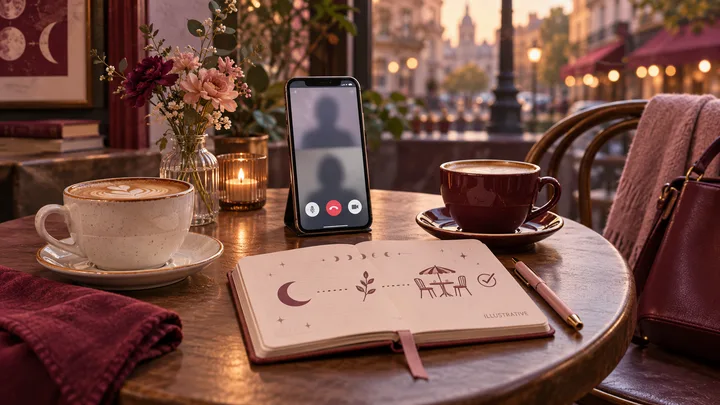
If you want to share, make the choice safer and clearer
You may decide to share. That choice doesn’t make you careless, and waiting doesn’t make you prudish. The important thing is that the decision belongs to you and that you understand what you can and cannot control afterward.
First, check the conditions. Have you met him, or at least seen him live on video? Does his identity make sense across the profile, voice, work story, and ordinary details he gives you? Have you told someone you trust about the connection? Are you sharing because you want this exact act, or because you’re trying to keep him interested? If he vanished tomorrow, would you still feel that the image was yours to give? That last question can be clarifying.
Second, set a boundary in words before sending. “This is for you only. Don’t save it, screenshot it, show it, or share it.” Ask whether he agrees. Consent isn’t a legal spell that controls a dishonest person, but clear language makes the agreement visible and gives you a record of what you intended. Don’t include your face, name, workplace, distinctive jewelry, home, school, children, or anything else that makes identification easy if you don’t want those details connected.
Third, check the technology. Review the recipient and the app. Turn off automatic cloud backups if that fits your device and privacy needs. Remove location data where possible. Don’t use a work account, a shared device, or a platform where you don’t understand the privacy settings. None of these steps makes sharing risk-free. They reduce what a stranger can connect to you.
Fourth, keep your boundary active. You can change your mind after you send the first image. You can say no to a request for more. You can ask him to delete it. His promise to delete it may or may not be reliable, so treat it as a request, not a reset button. eSafety is clear that permission for one kind of online sexual activity doesn’t automatically cover another, and consent can be withdrawn at any time.
And if there’s any pressure, pause the entire exchange. You don’t owe a risk-management seminar to a man who refuses a simple no.
Be careful with the phrase “trust me.” Trust is not an instruction. It’s a history. It grows when a person does what he said he would do, protects what you placed in his care, and stays recognizable when he doesn’t get his way. You can tell him that. “I build trust through time and actions, not promises.” A mature man may understand immediately. A manipulative man may call the standard unfair because he wants the benefit before he has built the foundation.
If you share an image, don’t let the first response decide how you feel about it. Some people answer warmly and then ask for a more explicit photo. Some praise you, then become entitled. Notice whether he thanks you without escalating. Notice whether he asks permission before saving anything. Notice whether he can return to a normal conversation. The moment after intimacy often shows more than the invitation.
You’re also allowed to share a less intimate picture if that feels true to you. A dressed photo, a voice note, or a playful message can keep flirtation alive without giving him access you’re not ready to give. But don’t use a substitute to silence your own no. If he keeps pushing for the original thing, the problem isn’t a lack of creativity. It’s a lack of respect.
Sources: Consent and sending nudes, eSafety Commissioner; Online dating safety, eSafety Commissioner; Image-Based Abuse: What To Know and Do, Federal Trade Commission
What to do if he saves, shares, or threatens the image
If he threatens you, don’t bargain. Don’t send more photos, money, gift cards, or passwords to make the threat disappear. Save what you can safely save: screenshots, usernames, profile links, messages, payment requests, and the time of each contact. If you think opening a message or saving evidence could put you in immediate danger, ask a trusted person or local support service to help you plan the next step.
Image-based abuse includes creating, sharing, or threatening to share an intimate image without permission. The FTC says the harm can be used for control, retaliation, or financial extortion, and it can involve real images or altered ones. A threat is not harmless because he hasn’t posted anything yet. It is a demand for power.
Report the account and the content to the platform. RAINN’s current guidance puts preserving evidence, reporting to the platform, securing accounts and devices, and seeking support in that order, with emergency services if you’re in immediate danger. eSafety also advises stopping contact and not paying a blackmailer when intimate images are used for extortion. The exact reporting route and legal remedy depend on where you live, so use your local police, victim-support service, or online-safety authority when you need help.
Change passwords, turn on two-factor authentication, review logged-in devices, and check whether the man knows your email, phone number, workplace, or home address. Tell one person who can stay calm. Shame isolates you, which is exactly what a threatening person wants. You did not cause his abuse by flirting, trusting him, or sending an image.
If an intimate image appears online, report each location. The FTC explains that covered platforms in the United States must provide a removal process for nonconsensual intimate images and remove the image and identical copies within the legal time frame after a valid request. RAINN provides platform-specific reporting links and support resources. If you were under eighteen when the image was made, treat it as a child sexual abuse material issue and seek specialized help immediately. Do not forward the image to friends as proof.
If you think he may publish the image, don’t search for it repeatedly by yourself. Ask a trusted person to help monitor the places you’re most concerned about, and keep a record of every report. If he knows your workplace or family members, tell the people who need to know only what will help them support you. You don’t have to make a public announcement. You do need a small circle that can act without blaming you.
After the immediate steps, give yourself time before deciding what the experience means. You may feel embarrassed, angry, numb, or still attached to him. Those feelings can coexist. You can miss someone who harmed you and still end contact. You can believe you made a rushed choice and still insist that he had no right to exploit it.
Sources: Consent and sending nudes, eSafety Commissioner; Image-Based Abuse: What To Know and Do, Federal Trade Commission; Report & Remove Intimate Images, Sexual Deepfakes, & Fake Nudes, RAINN
Turn the question into a dating decision
The photo is not the whole relationship. It’s a pressure point that reveals how the relationship handles access, privacy, and pace. Use it to decide what happens next.
If he accepts your boundary and moves toward a real meeting, keep the pace ordinary. Have a short live video call. Meet in a public place during the day or early evening. Tell a friend where you are and arrange your own way home. Keep the first meeting short enough that you can leave without negotiating. eSafety recommends recording the person’s profile and messages before meeting, then telling someone where you’re going. These actions don’t make romance cold. They give romance a safe container.
If he respects the boundary but still avoids a video call or concrete plan, don’t keep rewarding the fantasy with more emotional labor. Ask one direct question: “Are you willing to meet in a public place on a specific day?” A vague answer is information. So is a plan that moves every time you get close to it.
Astrodienst lists synastry, composite, and Davison relationship charts as different ways to work with partnership astrology. Synastry can show how his Mars touches your Moon. It cannot tell you whether he will respect a message you send at 10:14 p.m. A relationship chart may describe the atmosphere between you. Your choices still create the relationship’s terms.
Your decision doesn’t need to be dramatic. Continue slowly if he respects you and becomes more real. Pause if he stays vague. Leave if he pressures or threatens you. Three options. One clear priority: your freedom must remain inside the connection.
Here is a simple evidence table you can make in your notes. Write what he says in one column and what he does in the next. “I want to meet you” means little without a date, place, and arrival. “I respect your privacy” means little if he asks again tomorrow. “I’m serious about you” means little if he keeps you hidden and available only at night. The gap between words and actions is not a puzzle for you to solve. It is part of the answer.
Separate chemistry from investment. Chemistry is how quickly your attention locks onto him. Investment is what you give: your time, private information, emotional care, travel, money, sexual access, or hope. A strong spark can be worth exploring, but it should not receive unlimited investment before he shows reciprocal effort. Let each step buy the next step with evidence.
This protects your relationship with yourself, too. When you keep a promise to your own pace, you become easier to trust from the inside. You stop asking whether a man’s desire is strong enough to justify your discomfort. You start asking whether the connection is strong enough to include your comfort. That is a different standard. It changes who gets access to you.
Sources: Online dating safety, eSafety Commissioner; Partner horoscopes, Astrodienst; Partner horoscopes, Astrodienst
The conversation that tells you what comes next
You don’t need a perfect speech. You need one honest sentence, followed by enough silence for him to answer with his behavior.
Try this: “I’m attracted to you, but I’m not sharing intimate photos before we meet. I want a short video call first, then a public date where I can make my own way home. If that pace doesn’t work for you, I understand, but I won’t change it.”
That message does several things at once. It names desire, so you don’t have to pretend you’re indifferent. It states the boundary without apology. It offers a reasonable next step. And it gives him a clean choice. A healthy man may not love every part of your pace, but he can respect it. He can say yes, no, or not yet without trying to control your answer.
Then watch for four things. Does he respond to the boundary itself, or does he argue about your reasons? Does he make the video call? Does he set a specific public date? Does he remain kind when the conversation is no longer sexual? You’re not grading a performance. You’re noticing whether his actions match the relationship he says he wants.
This is the part many women skip. They ask whether he is their type, whether the chemistry is rare, or whether the chart shows long-term potential. Ask a more immediate question first: “Can I be fully myself, including my no, and still be treated with care?” If the answer is no, the rest of the chart has become decoration around a bad deal.
Get the Dating Clarity Report if you want help sorting his consistency, intentions, pace, needs, and boundaries into a decision you can act on. Bring the same standard to the report that you bring to him. You want insight that returns you to your own judgment.
If he responds well, don’t rush to reward him with the photo. Respect is the starting line, not a coupon. Have the call. Make the date. See how he treats the parts of you that aren’t erotic. Does he listen when you talk about work? Is he curious about your friends? Can he laugh without turning every exchange sexual? Can he disagree without making you feel unsafe? These small moments build the picture you need.
If he responds badly, don’t turn the bad response into a debate about astrology, gender, or modern dating. Name the behavior and leave. “You’re pressuring me, so I’m ending this conversation.” Then stop replying. Block him if he continues. You don’t need the final word from someone who has already told you he wants control more than connection.
And if you’re still unsure, choose the option that preserves your future choices. Waiting keeps the door open. Sending under pressure narrows it. You can send an intimate photo next week, next month, or never. A man who is right for your life can meet you in that freedom.
Sources: Consent and sending nudes, eSafety Commissioner; Online dating safety, eSafety Commissioner; Partner horoscopes, Astrodienst
A little more clarity
What if I already sent an intimate photo before we met?
You haven’t lost your right to a boundary. Tell him clearly not to save, screenshot, show, or share the image, and don’t send more if you feel pressured. If he threatens or shares it, save evidence, report the account and content, secure your accounts, and contact local support or law enforcement if you’re unsafe. His misuse would be his choice, not proof that you caused the harm.
Sources & further reading
- Consent and sending nudes, eSafety Commissioner
Supports the claims that intimate image sharing requires informed, unpressured and specific consent, and that consent is reversible.
- Online dating safety, eSafety Commissioner
Supports guidance about pressure, catfishing, public first meetings, recording profile evidence and telling someone where you are.
- Image-Based Abuse: What To Know and Do, Federal Trade Commission
Supports the definition of nonconsensual intimate image abuse, common motives, reporting routes and U.S. platform-removal guidance.
- Report & Remove Intimate Images, Sexual Deepfakes, & Fake Nudes, RAINN
Supports preserving evidence, reporting to the platform, securing accounts and devices, FTC complaints after non-removal, and survivor support.
- Partner horoscopes, Astrodienst
Supports the description of synastry as chart comparison and its distinction from composite and Davison relationship charts.
- Partner horoscopes, Astrodienst
Supports the distinction between synastry, composite and Davison charts and the need for both partners’ birth data.
- Introduction to Astrology: The Aspects, Astrodienst
Supports the explanation that aspects are angular relationships whose meaning depends on the planets involved and their closeness.
Dating Clarity Report
Six observations about the man you are dating. A clear view of the patterns, plus a conversation for your next decision.
Get my dating clarity report