
Test integration, not permission
You're deciding whether to accept his invitation or keep dinner with your closest friend. The easy move is to cancel. The useful move is to tell the truth and see whether the relationship can include what was already yours.
Don't stage a test. Don't disappear to make him panic or announce a new hobby to provoke jealousy. Bring him an ordinary fact instead: “I have dinner with my cousin on Friday. I'd like to see you Saturday.” A clean invitation gives him something real to respond to.
Choose a commitment that existed before him. Your sister's birthday, a weekly class, a work trip, a quiet Sunday. Tell him what it is, when it happens, and what time you can offer together. You're not asking him to approve your life. You're inviting him to help build a workable rhythm around it.
Imagine Maria has dated Daniel for six weeks. He says he admires her independence. When her volunteer shift conflicts with their date, she tells him on Tuesday and offers two other evenings. Daniel asks what she does there, says he wants to hear about it, and chooses Thursday. He didn't merely permit the shift. He found a way to stay part of her world without taking it over.
That is the distinction this article cares about. Permission keeps him in the position of gatekeeper. Integration lets both people plan, ask questions, and make adjustments. Look for curiosity, not surveillance. Does he want to know what matters to you? Can he remember it later? Does he bring his own life into the relationship with the same openness he expects from you?
His first feeling may be disappointment. That isn't a verdict. The evidence comes next. Does he suggest another date, or make you prove that you care? Does he listen to the story afterward, or interrogate it? Does he return warmly, or attach a price to your absence? One awkward reaction can be repaired. A repeated penalty is a pattern.
Astrologically, this is less a question of whether you possess enough independence than whether the relationship can hold two complete people. Venus-Uranus can describe the spark of difference and the need for a bond that stays alive. Saturn asks whether that freedom has a dependable container. You need both. Air without reliability becomes distance. Structure without freedom becomes a smaller life.
The first observation should feel almost boring. That's a feature. Big declarations leave room for performance. A normal scheduling choice shows whether he can hold a simple truth: you want him, and your life still contains people, work, pleasure, duty, and rest that don't orbit him.
After the conversation, write down the exchange in plain language. “He asked about the class and offered Sunday” is useful. “He seemed supportive” is not. You are testing whether he can participate in the shape of your life, not whether he can say the right sentence about strong women.
Yes, but test integration, not permission. Bring one real commitment into the relationship and see whether he can relate to it, plan around it, and remain connected when it changes the shape of your time together. A man may say he loves an independent woman. The stronger evidence is whether he can become curious about the life that independence contains, make dependable agreements around it, and let you return without a penalty. In synastry, Venus and Uranus describe the need for a living, distinct bond, while Saturn asks whether the bond can carry weight. The chart can name the tension. His conduct shows whether the two principles can work together.
Sources: Synastry: The Astrology of Relationships; Astrodienst Astrowiki: Synastry; Synastry: Venus-Uranus Aspects Between Two Charts
When admiration stops at the surface
Many women get caught here because the opening promise sounds right. He admires your busy life. He calls you driven. He says he doesn't want a clingy relationship. Then the first real negotiation arrives, and the warm language changes shape.
He may have liked independence as an image. The image made you interesting. The reality asks him to tolerate uncertainty, share your attention, and learn the people and purposes that shape your days. That takes more character than praising your freedom over dinner.
The key question isn't whether he can leave you alone. It is whether he can meet you there. A man can be perfectly comfortable with your absence and still show no interest in your inner world. Another may ask about your work, remember your sister's appointment, or want to understand why the class matters. The second man is building connection across difference.
This is why chemistry can mislead you. Intensity makes constant contact feel like proof. A fast connection can turn every gap into a question: Is he losing interest? Am I asking too much? Should I reassure him again? You may begin managing his feelings before you've even asked whether he can manage his own.
Astrology gives this tension a language. Venus describes what we value, how we give affection, and what feels pleasing in relationship. Uranus brings difference, independence, surprise, and the need to remain true to a living self. When Venus and Uranus meet in synastry, astrologers often read a spark that needs room. Harmonious contacts can support unusual interests and separate social lives. Hard contacts can make closeness and distance alternate so sharply that one person feels wanted one day and unreachable the next. The aspect doesn't excuse inconsistency. It names the pressure point.
That distinction matters. “He needs freedom” can mean he wants a healthy margin for work, friends, creativity, and solitude. It can also mean he wants the privileges of intimacy without the duties of a relationship. Those are not the same. One builds an agreement. The other keeps the door open for himself while asking you to wait outside.
Listen for the noun beneath the word freedom. Freedom to do what? Freedom from what? If he means freedom from control, good. If he means freedom from honest plans, repair, and accountability, believe the full sentence. You don't have to become smaller so his idea of independence can survive.
Consider an example. A man says he loves that you travel for work, but he refuses to plan a weekend because he “doesn't want labels.” He wants your flexibility, not your full life. Your work is serving the arrangement. It isn't being welcomed into one.
Your job isn't to persuade him that your life is reasonable. Your job is to notice whether his version of love makes room for mutual knowledge, not just mutual access.
Notice how quickly you start editing yourself. Do you delay mentioning plans because you want to avoid his reaction? Do you keep good news vague because he tends to compete? Self-erasure often begins as a small courtesy. Over time, it becomes the relationship's unspoken price.
You may meet a man who genuinely prefers a tightly shared life. That preference isn't automatically wrong. Compatibility doesn't require everyone to want the same amount of distance. It requires both people to state the preference and consent to the shape.
Ask yourself what you would advise a friend in the same scene. You would notice the difference between a man who feels a tender pang and a man who makes her earn permission. Dating can blur that difference when you are the one being watched. Step back. Describe his action in plain words.
There is another trap: you may mistake his interest in your schedule for control when he is trying to build a shared life. The difference is whether he can hear your answer and whether he offers his own life for the same kind of conversation. A caring question leaves room for your no. A controlling question keeps returning until your no becomes a yes.
You can also want more togetherness than he does. That doesn't make you demanding. If you want two planned dates and he wants one, the answer isn't to pretend you need less. Say what would satisfy you. Then see whether the difference can be negotiated without either person being shamed for having a need.
The real incompatibility appears when the terms are unequal. He gets to be spontaneous while you stay available. He gets privacy while you provide transparency. He gets a full social life while you are expected to explain yours. A shared relationship cannot stay generous if one person gets freedom and the other performs access.
Sources: Synastry: The Astrology of Relationships; Synastry: Venus-Uranus Aspects Between Two Charts
Let synastry show you what to ask
Synastry compares two birth charts to describe the dynamics that arise between particular people. Astrologers read cross-chart aspects and the houses each person's planets activate in the other's chart. That makes the relationship specific. It also keeps you from reducing a living bond to two Sun signs.
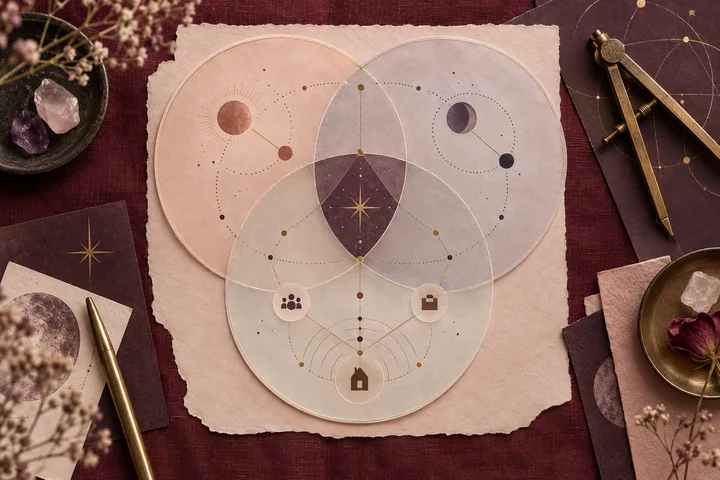
For this question, three symbols give you a useful starting map. Venus-Uranus can describe attraction that needs air, unusual interests, and a relationship where both people remain distinct. In a tense contact, it can also describe sudden distance or an uneven ability to count on each other. The aspect names the pressure point. It doesn't excuse a man who keeps you guessing.
Saturn asks a different question. Can this bond carry weight? Astrodienst's synastry material describes Saturn contacts as difficult at times, yet capable of lending stability and security to long-term relationships. Put the two symbols together and the practical question becomes clear: can he give you room without becoming unreliable, and can he offer commitment without making your life smaller?
The Moon brings the question into the body. It speaks to safety, care, and the feeling of being at home. When your friendships or work stir his fear of being left out, more reassurance may soothe the moment without changing the pattern. A better reading asks what agreement would make both people feel considered, then watches whether that agreement holds.
House overlays help locate the arena. An eleventh-house emphasis can bring friends, community, and future plans into the story. A sixth-house emphasis can put the issue in calendars, work, health, and daily effort. The seventh can make partnership itself the focus. Those placements tell you where to ask the question. They don't answer it for you.
Imagine a chart with a lively Venus-Uranus contact and Saturn tied to the eleventh house. Read it as a relationship that may need both independence and a dependable place among friends and shared plans. Ask, “How will we protect separate friendships and still keep our promises?” Then see what happens when a real Saturday arrives. The chart has done its job if it improves the conversation.
You can make the same translation with the Moon. If the Moon is strongly involved, ask what helps each of you feel remembered when the other is busy. That might mean a good-night call, a clear return time, or a message when plans change. Don't use lunar language to demand constant access. Use it to name the kind of reassurance that actually works.
A Venus emphasis can point you toward values and pleasure. Ask whether he respects the things that make your life feel rich, even when he doesn't share them. Does he make room for the concert, the volunteer shift, the class, or the friend who has known you for years? Affection that welcomes your values will not require you to hide the sources of your joy.
This is where the question becomes more exact. You aren't asking him to join every activity. You are asking whether he can recognize the meaning of an activity without treating it as competition. A friend may be the person who steadies you. Your work may be where your confidence grows. Rest may be how you return to yourself. A relationship with room doesn't need to own those experiences to honor them.
Try a three-part conversation. First, tell him what the commitment gives you. Then ask what he needs in order to feel included without taking over. Finally, agree on one practical gesture from each of you. You might share a story afterward while he gives you notice before changing plans. He might want a regular date, while you need him to stop treating your other time as evidence against him. Specific agreements reveal whether both people are building the bridge.
Uranus can also describe a real strength. Some relationships thrive because both people resist a narrow script. They travel separately, keep unusual work hours, build friendships across different worlds, or choose a pace that doesn't resemble anyone else's. The question isn't whether your relationship looks conventional. It's whether the arrangement is spoken, mutual, and kind when plans have to change.
Saturn deserves the same fairness. A serious contact is not automatically control. It may show patience, duty, and a willingness to stay present through the ordinary work of partnership. But structure becomes control when only one person writes the rules, when obedience replaces trust, or when your separate life is treated as a breach of contract. Look at who carries the weight and who gets the authority.
The most useful chart reading produces a sentence you can say out loud. “I want you to know what matters to me, not just when I'm free.” “I need notice when plans change.” “I want closeness without handing over every part of my life.” If the astrology can't help you reach a sentence like that, it's entertaining you more than it is helping you.
This approach also prevents a common mistake: treating a man's chart as an excuse for his behavior. You may see a pattern that explains why he resists routine, fears dependence, or needs more solitude than you do. Understanding the pattern can make you kinder. It doesn't make you responsible for absorbing its costs. Compatibility includes the form his needs take in your shared life.
Read the whole relationship, not the most dramatic contact. One striking aspect can describe the spark that made you curious. Other contacts, natal needs, and the current season may tell a quieter story about care. And the man still has to choose. A chart can show a door. His conduct tells you whether he opens it, closes it, or expects you to stand outside and wait.
This is the scope to keep in mind. Without a reliable birth time, house and angle interpretations may need to stay conditional. If you seek a personal reading, give the astrologer the birth dates, places, and times you actually know. Here, no personal chart has been calculated. The useful evidence is the pattern you can observe in the relationship.
The Astrology Podcast's synastry discussion makes the same distinction in astrological terms: a chart can describe dynamics that arise, but it cannot dictate how people resolve them. So use symbolism to choose the conversation. Ask what he wants to understand about your life, what he can reliably offer, and how the two of you will handle a change of plan.

Sources: Synastry: The Astrology of Relationships; Astrodienst Astrowiki: Synastry; Synastry: Venus-Uranus Aspects Between Two Charts
Watch whether curiosity becomes reciprocity
The useful comparison isn't between a perfect man and a terrible one. It's between a man who learns how to join your real life and a man who only wants access to the parts that flatter him.
Imagine Maria tells Daniel she has a monthly book-club night. He asks what she is reading and suggests another evening for their date. The next month, he schedules over it, calls the group childish, and goes silent when she keeps her commitment. Maria doesn't need to decide what he secretly feels. She can name what he did.
She might say, “When you called my book club childish and went quiet, I felt punished for keeping a commitment. I need you to respect time I reserve for my friends. Can you do that?” One awkward moment doesn't settle the matter. His repair will tell her more.
A man with room may defend his intention or need a little time. He still returns to the impact. He changes the next choice. A man without room makes the relationship itself the punishment. Every request for balance becomes proof that you don't love him enough.
Watch four things. Does he remember what matters to you? Does he bring his own world into the exchange? Can he hear no without going cold? When he crosses a line, does he repair without making you manage his shame?
The strongest sign is often what happens after the first successful adjustment. A man can perform generosity once. Repeated integration looks quieter. He remembers the commitment without prompting. He asks how it went because he listened the first time. He offers his own schedule instead of expecting you to remain indefinitely flexible. You stop having the same argument because the relationship has learned something.
Compare two replies. “Fine, go. I guess I know where I stand” keeps the focus on his injury and makes you repair it. “I wanted more time with you, but I understand. Are you free Sunday?” names desire and moves toward a plan. Neither reply is emotionless. Only one makes room for two people. You don't need him to feel nothing. You need him to handle feeling without handing you the bill.
The pattern should include reciprocity. He doesn't have to attend every gathering or understand every interest at once. He can remember the date, ask how it went, celebrate your good news, and give you a clear place in his life. Low-maintenance isn't the same as generous. Quiet absence can be neglect, too.
Astrologically, this is the meeting of Uranian space and Saturnian responsibility. One keeps the relationship alive and breathable. The other makes it dependable. If you get only space, you may be left waiting. If you get only duty, you may disappear inside the arrangement. Look for both in his actual conduct.
The emotional cost is decisive. A relationship should leave room for a warm return and a growing sense that you are known. If every difference becomes a crisis that only your surrender can end, the relationship has already given you its answer.
Pay attention to the difference between a question and an interrogation. “Who will be there?” can be ordinary curiosity. “Why do you need them when you have me?” asks you to defend the existence of your other bonds. The first invites connection. The second makes your life stand trial.
Notice what happens when you bring good news, not just when you set a boundary. A man who has room can celebrate a promotion, a new client, a trip, or a friend's kindness without pulling the focus back to himself. He may want to hear the story. He doesn't need to own the reason you feel alive.
Notice the repair window, too. A good response can arrive after an imperfect first reaction. He may feel disappointed, speak clumsily, then recognize what happened and correct it. That is different from a cycle in which the apology appears only after you have cancelled, soothed him, or accepted the same injury again.
If you find yourself hiding plans, softening achievements, or giving up small pleasures before he even asks, take that seriously. The relationship may not contain an explicit rule, yet your body has learned the cost of being fully visible. You don't need to wait for a dramatic prohibition before you protect your life.
Sources: Synastry: The Astrology of Relationships; Synastry: Venus-Uranus Aspects Between Two Charts
Make room for a hard season without abandoning yourself
Sometimes a man's limited availability has a real cause. He may be caring for a parent, starting a demanding job, grieving, traveling, or managing a custody schedule. A full life doesn't always look spacious. A good man can be stretched thin.
That changes the question. Don't ask him to perform unlimited availability. Ask, “What can you realistically offer right now, and what would making room look like?” Then look for an answer with edges: Wednesday evenings, a Sunday call, advance notice when shifts change, or a clear plan for the next meeting.
Consider this example. A man in medical residency can't text through the day. He tells you his schedule, protects one evening, and warns you when a shift changes. He asks about your weekend and doesn't punish you for taking a trip with friends. You may still decide that this pace isn't right for you. At least you're choosing from clear information.
The exception becomes an excuse when only your needs stay flexible. His job is demanding, but yours is treated as an inconvenience. His friends are sacred, but yours are negotiable. His solitude is healthy, but yours is rejection. The chart may describe a tension. The double standard shows how he is choosing to live it.
Astrology gives this pattern a clean language. Uranus can describe unusual rhythms and sudden changes. Saturn can describe duties, limits, and the structure that lets a promise survive them. Separate routines can work. Long work stretches can work. A slower pace can work. None of them works when only one person gets to define the terms.
Pay attention to the places he controls. He may not control a hospital rota or a grieving household. He does control whether he tells the truth, proposes the next call, thanks you for your patience, and listens when the arrangement hurts. Capacity has limits. Consideration still has choices.
Ask for one small promise. Confirm plans by Thursday. Protect one evening for connection. Tell each other when a change is coming. Small agreements give him something real to do, and they give you evidence without turning the relationship into an exam.
You can believe his explanation and still decide that the relationship doesn't offer enough room, tenderness, or reliability. Understanding him isn't a contract to abandon yourself.
A hard season should have a shape and an end point, even if the date is uncertain. He may not know when the project will finish or when his parent will recover. He can still tell you what he knows, what he doesn't know, and when you will revisit the arrangement. Uncertainty becomes much easier to carry when it is shared instead of imposed.
Ask whether he makes any effort to know your life during the season. A man can be exhausted and still ask how your sister is doing, remember the work presentation, or protect the hour you need to sleep. These gestures don't create time out of nowhere. They show that limited capacity hasn't erased consideration.
You also get to name the cost. “I understand why you have less time. I don't want to be in a relationship that stays this thin for six months.” That isn't punishment. It's information. His circumstances may be valid, and your limit may be valid beside them.
Ask one more question during a hard season: what does he want you to understand about his limits, and what does he want to understand about yours? If he can answer only the first half, the arrangement will quietly become a service you provide. If both halves stay in the room, you have the beginning of a partnership, even when the calendar is difficult.
Your own choices matter here. Don't present your life as a test he must pass while offering no information about how you want to connect. Say what you can give. Say what you need. Then leave space for him to decide whether that shape suits him. Compatibility isn't the reward for the person who asks for less. It is the fit between honest needs and willing effort.
The right response to a hard season is not endless patience. It's an honest agreement that both people can actually live. If the agreement keeps changing only in his favor, stop calling it a season and start calling it the relationship you are being offered.
Sources: Astrodienst Astrowiki: Synastry; Synastry: Venus-Uranus Aspects Between Two Charts
A better method: ask, observe, then choose
Choose one part of your life you won't hide: a friend group, creative practice, child, faith community, demanding goal, or quiet hour. Name it plainly. A relationship needs to meet your real life, not a trimmed version prepared to keep it comfortable.
Ask, “What does making room for each other look like in practice?” Offer your answer, too. You might want shared weekends, separate friends, and one night alone. The point isn't to win a preferred amount of contact. It's to see whether he can discuss the shape without turning your needs into an accusation.
Give the conversation a small consequence. Keep the Saturday commitment. Ask him to confirm the next date by Thursday. Tell him when a busy week will change the usual rhythm. Then write down what he does in plain language: he offered another evening; he went cold after you said no; he apologized, and the next plan matched the apology.
Use the chart beside those facts, if you have one. Venus-Uranus can name the need for air. Saturn can name the work of staying dependable. The Moon can show where safety gets stirred. Let the symbols improve your questions. Don't let them bargain away what you already know.
Now choose the pace. If he welcomes your life, keeps agreements, and repairs after a miss, continue while protecting your balance. If he means well but stays inconsistent, slow down and ask for one clearer agreement. If he uses guilt, silence, monitoring, or withdrawal to make you cancel, stop explaining and step back.
Check your side, too. Can you respect his time with friends and rest? Can you hear a limit without making him prove love through exhaustion? His life must remain his. The right fit isn't constant access. It's a bond in which both people can leave the room and return with trust intact.
After two or three real occasions, decide. Does being with him make your life feel larger and safer, merely tolerated, or steadily smaller? Keep investing only in the pattern you can live with. Get my dating clarity report when you want a closer look at his consistency, intentions, pace, and your next boundary.
Don't grade the relationship by one generous evening or one jealous comment. Ask what repeats when the novelty fades. Does he keep learning? Does he keep his word? Does he make room for your answer even when it isn't the answer he wanted? Repetition turns a promising moment into evidence, and evidence makes a dating decision easier to trust.
Keep your notes factual. “He asked about my friend and suggested Sunday” tells you more than “He seemed supportive.” “He said my work was selfish and stopped replying” tells you more than “The energy felt off.” Plain language keeps hope from polishing a pattern that hurts you.
Rank what you see. Warmth matters. So does follow-through. A thoughtful conversation is encouraging, but repeated action carries more weight than a beautiful explanation. A single miss can be repaired. A repeated demand that you shrink is not a communication puzzle.
Keep the categories separate. Curiosity tells you whether he wants to know you. Planning tells you whether he can translate interest into a shared rhythm. Repair tells you whether the relationship can survive the moments when neither person gets exactly what she wants. You need all three. A man can be curious and still unreliable. He can plan well and still punish disagreement. Read the pattern as a whole.
And don't confuse a full life with emotional unavailability on your side. Make room for him, too. Tell him when you want more time. Keep the promises you ask him to keep. The test is not whether he can fit around an immovable woman. It is whether two real lives can meet without one becoming the other's cage.
If you need a final conversation, keep it concrete. Name the behavior, state the need, and ask whether he is willing to change one thing. “When plans with my friends lead to silence, I stop feeling free to be honest. I need us to handle disappointment without punishment. Will you work on that with me?” His answer matters, but the weeks after it matter more.
You aren't trying to prove that he is a bad man. You are deciding whether this relationship can hold the woman you already are. A man can be loving, attractive, and sincere, then still be the wrong fit for the amount of room your life requires. That conclusion is not cruel. It is clear.
That is the clean ending astrology can offer here. It can help you see why the bond feels electric, why distance stings, or why duty has become the central lesson. It can help you choose the conversation. But your life is not a chart exercise. Your friends are real. Your work is real. Your sleep, family, faith, pleasure, and ambition are real. The right relationship meets those facts with curiosity and care.
Your final answer doesn't need to sound dramatic. “This relationship gives my life more room.” “This pace is kind, but it isn't enough for me.” “I keep losing pieces of myself here.” Each sentence is a decision. Once you can say it plainly, you don't need another sign to make it true.
Sources: Synastry: The Astrology of Relationships; Astrodienst Astrowiki: Synastry; Synastry: Venus-Uranus Aspects Between Two Charts
A little more clarity
Does Venus-Uranus synastry mean he won't commit?
No. Venus-Uranus synastry describes a need for freshness, individuality, and honest room inside affection. Harmonious contacts can support a relationship where both people keep their friends, interests, and distinct identity. Hard contacts may bring more sudden distance or uneven availability, but the aspect doesn't excuse broken promises. Read it beside Saturn, the Moon, the wider chart, and his real behavior. Commitment becomes visible when freedom and responsibility work together.
What should I do if he says he supports my independence but acts jealous?
Name the exact behavior and its effect. Say, “When you criticize my friends and go quiet after I see them, I feel punished for having a life outside us. I need you to respect that time.” Then ask for a concrete change and watch what happens. A single defensive moment can be repaired. A repeated pattern of guilt, monitoring, withdrawal, or retaliation is your answer. You don't need a soulmate verdict to step away from a relationship that keeps making your world smaller.
Sources & further reading
- Synastry: The Astrology of Relationships
Supports the scope of synastry, its use of cross-chart aspects and house overlays, and the distinction between describing dynamics and deciding how people resolve them.
- Astrodienst Astrowiki: Synastry
Supports reading each natal chart before synastry and weighing Saturn contacts as possible sources of stability and security alongside difficult themes.
- Synastry: Venus-Uranus Aspects Between Two Charts
Supports the interpretation of Venus-Uranus contacts as attraction, individuality, freedom, social acceptance, and possible inconsistency depending on the aspect and its wider relationship context.
- Composite Chart: Venus-Uranus Aspects
Supports the comparison between freedom, flexibility, changing relationship forms, expectations, and the need for reliability in Venus-Uranus relationship patterns within a couple over time.
Dating Clarity Report
Six observations about the man you are dating. A clear view of the patterns, plus a conversation for your next decision.
Get my dating clarity report