
Imagine Maria brings up the thing she keeps trying to ignore
Imagine Maria is sitting beside the man she has been dating for three months. He has cancelled twice in one week. On the second cancellation, he said he would make it up to her, then spent the next evening posting from a bar with friends. She does not need a grand declaration. She wants to know whether his time with her means what he says it means.
She waits until they are together. Then she says, carefully, 'When plans change and I see you making time for everyone else, I feel pushed to the side. I need more notice, and I need to know whether you're actually making room for this.'
He grins. 'Wow. Should I submit a calendar invite for our next emotional summit?' He laughs. Maybe he kisses her forehead. Maybe he calls her adorable. The subject shifts. Maria laughs too, because the room feels easier when she joins him. But the concern has not gone anywhere.
This is the moment to study. Not the wit. Not whether he can make a room laugh. The question is whether he can come back to the point after the joke has done its work. Can he hear that she is asking for reliability? Can he answer without making her prove that her request is reasonable? Can he change the next plan?
A joke can be a bridge. It can also be a trapdoor. It may soften a hard conversation for two people who still intend to meet each other. It may also let one person escape the conversation while the other person carries the emotional weight alone. You do not have to decide which one it is from a single sentence. You do have to stop treating the difference as invisible.
The strongest clue is what follows your second sentence. If Maria says, 'I'm not asking for a summit. I'm asking you to take this seriously,' and he turns toward her, she has something real to work with. If he says she is too sensitive, repeats the joke, or becomes angry that she did not find it funny, he has answered her. He has chosen protection of his comfort over contact with her experience.
The joke is not the evidence. The response after it is
You can learn a lot from humor, but you cannot read intention from humor alone. Some people joke when they feel ashamed. Some joke because seriousness scares them. Some use play to keep a conversation warm. Others use it to make your concern look ridiculous. The same sentence can sit inside very different patterns.
Look at four details. First, what did you say? A small request, a vulnerable feeling, a boundary, and an accusation do not carry the same emotional charge. Second, what did he joke about? Did he make the situation lighter, or did he make you the punchline? Third, what happened when you clarified? Fourth, did anything change later?
A caring man can miss the first landing. He might say something glib, see your face change, and stop. He might ask, 'Wait. I made that worse, didn't I?' He might not have a polished answer, but he will try to understand the answer you need. That turn matters more than a perfect opening line.
A dismissive man often keeps the spotlight on your reaction. 'You can't take a joke.' 'I was only kidding.' 'You always make things heavy.' Those lines turn a question about his conduct into a trial of your personality. Now you are defending your sense of humor instead of discussing the missed date, the private information he shared, or the boundary you stated.
The Gottman Institute describes a bid as an attempt to get attention, affection, or acceptance, and it can arrive through a question, expression, or small outreach. Its relationship guidance separates responses into turning toward, turning away, and turning against. A joke may turn toward you if it acknowledges the feeling and invites warmth. It turns away when it skips the feeling. It turns against you when the joke attacks the legitimacy of the feeling itself. [The distinction is useful because it gives you a behavior to observe, not a motive to guess.](https://www.gottman.com/blog/want-to-improve-your-relationship-start-paying-more-attention-to-bids/)
So ask yourself a sharper question than 'Was he joking?' Ask, 'After I made myself vulnerable, did he help me feel more seen, or did he make me regret speaking?' That is the answer you can use.
He reveals less through the joke than through what happens after you tell him it hurt. A nervous joke followed by listening, an apology, and a changed choice can show discomfort with vulnerability that he is willing to outgrow. A joke that dismisses you, invites other people to laugh, or returns every time you raise the issue points to something more serious: he wants relief from your concern more than he wants understanding. Read the pattern across moments, not one awkward line. In synastry, Moon-Mercury contacts can describe how feelings and words meet, while difficult Mercury contacts may show a habit of arguing over wording or retreating into cleverness. They describe a pressure point, not a verdict. Your next step is plain. Name the concern again without defending it, ask him to respond seriously, and watch whether his behavior changes. If you keep having to audition your pain before he will respect it, stop investing at the same pace.
Sources: Improve Your Relationship by Paying Attention to Bids
What he may be protecting when he reaches for humor
Humor often arrives where a person feels exposed. He may fear that he has disappointed you. He may not know how to comfort you. He may have learned that earnest conversations lead to blame, so he tries to outrun the heat. Those explanations can help you understand the pattern. They do not require you to live inside it.
There is a difference between a defense and a character verdict. If he jokes once, then admits he felt cornered, you are seeing a defense that he can name. If he jokes every time you ask for care, he is using a defense as a relationship policy. You end up doing the work of translating your needs into a language that never makes him uncomfortable.
Watch for the kind of humor. Self-deprecating humor can be a first step toward accountability if it leads to a direct admission: 'I did mess that up.' Sarcasm aimed at you carries a different charge. So does faux confusion, where he pretends not to understand an ordinary request because acknowledging it would create an obligation. The line 'Do you want me to ask permission every time I see my friends?' is not a curious question when you asked for notice about a shared plan. It is a caricature of your need.
He may also be testing what you will tolerate. Not always in a calculated way. People test the edges of a relationship by repeating what gets them out of difficulty. If the joke works, the issue disappears. If you smile, he learns that your discomfort can be absorbed by you. If you protest and then soothe him because he feels accused, the whole exchange teaches him that you will carry both sides of the repair.
Do not diagnose him from this. Name the effect. 'When you joke about my concern, I stop feeling safe enough to finish the conversation.' That sentence gives him a clear doorway back. A man who wants closeness can walk through it. A man who wants only the benefits of closeness may complain that the doorway is too demanding.
You are allowed to hold compassion and standards at the same time. His fear may be real. So is your need for a serious answer.
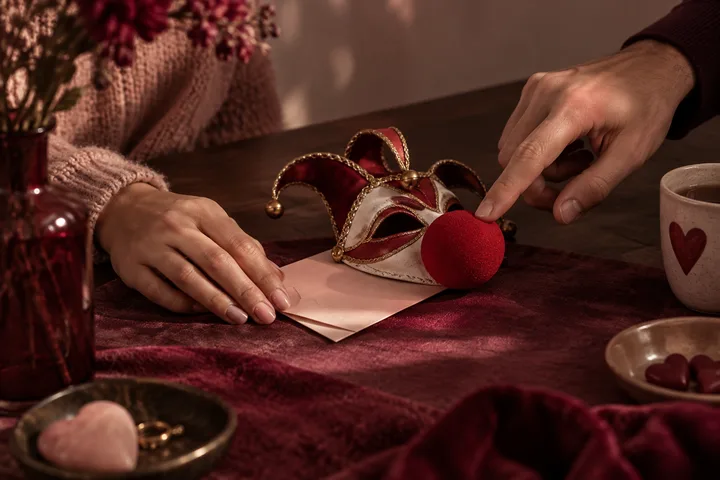
When the joke becomes contempt, defensiveness, or a shutdown
Not every bad joke is contempt. That word should stay precise. But ridicule, mocking, and name-calling are not harmless because the speaker adds 'just kidding' at the end. The Gottman Institute identifies contempt as disrespectful, hurtful communication that can include ridicule and mocking. It also describes defensiveness as a response that signals your concerns do not matter, especially when it becomes the man's default answer to a request. [Those patterns help separate an awkward attempt at levity from a repeated attack on your standing in the relationship.](https://www.gottman.com/blog/4-conflict-styles-that-hurt-your-relationship/?e-page-e7b509d=2)
A contemptuous joke sounds like, 'Here she goes again, our resident crisis manager.' It may arrive in front of friends, where your protest would make you look humorless. It may use a private wound as material. It may imitate your voice until you feel foolish for having one. The joke does not merely avoid the issue. It lowers your rank while he keeps the right to decide what counts as serious.
Defensive humor sounds lighter, but it still places the burden on you. 'Should I call the police because I took two hours to reply?' 'Sorry I failed the girlfriend exam.' 'I guess I'm the worst man alive.' Suddenly you are comforting him, denying that he is the worst man alive, and losing the original point. The performance creates noise around a simple request for accountability.
A shutdown can hide behind a joke too. He throws out one line, then reaches for his phone, changes the subject, or says he is too tired for your 'drama.' The joke was not the whole response. It was the last visible move before he closed the door.
You do not need to label the style in the moment. You need to track the result. Do you leave the conversation clearer, calmer, and more respected? Or do you leave it smaller, embarrassed, and responsible for restoring his mood? One difficult exchange can happen in a good relationship. A stable pattern of humiliation cannot become the price of entry for being heard.
If the joke includes threats, sexual humiliation, exposure of private messages, intimidation, or pressure to abandon friends and ordinary plans, treat that as a safety issue. You do not need an astrology reading to authorize distance. Get support from people you trust and choose the setting that protects you.
The synastry question: how do his words meet your feelings?
Synastry compares two birth charts. Astrologers study interchart aspects, or the relationships between one person's planets and the other person's planets, as well as house overlays that show where one person's planets fall in the other's chart. Astro.com describes synastry as a comparison of two or more horoscopes used to examine these interconnections. [That is the proper scope here.](https://www.astro.com/astrowiki/en/Synastry)
For this question, begin with the Moon and Mercury. The Moon speaks to emotional response, instinct, memory, and what helps a person feel held. Mercury speaks to speech, listening, interpretation, and the way a mind moves through a conversation. When his Mercury touches your Moon, his words can land directly on your sense of safety. When your Moon touches his Mercury, your feeling may become the subject his mind tries to solve, explain, or reframe.
A warm contact can make it easier to name private things. You may feel that he catches the meaning beneath your words. You may also enjoy the same playful language, which can make humor a genuine form of affection. That is the best expression of a Moon-Mercury connection: emotion gets a voice, and language gives emotion somewhere to rest.
The challenging expression is subtler. He may hear your feeling as a problem to correct. You may hear his attempt to reason as coldness. A joke can then become his shortcut around the emotional layer, while your request for acknowledgment can sound to him like an accusation. Cafe Astrology's Moon-Mercury reference describes this tension in difficult contacts as a tendency toward criticism, over-analysis, sensitivity to criticism, and the need for sympathetic listening. [Use that interpretation as a lens for the conversation, not as a sentence handed down about either person.](https://cafeastrology.com/synastry/moon_mercury_aspects.html)
The chart does not tell you that he will mock you. It can show why one person's manner of speaking presses on the other's tender places. The lived pattern tells you whether both people learn the language of care.

Sources: Synastry - Astrodienst Astrowiki; Synastry: Moon - Mercury Aspects Between Two Charts
Why clever chemistry can hide a thin emotional bridge
Some connections are brilliant before they are safe. You talk for hours. You finish each other's sentences. Your private jokes multiply. He can make you laugh in a bad week, and you can make him feel understood without much explanation. That is real intimacy. It is also possible to confuse verbal ease with emotional availability.
Strong Mercury contacts can create a quick sense of recognition. Cafe Astrology's discussion of Mercury in synastry warns that powerful Mercury cross-aspects may feel like understanding while deeper emotional communication remains untested. It points to the Moon, Mars, and Ascendant as additional layers when a couple wants to understand hopes, desire, and embodied response. [The useful comparison is simple: can you talk beautifully, and can you stay present when the talk stops being beautiful?](https://cafeastrology.com/articles/synastrymercury.html)
A joke is often where this difference appears. He may be dazzling when the conversation is playful and evasive when it becomes tender. You may be deeply attracted to his mind, then discover that he treats your needs as interruptions to the performance. The bond has chemistry. The bridge has missing boards.
Do not punish the playful part. Ask it to grow up enough to serve the whole relationship. A good joke can bring you back into contact after tension. It can help two people breathe, especially when neither wants to turn every difference into a solemn ceremony. But the joke must return you to the issue. If it ends the issue every time, it is not creating intimacy. It is creating a private escape hatch.
This is where synastry becomes practical. Look for the chart factors that describe emotional reception, conflict, and repair, not only the contacts that describe sparkle. Moon-Mercury tells you how feeling and speech meet. Mercury-Mars can show how quickly words become heat. Mercury-Saturn can show seriousness, inhibition, judgment, or the discipline to keep speaking when a subject is hard. Venus may describe what feels pleasing, but pleasure alone cannot answer whether your concern gets a fair hearing.
The ranking matters. First, observe whether he repairs. Second, ask whether the pattern is workable for your nervous system and your needs. Third, use the chart to name the conversation you need to have. Do not reverse that order because the synastry feels unusually magnetic.
Sources: Love, Relationship Astrology: Mercury in Synastry; Synastry: Moon - Mercury Aspects Between Two Charts
The strongest exception: a joke can be a bridge back to tenderness
Here is the meaningful exception. He jokes because he is tense, then he notices that you did not feel met. He stops. 'That came out wrong. Tell me again.' He listens without making you simplify the feeling into a courtroom argument. He tells you what he heard. He answers the practical part. Later, he changes one small behavior without demanding praise for it.
That man may still be clumsy. He may still reach for humor too fast. But he is not asking you to abandon the subject. He is learning to come back. The difference between a problem and a pattern is not whether he ever misses you. It is whether he can find you again without making you chase him through a maze of explanations.
A joke can also help when you both know the language. You may say, 'I need reassurance, not a comedy set,' and he may answer, 'Fair. I'm listening.' The joke has now become a shared signal. It does not erase your concern. It helps him shift modes and helps you stay connected while he does.
Astrologically, an easy Moon-Mercury contact can support this kind of return. So can a disciplined Saturn link when both people use it for steadiness rather than judgment. Even a tense aspect can become workable when the pair learns its lesson: slow the words, name the feeling, ask one clear question, and let silence make room for an answer. A soft chart cannot do that work for a proud person. A difficult chart cannot prevent it when two adults choose it.
Repair has a shape. He comes back to the moment without making you drag him there. He can say what he did, not only what he meant. He can recognize the effect without claiming that the effect was your fault. Then he participates in the new agreement. If he says, 'I was trying to lighten the mood,' that explains the impulse. If he adds, 'I see that I made you feel alone, and next time I'll ask whether you want comfort before I joke,' he has moved from explanation into repair.
You can offer your own part without taking his. Maybe you brought the concern up with a cutting tone. Say so. Maybe you waited until resentment had filled the room. Own that timing. Then return to the point: his joke still dismissed you, and the relationship still needs a better way to handle hard subjects. Mutual accountability is not a contest in which your imperfection cancels his responsibility. It is two people making the path clearer.
Test the exception over time. Does he repair only when you are about to leave? Does he make a beautiful apology and repeat the same joke the following week? A single good recovery matters, but consistency gives it meaning. You are not searching for a man who never misfires. You are looking for a man who does not make you pay to be taken seriously.
Your standards do not kill humor. They protect the conditions in which humor can stay kind.

Sources: Improve Your Relationship by Paying Attention to Bids; 4 Conflict Styles that Hurt Your Relationship; Synastry: Moon - Mercury Aspects Between Two Charts
How the pattern changes under different circumstances
Context matters, but it does not cancel impact. If you raise a sensitive concern while he is driving, rushing to work, or already flooded by another crisis, he may not have the capacity to respond well in that minute. A mature answer can still be brief: 'I want to talk about this properly tonight. I don't want to joke it away.' Capacity changes the timing. It does not remove the need for repair.
The pattern also changes when the concern is specific. 'You don't care about me' invites a defense because it attacks the whole self. 'When you cancel within an hour, I need you to suggest a new day instead of leaving me to ask' gives him something he can answer. You should not have to speak perfectly to deserve respect. Still, clear requests make the response easier to read.
Watch what happens when you raise the same issue in a calm moment. If the joking disappears when there is no public audience and no immediate pressure, he may be struggling with conflict performance rather than rejecting your needs. If the joke remains, then the avoidance is more settled. If he is tender in private but mocks you in front of friends, the social setting reveals a separate problem: he protects his image by spending your dignity.
Your own chart may also describe your entry point. A strong Moon emphasis may make dismissal feel physically loud. Mercury-Saturn may make you edit your needs until they sound acceptable. Mars contacts may pull you into proving the point. None of these signatures make you too much. They show where you need to practice directness and where his response will matter most.
His chart, if you have accurate birth data, may show a Mercury that prefers wit, detachment, speed, or argument. It may show Saturn pressing on Mercury, Moon, or Venus. It may show a strong Uranian need for freedom or a Neptunian tendency to blur what was said. Read those signatures as tendencies in the bond. Then compare them with his actual choices. A chart can explain the weather. It cannot make you stand outside in a storm.
The circumstances may change the interpretation. They should not change your basic right to finish a sentence and receive a serious answer.
Sources: Synastry - Astrodienst Astrowiki; Love, Relationship Astrology: Mercury in Synastry
The conversation that gives you a clean answer
Choose a neutral moment. Not in the middle of the joke, not while one of you is leaving, and not after you have collected six months of evidence. Say what happened, what it did to you, and what you need next.
Try this: 'When I told you I was hurt and you made me the punchline, I felt dismissed. I can handle humor, but I can't build closeness with someone who jokes me out of serious conversations. If you don't understand my concern, ask me. If you disagree, tell me. Please don't turn it into a performance.'
Then stop. Do not fill the silence with a second speech that proves you are reasonable. Do not offer him the exact apology he should give. Let him answer.
A useful response has three parts. He acknowledges the impact without arguing about your right to feel it. He explains his side without using it as an excuse. He agrees to a concrete change, such as asking whether you want comfort or problem-solving, making a new plan after cancelling, or keeping private concerns private.
A weak response stays on the surface. 'I said I was sorry, what more do you want?' 'You know that's just my personality.' 'I can't believe we're still talking about this.' A cruel response punishes you for bringing it up. A promising response may be imperfect, but it moves toward the subject and leaves you with more dignity than you had before.
Give the new agreement a chance to become behavior. You do not need a ten-page relationship contract. You need to see whether the next moment looks different. If he slips, does he catch himself? If you remind him, does he resent the reminder or use it? If nothing changes, believe the repetition.
Your clarity will come faster when you stop asking whether he meant to hurt you and start asking whether he is willing to stop doing what hurts you. Intention belongs in the conversation. Pattern belongs in the decision.
Before you have this talk, decide what you will do with each likely answer. If he listens and proposes a change, you can keep dating while you watch whether the change holds. If he listens but says he cannot offer what you need, believe that too. A clear mismatch is painful, but it is kinder than building a future around a promise he has already said he cannot keep.
If he turns the conversation into another joke, bring him back once: 'I heard the joke. I'm still asking you a serious question.' If he comes back, continue. If he doubles down, end the conversation without trying to win. You can say, 'We're not having a useful conversation, so I'm going to go. We can speak when you're ready to treat this respectfully.' Leaving the exchange is not a dramatic punishment. It is a boundary around your attention.
You may notice yourself editing before you speak. You call the issue silly. You add a laugh. You say, 'This is probably my problem,' because you want to make it easy for him to care. Then he jokes, and you tell yourself you should have chosen a better moment. The relationship begins to train you out of your own perception.
Pause there. A need does not become unreasonable because you expressed it imperfectly. You can revise your delivery without deleting the message. 'I was sharper than I meant to be, but the concern is still real.' That is accountability without self-erasure.
Write down the facts after an exchange. What did you ask for? What did he answer? What changed? This is not a dossier. It is a way to keep your memory connected to the event when charm and confusion arrive afterward. Notice whether you feel more free around him over time, or more careful.
Keep the record concrete. 'He laughed' is a fact. 'He wanted to make me feel foolish' is an interpretation. You may reach that interpretation, but give yourself enough detail to see how you got there. Did he ask a question? Did he lower his voice? Did he make the joke private or public? Did he return to the subject without being pushed? Clear notes protect you from both extremes, from excusing everything and from turning one clumsy moment into a complete identity verdict.
The Dating Clarity Report can help you organize those observations around the questions that actually govern investment: Is his care consistent? Are his intentions becoming clearer? Can he meet your pace without pressing you to abandon your boundaries? A report should support that conversation. It should never replace the conversation or hand you a soulmate verdict.
Synastry can add language to the pattern when you have both birth dates, places, and reliable birth times. Without those inputs, do not pretend to have a precise house overlay or Ascendant contact. You can still ask the chart question in principle: how do words, feelings, desire, and responsibility meet between these two people? Keep the scope honest, then return to the living evidence.
If he makes you afraid to raise ordinary concerns, reach for support outside the relationship. Tell a friend what has been happening. Choose public settings when needed. You are not required to stay available while someone experiments with how much disrespect you will absorb.
Love can be playful. It cannot ask you to disappear inside the punchline. Your feelings belong in the relationship, too. They deserve a place at the table, every time.

Sources: Improve Your Relationship by Paying Attention to Bids; 4 Conflict Styles that Hurt Your Relationship; Synastry - Astrodienst Astrowiki; Love, Relationship Astrology: Mercury in Synastry
Your answer is in the repair, and your decision is yours
He may reveal discomfort. He may reveal immaturity. He may reveal that he has learned to make a woman doubt the seriousness of her own experience whenever accountability comes close. You do not need to choose the most generous explanation before you have watched what he does next.
The governing judgment is this: a joke about your concern is workable only when he can return to your concern with respect. If he listens, repairs, and changes, the moment can become part of a stronger bond. If he repeats the joke, mocks the boundary, or makes your hurt the real offense, treat the pattern as information about compatibility.
The ranking is simple. First, protect your dignity and safety. Second, make one clear request and observe the response. Third, use synastry to understand the emotional and verbal pressure point, then decide whether the relationship has the patience to work with it. Chart symbolism can illuminate the lesson. It cannot do the choosing for you.
Maria does not need to prove that the cancelled dates were objectively terrible. She needs to know whether this man can hear the meaning they carried for her and help create a better agreement. If he can, she can slow down and watch. If he cannot, she should stop investing as if potential were already partnership.
There is no prize for staying until a dismissive man finally understands the lesson. You can leave while the evidence is still small. You can also stay for a measured period after a genuine repair, provided you do not confuse patience with an obligation to wait forever. Set a private marker for yourself. Over the next few weeks, notice whether he asks about the concern again, keeps the new agreement when the moment is inconvenient, and lets you speak without preparing a joke as a shield. Notice your body too. Do you relax before bringing up ordinary needs, or do you rehearse every sentence so he cannot twist it? A relationship is not compatible merely because it survives your careful delivery. It is compatible when both people can bring ordinary human friction into the room and remain on the same side of the problem. That is the standard beneath the astrology, and it is high enough to protect the love you want.
Start the conversation this week. Say, 'I want to revisit what happened. When I share a concern, I need you to answer me seriously before we joke. Can you do that with me?' Then listen to the answer. Watch the face, the tone, the follow-through. The truth will not be hidden in the cleverest line. It will be in whether he makes room for you after the laugh ends.
Sources: Improve Your Relationship by Paying Attention to Bids; 4 Conflict Styles that Hurt Your Relationship; Synastry: Moon - Mercury Aspects Between Two Charts; Love, Relationship Astrology: Mercury in Synastry
A little more clarity
Does turning my concern into a joke mean he doesn't care?
Not automatically. The decisive clue is what he does after you say the joke hurt. If he listens, apologizes, and changes the behavior, he may be using humor to manage discomfort. If he repeats the joke, blames your sensitivity, or refuses a serious answer, the pattern shows that protecting his comfort matters more to him than meeting your concern.
Can synastry show why he jokes when I talk about my feelings?
Synastry can describe the meeting point between communication and emotion. Moon-Mercury contacts may show ease, misunderstanding, or a tendency for one person to solve what the other needs to express. Mercury contacts with Mars or Saturn can add heat, inhibition, judgment, or endurance. The chart offers a language for the pattern. His repeated choices decide whether the pattern becomes safer.
What should I say when he tells me I can't take a joke?
Say, 'I can take a joke. I'm telling you this one moved us away from the issue. I need you to answer the concern instead of making my reaction the problem.' Then pause. A respectful man may need a moment, but he will engage. If he keeps mocking you or punishes you for speaking, take that response seriously.
How many times should I explain the same concern?
Explain it clearly once, revisit it once if the first conversation was rushed or confused, and then judge the pattern. Repeating yourself cannot create willingness in someone who benefits from misunderstanding you. Give a genuine repair room to become a habit, but don't keep lowering the standard while you wait for basic respect.
Sources & further reading
- Improve Your Relationship by Paying Attention to Bids
Defines bids for connection and distinguishes turning toward, turning away, and turning against a partner.
- 4 Conflict Styles that Hurt Your Relationship
Explains how ridicule, contempt, defensiveness, and shutdown can erode trust during conflict.
- Synastry - Astrodienst Astrowiki
Provides the scope of synastry as comparison of charts, interchart aspects, and house placements.
- Synastry: Moon - Mercury Aspects Between Two Charts
Describes how Moon-Mercury contacts can support expression or create criticism, sensitivity, and analytical distance.
- Love, Relationship Astrology: Mercury in Synastry
Places Mercury contacts in a wider reading that includes emotional, desire, and relational factors.
Dating Clarity Report
Six observations about the man you are dating. A clear view of the patterns, plus a conversation for your next decision.
Get my dating clarity report