
The same scene can mean two different things
He snaps at the waiter. He corrects the cashier three times. He leaves a tip with a little speech attached to it, as if generosity gives him the right to humiliate someone. You sit there with your stomach tight and wonder whether you've just seen the real man.
Maybe you have. Or maybe you saw a tired person lose his temper once, then recognize the harm, apologize, and change his tone before the evening ends. Those are not the same event. The first points toward a relationship with power. The second points toward a bad moment followed by responsibility. Your job isn't to rescue the nicest interpretation. It's to tell the difference.
That difference matters because a service worker is often in a constrained position. The person serving him may need the shift, the tip, or the manager's approval. Your date has more room to walk away. When he uses that imbalance to punish, mock, or perform superiority, you're not watching a small etiquette flaw. You're watching what he does when the other person has less power and cannot easily answer back.
Still, don't turn a single scene into a courtroom. People can be hungry, grieving, sick, late, embarrassed, or overwhelmed. A delayed order can land on top of a day you know nothing about. Context doesn't excuse cruelty. It does help you judge the whole event instead of grabbing one frame and calling it the film.
Start with three questions. What exactly did he do? Who carried the cost of his behavior? What did he do after he saw your face, the worker's face, or the consequences? Specifics will protect you from two common mistakes: explaining away a pattern because you're attracted to him, and ending something promising because you witnessed one imperfect human moment.
The strongest clue often arrives after the incident. A man who says, ‘I was rude. That wasn't fair. I'll fix it,' has given you something to work with. A man who says, ‘People like that need to learn' has given you a value statement. A man who blames you for noticing has made the scene about your loyalty instead of his conduct.
Compare the public scene with the private one you already know. Has he ever been tender with you after you made a mistake? Has he ever thanked someone whose work benefited him without making a performance of his generosity? Has he ever accepted a correction from a person he considered less experienced? These details matter because character isn't only revealed by bad behavior. It is also revealed by the ease with which someone can offer respect when nobody is rewarding him for it.
You may notice a fourth possibility: he is polite to workers but dismissive toward people he dates. That still counts. Courtesy in public is not proof of emotional maturity. Look at the full field of conduct. Does he keep promises when no one is watching? Does he treat your time as real? Does he allow you to want something different? The worker at the next table is one doorway into the question, not the whole house.
So yes, pay attention. Just don't make the first interpretation the final one. Let the next conversation test it.
If you felt yourself shrinking beside him, include that in the record. Your body may have noticed the social danger before your mind found the right words. That response is not a chart calculation, and it isn't a final verdict either. It is a reason to slow down, ask a direct question, and see whether the relationship makes more room for you or less.
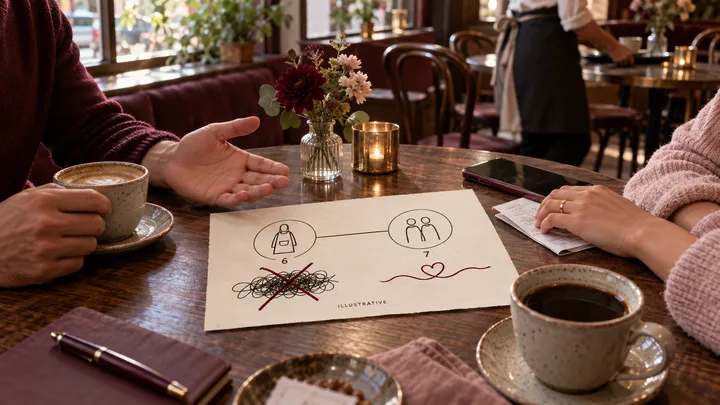
His treatment of service workers can show how he handles power, inconvenience, and people he does not need to impress. That matters. But one sharp exchange, especially on a genuinely difficult day, isn't enough to decide who he is. Read the moment as a question. Then watch what happens when you name it, whether he repairs without being coached, and whether the same contempt returns when he feels rushed, ignored, or entitled. In astrology, service and ordinary duty belong to the sixth house, while partnership belongs to the seventh. That gives you a clean way to hold both truths: his conduct toward workers is relevant to the relationship, but it is one piece of a larger pattern. Give the most weight to repeated disrespect, denial, and refusal to repair. Give the most weight to your safety, dignity, and ability to set a boundary.
Sources: Sixth House in Astrology: Meaning & Definition; The Four Horsemen: Contempt
What the sixth house adds to the reading
Astrology gives this question a precise home. The sixth house describes daily work, routine, service, practical duties, and the people whose labor keeps ordinary life moving. Traditional language also connects it with servants and illness. Modern readers often hear service, health, craft, and maintenance in the same place. The point isn't that every waiter is a sixth-house symbol in a rigid formula. The point is that the scene belongs to the world of ordinary labor and unequal responsibility, not only to romance's grand gestures.
The seventh house shows the committed partner and the relationship you are building together. That contrast helps. You can study his sixth-house habits without pretending they are a complete seventh-house verdict. You are asking how the daily world he enters will feel when you are beside him. Will he notice effort? Will he respect the person doing a task he doesn't want to do? Will he accept limits from someone whose job is to serve him? Those questions move from symbolism into lived compatibility.
If you have his birth data, read the sixth house by its sign, its ruler, planets placed there, and the condition of that ruler. A precise chart requires his birth date, exact birth time, and birth place. Without a reliable time, house placements and angles may shift, so don't claim a sixth-house placement you haven't calculated. You can still interpret the observed behavior directly, and you can still use synastry to explore how his everyday habits meet your needs. Just keep the scope honest.
A strong sixth-house emphasis doesn't make a man humble, and a difficult-looking sixth-house signature doesn't make him cruel. Astrology describes a field of work. The person still chooses how to inhabit it. Mars there might show heat, speed, and a combative approach to daily tasks. Saturn might show duty, restraint, or a hard relationship with obligation. Mercury might make him exacting about details. Any of them can mature into skill, or harden into criticism. The rest of the chart and the lived pattern decide which expression you're meeting.
Notice the difference between service and servility. A man may value good work without believing workers exist beneath him. He may complain about a mistake and still speak with dignity. He may be direct, impatient, or particular, yet willing to hear an explanation and correct himself. The astrological question is not, ‘Does he demand perfection?' It is, ‘What does he do with the power he has in an ordinary exchange?'
This is why the sixth house is useful here. It pulls your eye away from the performance of romance and toward the texture of daily life. Flowers are easy. Patience with a tired cashier tells you more about the life you might share.
The sixth house also reminds you to notice the unglamorous exchanges that create a relationship. Who makes the appointment? Who checks the details? Who waits on hold? Who cleans up the problem when the plan goes wrong? If he speaks warmly about equality but expects other people to absorb every inconvenience, his daily practice is contradicting his ideal. You don't need to shame him for having preferences. You do need to ask whether the partnership will distribute effort fairly.
This is not a hunt for a perfectly gentle temperament. Some people speak quickly. Some dislike inefficiency. Some have a dry humor that lands badly. The question is whether their style leaves room for another person's dignity. A sharp man can still be fair. A quiet man can still be cruel. Astrology helps you describe the style, but your decision rests on the treatment.
If you are comparing charts, resist the urge to make a single placement carry the whole relationship. Synastry is a conversation among planets, signs, houses, rulers, and timing. A hard Saturn contact may describe friction around duty, but it can also build reliability when both people accept responsibility. A Mars contact may bring impatience, but it can also give courage to address a problem. The lived expression still outranks the romantic story you tell about the aspect.
You can also read the sixth house through the habits he expects from you. Does he assume you will organize the trip, soothe the conflict, remember the appointment, and forgive the sharp remark? The house of service becomes personal when one partner quietly becomes the staff of the relationship. Watch who serves, who receives, and who says thank you. Mutual care feels different from one-sided accommodation.
The most useful astrological reading stays close to life. It asks how a symbol becomes a habit, how a habit affects another person, and what choice would bring the pattern into better balance. That is more helpful than announcing that a placement makes him generous or cruel. You are not looking for a label to replace observation. You are looking for language that helps you observe with greater precision.
Sources: Sixth House in Astrology: Meaning & Definition; Sixth House
Read the behavior in layers, not labels
Before you decide what the scene means, separate the behavior into layers. The first layer is pressure. Was he dealing with a real error, a long wait, a billing problem, or a safety concern? A man can be firm about a wrong charge without treating the person in front of him as disposable. Pressure explains intensity. It does not automatically excuse contempt.
The second layer is language. Did he describe the problem, or attack the worker's intelligence and character? ‘This isn't what I ordered. Could you check it?' is a complaint. ‘Are you stupid?' is a status move. Sarcasm, sneering, mocking, name-calling, and public humiliation all carry the message that one person is superior and the other is lesser. That is the same emotional shape relationship counselors call contempt, and it deserves more attention than ordinary irritation.
The third layer is audience. Some men act charming with you and cruel with people they think cannot affect them. Others become harsher when friends are watching because they want to look powerful. Ask yourself whether his behavior changed once he realized you were uncomfortable. Did he lower his voice, soften his words, or make a quiet correction? Or did he perform the scene more aggressively because your discomfort gave him another person to dominate?
The fourth layer is repair. Repair is not a vague, ‘Sorry you felt that way.' It has an object. He names what he did, acknowledges the other person's position, and changes the next move. He might call the manager back, add a tip, apologize directly, or simply stop escalating. He doesn't need a dramatic confession. He needs to take responsibility without asking you to prove that the worker deserved kindness.
The fifth layer is recurrence. A pattern can hide inside separate settings. He is rude to a server, dismissive with a receptionist, impatient with a delivery driver, and cutting toward a junior colleague. Each incident has its own excuse. Together they describe a rule: he gives respect when he wants something, then withdraws it when he believes the other person has less power.
Now compare the layers with his treatment of you. Does he interrupt you when you disagree? Does he punish delays, mistakes, or a changed plan? Does he become charming again before he takes responsibility? A service-worker scene matters most when it echoes your private experience. The public incident may be the easier version of a pattern you already feel in your body.
You don't need a diagnosis. You need a clear record. Write down the exact words, the context, the repair, and what happened the next time he had power. That small discipline will keep attraction from editing the evidence.
Try this comparison the next time you see the pattern. In one column, write ‘problem solving.' In the other, write ‘punishment.' Problem solving names the issue, asks for a remedy, and stops when the remedy appears. Punishment keeps going after the issue is clear. It adds humiliation, volume, threats, or a demand that the other person feel small. The difference can be subtle in a crowded room, so write down what continued after the practical problem could have been solved.
A man who is merely particular may say, ‘Could you please check the bill?' A man moving toward contempt may say, ‘People like you never get anything right.' The first sentence protects his interest. The second attacks a person's worth. If he later says he was just joking, ask whether the joke made the room safer or made one person absorb the embarrassment. Humor can repair tension. It can also hide aggression.
Do not let the word ‘service' make you excuse a demand for endless patience from yourself. The worker may have a duty to help him. You do not have a duty to tolerate a man who uses you as a witness, shield, or audience while he degrades someone else. If he wants you to agree that the worker deserved it, you can decline the invitation. Your silence is not a compatibility test you have to pass.
Sources: The Four Horsemen: Contempt; How to Make Repair Attempts So Your Partner Feels Loved
The conversation that separates a bad day from a value
Bring it up when neither of you is still hungry, late, or performing for an audience. You don't need to deliver a speech. Try this: ‘I noticed how you spoke to her. I understand that the order was wrong, but the way you handled it made me uncomfortable. What was happening for you?'
If he is capable of reflection, the question gives him a door. He may say he was stressed, then add that stress isn't an excuse. He may tell you what he wishes he had done differently. He may ask what you saw. Stay with the details. You are not asking him to pass a moral exam. You are finding out whether he can meet an honest observation without turning you into the enemy.
Listen for ownership before explanation. ‘I was exhausted' can be useful context. ‘I was exhausted, and I was wrong to take it out on her' is accountability. ‘She was incompetent' keeps the blame outside him. ‘You always judge me' changes the subject. The distinction is simple, but it can disappear when you want the relationship to work.
Then make your boundary concrete. ‘I won't stay at a table while someone is being mocked. If you're upset, we can ask for the manager or leave.' A boundary tells him what you will do. It isn't a demand that he feel the same way you do. Watch his response. A compatible man may disagree about the original mistake and still care that the interaction crossed your line.
The conversation also shows you how the two of you handle difference. In synastry, no relationship stays inside attraction. Your Moon needs emotional safety. Your Mercury needs a way to speak plainly. Your Venus needs respect in the small exchanges that build affection. Your Saturn needs evidence that a promise can survive an uncomfortable conversation. We don't need a complete chart calculation to understand those needs, and we shouldn't invent one when we don't have the inputs.
If he laughs at your concern, calls you dramatic, or says kindness is weakness, believe the content of that answer. If he apologizes only because he fears losing access to you, look for behavior after the apology. He may say exactly what you want and return to the same conduct a week later. Words begin repair. Repeated action completes it.
Give the conversation one clear purpose. You're not trying to force a confession. You're checking whether there is room in this relationship for your conscience, your standards, and your right to name what you see.
You can also ask a second question after he answers: ‘What would you do differently next time?' His answer will show whether he has learned anything usable. ‘I don't know' can be honest if it leads to thought. ‘Nothing, because I was right' closes the door. ‘I should have asked for the manager instead of insulting her' gives you a behavior you can later observe.
Don't cross-examine him for an hour. One clear observation, one clear boundary, and enough silence for a real answer will tell you more than a long argument. If he keeps demanding examples, you can give one. If he keeps moving the standard, you can stop. You are dating him, not defending a thesis about his soul.
Remember that your discomfort is not a request for permission. You can leave a date because you didn't like what you saw. You can also stay curious without promising more. The middle path is not indecision. It is a slower pace that lets conduct accumulate before you attach your future to it.
If you worry that speaking up will make you seem difficult, notice the story underneath that fear. Are you trying to be easy to keep? Are you hoping he will choose you if you ask for less? A relationship that depends on your silence has already told you something about its terms. You can be warm and still be clear. You can be attracted and still say no.
Sources: The Four Horsemen: Contempt; How to Make Repair Attempts So Your Partner Feels Loved
The strongest exception is real stress, followed by real repair
The strongest exception to a harsh reading is a genuine crisis. He may have received frightening news, been in physical pain, or reached the end of a brutal day. You may not know the whole story in the restaurant. A person under strain can act unlike himself. That possibility deserves room, especially when the behavior is brief, unusual, and followed by immediate care for the harm done.
But stress isn't a magic eraser. It becomes meaningful only when it changes what repair needs to look like. He may need to step outside, regulate his body, or ask you to take over the conversation. He may need to return to the worker and apologize. He may need to tell you, without self-pity, that he is not fit to keep dating that evening. A crisis can explain a rupture. It cannot require you to stand there and absorb it.
This is where the astrology becomes more humane and more exact. Every planet has a dignified expression and a distorted one. Mars can defend a boundary or attack the nearest target. Saturn can honor labor or use rules to shame people. Mercury can clarify a mistake or weaponize cleverness. The chart doesn't remove choice. It shows the kind of work a person must do to bring a difficult symbol into its better form.
In a relationship, you should not become the unpaid manager of that work. You can invite reflection. You can state the standard. You can notice progress. You cannot carry his Saturn, cool his Mars, or translate his contempt into tenderness while he stays passive. A report that makes you responsible for his growth has already lost the plot.
Look for the repair cycle in more than one setting. After he hurts you, can he listen? After he disappoints you, can he change the plan? After a worker pushes back, can he accept a limit? The healthy exception has a shape: pressure, rupture, recognition, repair, and a different choice next time. The dangerous pattern has another: pressure, cruelty, excuse, charm, repetition.
Relationship conflict is not proof that two people are wrong for each other. The more useful question is whether the conflict can move toward safety and goodwill. A difficult day can become a revealing day if both people tell the truth about it. You should not confuse forgiveness with the absence of standards, or compassion with staying close to someone who keeps making you smaller.
So leave the door open only as far as the evidence allows. One mistake plus sincere repair deserves observation. A pattern plus denial deserves distance. Your tenderness can stay intact while your boundary becomes firm.
A useful test is whether his repair costs him anything. Does he give up the last word? Does he accept an awkward apology? Does he correct himself in front of the same people he wanted to impress? Does he change a habit that has been convenient for him? Repair that costs nothing may still be a start, but repair that requires humility carries more weight.
There is another exception worth holding carefully: cultural and personal differences in directness. A blunt request is not automatically disrespectful. A person raised to speak plainly may sound severe to someone who prefers soft language. Ask whether the directness is mutual and whether he can adjust when he learns it hurts someone. Difference becomes a problem when only one person gets to define what counts as acceptable.
The same care applies to workers whose job requires them to enforce a rule. A cashier may refuse a return. A host may follow a seating policy. A driver may have to cancel. Your date can be disappointed and still recognize that the worker is carrying a limit he didn't create. Watch whether he directs his frustration at the person with the least control over the situation. That is often where entitlement becomes visible.
You may also see the opposite pattern. He notices the worker is overwhelmed, lowers the demand, and offers a reasonable solution. He doesn't need praise for it. He simply understands that a human being can make a mistake without becoming an object of punishment. That response isn't proof that every future conflict will be easy, but it is evidence of an inner resource. Look for that resource when he is tired, embarrassed, and disappointed.
Sources: Sixth House; The Four Horsemen: Contempt; How to Make Repair Attempts So Your Partner Feels Loved
Your decision: watch the pattern, then choose your pace
You don't have to decide whether he is a good man in the abstract. Decide whether his way of moving through ordinary life is safe and respectful enough for you to keep investing. That's a smaller question. It is also the one you can answer.
For the next few dates, watch what happens in low-stakes moments. A wrong coffee. A crowded train. A slow reply from a colleague. A bill that needs correcting. A friend who says no. Notice his first impulse, not his polished explanation afterward. Does he stay connected to the human being in front of him? Does he solve the problem without needing a victim? Does he recover when you say, ‘That wasn't okay with me'?
Use a three-part note after each relevant incident. Write the trigger. Write the treatment. Write the repair. The trigger might be delay, cost, refusal, or embarrassment. The treatment might be direct, impatient, mocking, threatening, or respectful. The repair might be immediate, delayed, coached, partial, or absent. After three or four observations, the shape will be clearer than the first scene was.
Your chart can help you see why this particular behavior grips you. A strong Saturn pattern may make you overvalue endurance. A sensitive Moon may register disrespect before your mind can name it. Venus tied to Neptune may make the promise of tenderness louder than the evidence. These are interpretive possibilities, not claims about your chart without birth data. The practical question stays the same: does this man meet your need for dignity in the daily world?
If you continue, slow the pace. Don't merge finances, cancel your friendships, or make yourself indispensable while you are still studying his relationship to power. Let time do its work. Consistency is a form of truth. Give him chances to show you who he is, but don't design tests that keep you trapped in uncertainty.
If you leave, you don't need a final exhibit. Discomfort is information. Repeated contempt is a decision. You can say, ‘I don't want a relationship where people are treated that way, and I don't want to keep dating.' You don't need him to agree with your reading before you act on it.
The opening question changes here. You began by asking whether one bad day revealed the whole man. Now ask a better question: when life puts someone with less power in front of him, and when you tell him what you saw, does he choose respect? Watch that choice. Then choose your pace.
Here is a simple decision guide. If the incident was mild, unusual, and followed by unprompted repair, keep dating if you still feel open, but stay observant. If the incident was severe, followed by a sincere apology, and you can see a different choice later, decide whether the repair meets your standard. If the incident was severe, repeated, or paired with threats, mockery, or blame, you don't need more astrological interpretation. Protect your peace and step away.
If you need words, use these: ‘I care about how people are treated, especially when they have less room to push back. I saw something that didn't sit right with me. I'm going to slow this down while I see whether respect is part of your daily life, not just your dating persona.' The sentence doesn't threaten. It doesn't beg. It gives your judgment a place to stand.
A Dating Clarity Report can help you put the wider relationship pattern beside this one scene: his consistency, intentions, pace, needs, and boundaries. The goal isn't to turn a chart into a sentence handed down from above. It is to help you ask better questions, notice what his actions keep saying, and make a decision you can live with when the first rush of attraction has passed.
You are allowed to make the decision before the pattern becomes undeniable. Astrology can help you name a theme, but you don't need a cosmic signature to trust repeated unease. If a man has shown you enough contempt that you no longer feel open, that feeling is already part of the relationship. You don't have to wait until he agrees with your interpretation. Choose the pace that protects your ability to think clearly.
Compatibility is not the absence of difficult moments. It is the presence of enough respect to move through them without sacrificing yourself. A man can have a bad day and still be right for you if he can face the harm, repair it, and keep learning. He is not right for you when his comfort depends on somebody else carrying the shame.
Give yourself a practical time frame if that helps. You might watch through the next three ordinary outings, or through the next moment when a plan changes and he doesn't get his way. The number is less important than the quality of the evidence. You are looking for unprompted respect, not a temporary performance after one serious talk.
And keep your own conduct in view. Don't retaliate against a worker to prove a point. Don't use his mistake as an excuse to humiliate him back. State what you saw, protect the person being treated badly when you can do so safely, and make the decision that follows. Your standards become trustworthy when you apply them without abandoning yourself.
A clear decision can be quiet. You may not need a dramatic breakup, a final debate, or one more chance to explain the obvious. You can simply stop arranging your life around a man whose behavior keeps asking you to betray your own perception. The dignity you want him to show other people also belongs to you.
That is the real astrological lesson in this question. The sixth house brings lofty hopes down to the next task, the next exchange, the next choice. A relationship becomes livable through those small choices. Watch them closely. Then let your answer be as practical as the evidence in front of you.
You are not asking for perfection. You are asking for a man who can remain human when he is frustrated, and who can recognize your humanity when you challenge him. That standard is neither severe nor sentimental. It is the daily ground a lasting relationship needs. It protects tenderness without asking you to abandon judgment, and it gives ordinary behavior the weight it deserves. Let respect be the measure, always.
Sources: Sixth House in Astrology: Meaning & Definition; The Four Horsemen: Contempt; How to Make Repair Attempts So Your Partner Feels Loved
A little more clarity
Is being rude to a waiter always a red flag?
No. It is a meaningful signal, not an automatic verdict. Check the context, the exact behavior, and what he does afterward. A single lapse followed by direct accountability and changed conduct is different from contempt, blame, and repetition. If the scene echoes how he treats you, give it more weight.
What does the sixth house mean when I read this question astrologically?
The sixth house describes daily work, service, routine, practical duties, and the people whose labor supports ordinary life. It can help you study his relationship with effort and service, but it doesn't declare him kind or cruel by itself. Read the sign, ruler, planets, and aspects only when the chart inputs support that calculation.
What should I say if he gets defensive when I bring it up?
Keep the observation specific: ‘I saw you mock her, and I won't stay in conversations where someone is treated that way.' Then stop arguing about whether your feeling is valid. His next move matters. Reflection, ownership, and a concrete repair leave room for trust. Insults, reversal, and repeated behavior tell you to step back.
How long should I watch before deciding whether to leave?
You don't owe a fixed waiting period. Leave immediately if you feel unsafe, threatened, or repeatedly humiliated. If the incident was limited and he repaired it, slow the relationship and observe several ordinary situations. Look for a consistent cycle of respect, accountability, and change rather than a perfect performance.
Sources & further reading
- Sixth House in Astrology: Meaning & Definition
Supports the sixth house meanings of daily work, service, routine, health, and ordinary practical life.
- Sixth House
Supports the sixth house connection with service, daily tasks, employees, and consistent routine.
- The Four Horsemen: Contempt
Supports the distinction between ordinary frustration and contempt expressed through superiority, mockery, and disrespect.
- How to Make Repair Attempts So Your Partner Feels Loved
Supports reading repair as a concrete effort to stop escalation, understand needs, and restore connection.
Dating Clarity Report
Six observations about the man you are dating. A clear view of the patterns, plus a conversation for your next decision.
Get my dating clarity report